
Marienplatz in München, from medieval market square to civic stage
Published on 08/27/2026 at 14:17 | Editorial responsibility: Rafael Müller, Editor-in-Chief AD HOC NEWS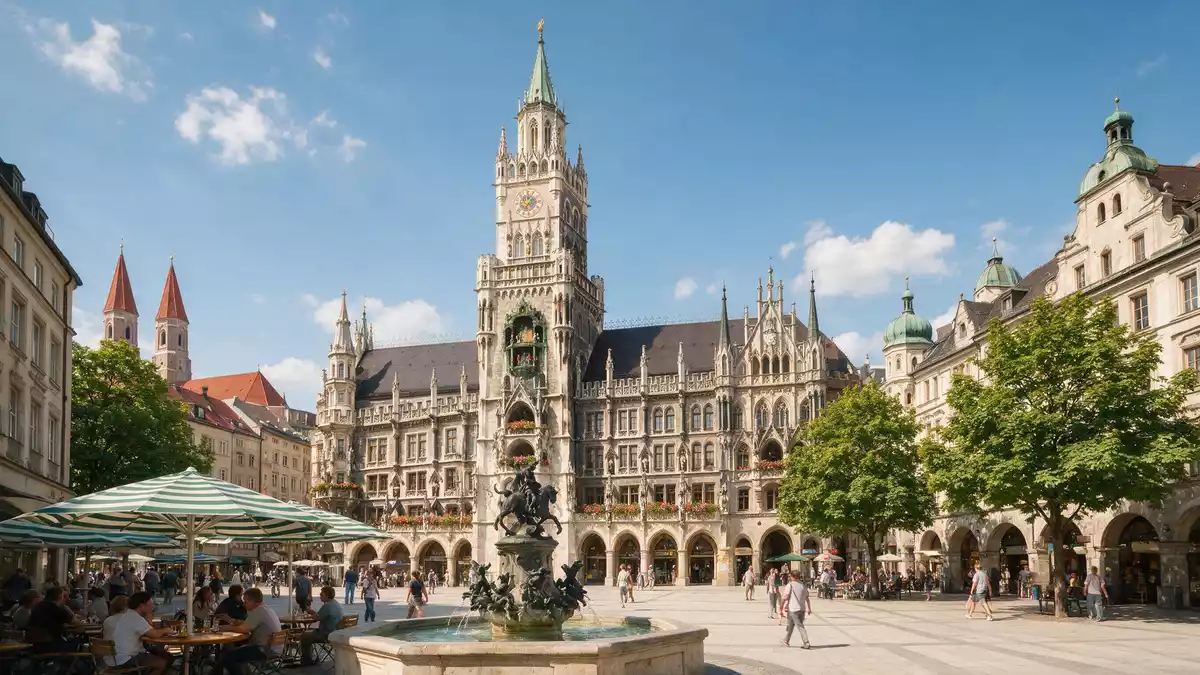
Marienplatz is the central square of München, laid out as the city’s marketplace in 1158 and later framed by the neo-Gothic bulk of the Neues Rathaus and its Glockenspiel.central square of the city
From market crossing to Marienplatz
Marienplatz occupies the point where the original north–south route through München crossed the salt road whose tolls funded the new settlement in 1158, fixing the square as the city’s commercial and civic focus.salt road met the older route In its early centuries the space functioned as a market, known simply as Markt or Schrannenplatz, where traders sold produce such as eggs, flour, wine and fish from stalls that filled the open ground.marketplace for everyday goods
The present name Marienplatz dates from 9 October 1854, when the square was formally renamed after the Mariensäule, the Marian column that had stood at its centre since 1638.renamed after the Marian column The column itself was raised during the Thirty Years’ War as a sign of gratitude that München escaped destruction, and its gilded statue of the Virgin Mary remains the focal point of the square’s open space.Mariensäule with golden Madonna
The Neues Rathaus and its moving figures
On the northern side of Marienplatz rises the Neues Rathaus, constructed in stages between 1867 and 1909 as the seat of the city’s administration and designed in a richly detailed neo-Gothic style that dominates the square’s skyline.built between 1867 and 1909 The long facade with its towers, pinnacles and traceried windows creates a stone backdrop against which everyday life on the square unfolds, from tram tracks nearby to gatherings around the central column.
High in the tower of the Neues Rathaus sits the Glockenspiel, whose mechanical figures re-enact two episodes from München’s history when its bells ring out.Glockenspiel in the tower The upper level shows the 1568 wedding of Duke Wilhelm V and Renate of Lorraine through a jousting tournament in which the Bavarian knight defeats his opponent, while the lower level presents the Schäfflertanz, recalling the barrel makers’ dance after a plague outbreak.wedding and Schäfflertanz scenes
A civic square shaped by history
For centuries Marienplatz has been a stage for civic events, from medieval tournaments to public proclamations, and since 1566 it has also functioned as a political site through the presence of the Landschaftshäuser, where representatives of the estates met the Bavarian duke.Landschaftshäuser and political role The surrounding streets of the Altstadt radiate from the square, which serves as the reference point for road measurements in München and the starting point for exploring the historic core.starting point for city streets
The Fischbrunnen on one corner of the square recalls the former fish market through its name, linking present-day urban fabric to earlier trading patterns.Fischbrunnen and fish market Around the square stand buildings such as department stores and the Altes Rathaus, giving Marienplatz a layered architectural setting that reflects successive periods in München’s development while preserving its function as the city’s meeting point.
Visiting Marienplatz: what travellers from Western Europe should know
- Marienplatz lies in München’s Altstadt, reached directly by S-Bahn and U-Bahn lines that serve the Marienplatz station beneath the square.
- The square is laid out as level paving, with approaches from surrounding streets and passages that suit walking between the Neues Rathaus, the Mariensäule and nearby shops.
- From Marienplatz it is a short walk along pedestrian streets to other central sights such as the Frauenkirche and Viktualienmarkt, keeping visits to the historic centre compact.
- Germany’s official language is German and the currency is the euro.
Searching for Marienplatz on social platforms
These links open searches for Marienplatz on each platform.Frequently asked questions about Marienplatz
Where is Marienplatz in München?
Marienplatz is in the Altstadt, München’s historic centre, where major streets converge and public transport lines meet at the underground Marienplatz station.
What should visitors expect on a visit to Marienplatz?
Visitors encounter an open square framed by the neo-Gothic Neues Rathaus, the Mariensäule in the centre, fountains and surrounding shops and historic buildings.
What makes Marienplatz distinctive among German city squares?
The combination of its medieval origins, the Marian column from 1638 and the animated Glockenspiel in the Neues Rathaus tower gives Marienplatz a particular character.


