
Marienplatz and the civic face of München
Published on 09/07/2026 at 22:48 | Editorial responsibility: Rafael Müller, Editor-in-Chief AD HOC NEWS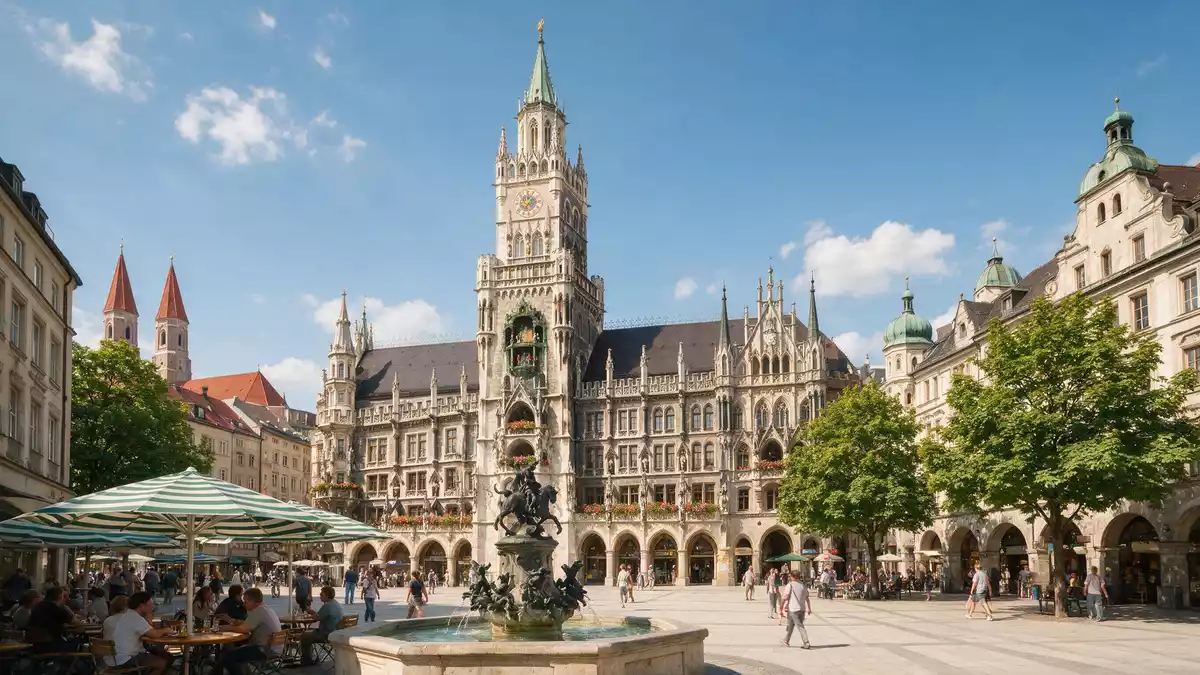
Marienplatz in München is a square where a medieval civic centre meets a nineteenth-century town hall façade. Its most recognisable features are the Mariensäule and the Neues Rathaus, both tightly bound to the square’s identity.Marienplatz in Munichthe Neues Rathaus
Marienplatz between market square and monument
The square has been part of München’s city centre since 1158, when the settlement took shape under Henry the Lion. In the Middle Ages it served as a market and a place for public gatherings, and its current name derives from the Mariensäule in the middle of the square.Mariensäule
The column was erected in 1638, and the golden figure of Mary remains the visual centre of the open space. Around it, the square reads as a clear composition of monument, paving and surrounding façades rather than a single enclosed room.a Marian column
The Neues Rathaus on the north side
On the north side stands the Neues Rathaus, a neo-Gothic building by Georg von Hauberrisser constructed between 1867 and 1909. Its long frontage, turrets and traceried detail give the square a strongly vertical edge.Georg von Hauberrisserconstructed between 1867 and 1909
The town hall houses the city’s government, and its clock tower forms one of the square’s strongest visual markers. The contrast between the ornate town hall and the open centre of Marienplatz gives the place its public character.
Marienplatz as a civic stage
Marienplatz links the Old Town Hall area, the market history of the square and the municipal seat on its northern edge. The space is shaped by stone, paving, the column and the large façade of the town hall rather than by a park-like setting.
The square has also kept a strong ceremonial role in München’s urban life. That role is visible in the way the Mariensäule stands free in the centre while the surrounding buildings define the edges.
Visiting Marienplatz: what travellers from Western Europe should know
- Marienplatz lies in the centre of München, with the S-Bahn and U-Bahn station of the same name serving the square. The names Marienplatz, Mariensäule and Neues Rathaus are the key reference points on site.
- The square is paved and open, with the column standing in the middle and large façades close by. The most prominent building edge is the north side, where the town hall rises above the square.
- The official language is German and the currency is the euro.
- Entry requirements depend on your nationality; UK travellers can check the FCDO travel advice at gov.uk/foreign-travel-advice, Irish travellers the Department of Foreign Affairs at ireland.ie.
Searching for Marienplatz on social platforms
These links open searches for Marienplatz on each platform.
Frequently asked questions about Marienplatz
Where is Marienplatz?
Marienplatz is the central square in München, in Germany. It sits among the city’s historic core and is marked by the Mariensäule and the Neues Rathaus.
What does a visit reveal?
A visit reveals an open urban square with a monumental column at its centre and a neo-Gothic town hall on the north side. The setting is compact, formal and strongly tied to the city’s civic history.
What makes Marienplatz distinctive?
Its distinctiveness lies in the combination of an old market square, a Marian column from 1638 and the later town hall frontage. The result is a place where different phases of München’s public life remain visible at once.


