
Mandalay Hill and the sacred skyline of Mandalay
Published on 09/12/2026 at 22:14 | Editorial responsibility: Rafael Müller, Editor-in-Chief AD HOC NEWS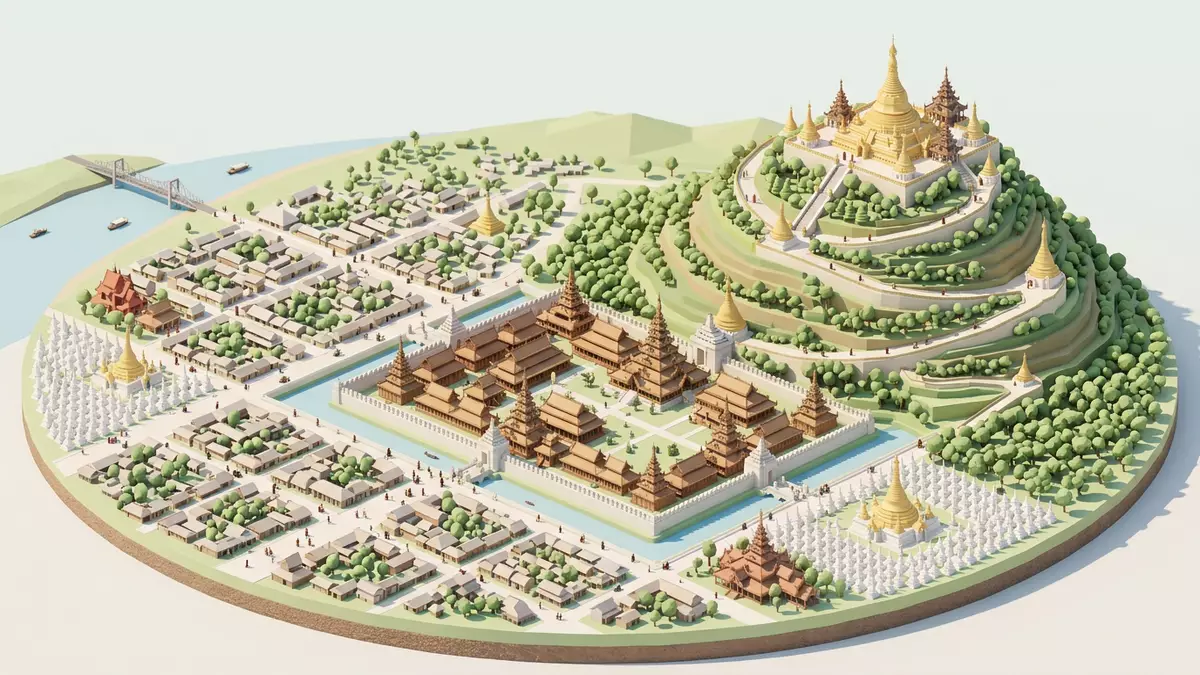
Mandalay Hill is the low, solitary hill that shapes the skyline of Mandalay, rising above the flat plain and giving the city its name. The hill stands to the north-east of the urban centre in Mandalay Region in Myanmar and has long been associated with Buddhist devotion and monastic life. At its summit is Sutaungpyei Pagoda, a hilltop temple surrounded by terraces and viewpoints that look out across the city and the Ayeyarwady River.
A sacred hill above a royal city
Mandalay Hill stands to the north-east of Mandalay’s former royal enclave, close to the lines of the old palace moat and walls that still define the central grid of streets.The city took its name from the hill, and the hill’s profile remains a reference point across the urban landscape. The hill rises to around 230 m (755 ft) above the surrounding plain, forming an unmistakable high point in an otherwise level setting.Tourism information for Mandalay Region describes it as a prominent landmark north of downtown Mandalay.
The slopes and summit of Mandalay Hill carry pagodas, monasteries and shrines, creating a layered religious landscape rather than a single isolated temple.Descriptions of the hill emphasise its abundance of religious structures and its role as a pilgrimage site for Burmese Buddhists. The hill sits within Mandalay’s Aungmyethazan Township, and its southern approaches lie near important temples such as Kyauk Tawgyi Pagoda, built under King Mindon in the nineteenth century at the base of the hill.
Climbing Mandalay Hill: stairways, shrines and a standing Buddha
The ascent of Mandalay Hill is a central part of its character. Covered stairways climb from the surrounding streets up through terraces and minor shrines towards the summit pagoda. On the southern side, one of these stairways passes between large guardian figures in the form of chinthe, the lion-like creatures familiar from gateways across Myanmar.Travel descriptions of the southern stairway note a long sequence of steps and a barefoot climb beneath a protective roof. Other covered routes rise from the west and north, each with its own sequence of small temples and resting platforms.
Among the notable images on the hill is a standing Buddha near the summit, associated with a prophecy that a great religious centre would grow at the foot of the hill.Local accounts of Mandalay Hill describe this image and the way it faces towards the city plain. The summit area is dominated by Sutaungpyei Pagoda, whose name can be translated as “wish-fulfilling”. This hilltop temple is surrounded by open terraces, tiled walkways and shrines, forming a broad platform above the stairways and the road access below.
Views, surrounding hills and Buddhist Mandalay
The summit terraces of Sutaungpyei Pagoda provide long views over Mandalay and the wider Mandalay Region.Accounts of the hill’s panoramic views describe sightlines towards the Shan Hills in the east, the Ayeyarwady River and the Buddhist centres around Sagaing in the west. From the summit, the grid of streets and the square outline of Mandalay Palace are recognisable features in the plain below, and the distant ridges form a backdrop that places the city within its broader landscape.
Mandalay Hill is part of a wider religious setting. At its foot stand important temples, including Kuthodaw Pagoda, known for a field of stone shrines that hold inscribed slabs sometimes described collectively as “the world’s largest book”, and Kyauk Tawgyi Pagoda at the southern base of the hill along 66th Street.Descriptions of Mandalay’s religious sites place these pagodas within the ensemble of shrines and monasteries clustered around the hill. Together, the hill and its surrounding temples form a landscape in which royal, monastic and lay Buddhist traditions meet.
Visiting Mandalay Hill: what travellers from Western Europe should know
- Mandalay Hill rises north-east of central Mandalay in Mandalay Region in Myanmar. The southern approaches lie near Mandalay Palace, and the hill is reached from urban streets that lead towards the covered stairways and the road up the slope.
- The climb on the main southern stairway involves a long sequence of steps under a covered walkway. Parts of the ascent pass through temple compounds, and visitors normally ascend without footwear along tiled surfaces.
- At the foot of the hill, major Buddhist sites such as Kyauk Tawgyi Pagoda and Kuthodaw Pagoda stand within walking distance of the southern approach, allowing visits to be combined within the same area.
- The official language is Burmese and the currency is the kyat. Entry requirements depend on your nationality; UK travellers can check the FCDO travel advice at gov.uk/foreign-travel-advice, Irish travellers the Department of Foreign Affairs at ireland.ie.
Searching for Mandalay Hill on social platforms
These links open searches for Mandalay Hill on each platform.
Frequently asked questions about Mandalay Hill
Where is Mandalay Hill located?
Mandalay Hill stands to the north-east of central Mandalay in Mandalay Region in Myanmar, close to the former royal palace area and its moat.
What should visitors expect on a visit to Mandalay Hill?
Visitors encounter covered stairways, pagodas and shrines on the climb, leading to Sutaungpyei Pagoda at the summit with broad terraces and views over Mandalay.
What makes Mandalay Hill distinctive within Mandalay?
Mandalay Hill is the main natural high point above the city, combining a hilltop temple, pilgrimage stairways and surrounding pagodas at its foot, and giving Mandalay its name.


