
Mandalay Hill and the long stairway above Mandalay
Published on 08/18/2026 at 14:23 | Editorial responsibility: Rafael Müller, Editor-in-Chief AD HOC NEWS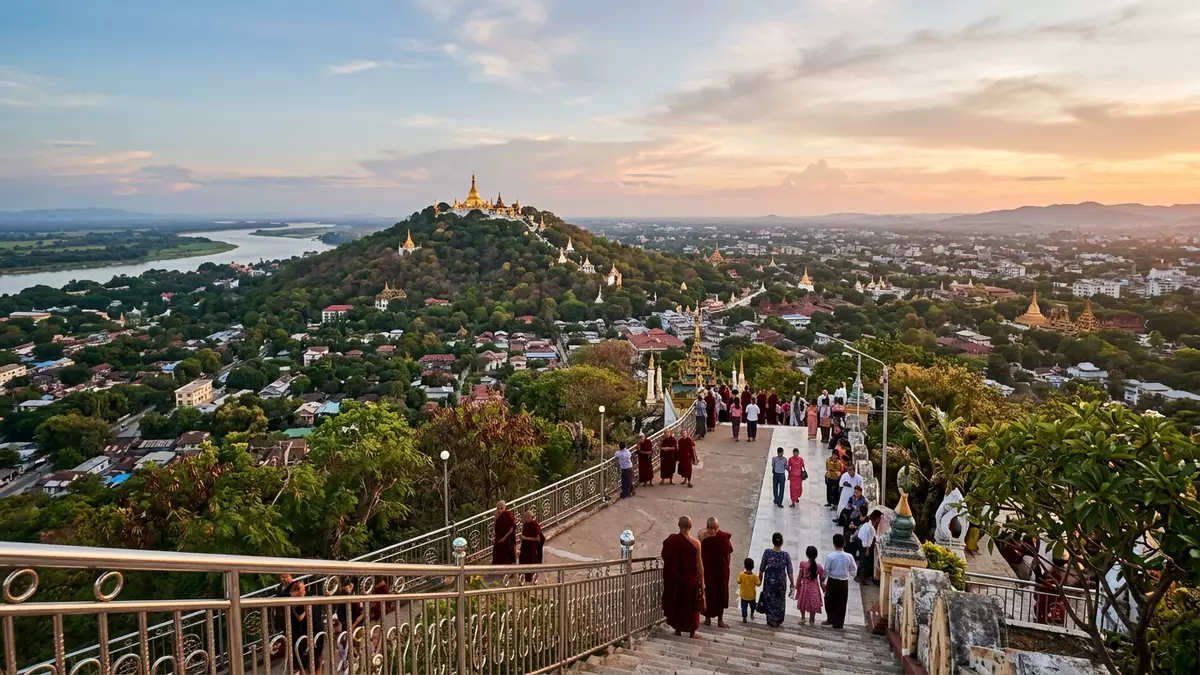
Mandalay Hill rises above the plain of Mandalay as a long, stepped spine of shrines and terraces, crowned by a gleaming hilltop pagoda. The hill gives the city its name and forms a rare height in an otherwise level landscape in central Myanmar, with Buddhist monuments scattered along its slopes since at least the nineteenth century.
The hill that named a royal city
Mandalay Hill stands to the north-east of central Mandalay, near the Ayeyarwady River and the walls of the former royal palace. The city of Mandalay, founded by King Mindon in 1857, took its name from the hill that already dominated this stretch of Upper Myanmar, tying the royal capital to an established sacred landscape.Mandalay Hill is a 240 metres hill located in this corner of the city.
The hill rises above the surrounding plain as a natural lookout over Mandalay, with an elevation that various descriptions place in the range of a little over 200 m (around 790 ft). From its upper terraces the view reaches across the grid of city streets, the square outline of the Mandalay Palace compound and the broad line of the Ayeyarwady as it flows past the city.The Mandalay Hill is situated to the north-east corner of the Mandalay Royal Palace and has long been used as a natural watch point over the region.
A hill layered with pagodas and monasteries
Mandalay Hill is known for its dense concentration of religious buildings, with pagodas and monasteries lining the routes that climb its slopes.The Mandalay Hill is surrounded by satellite hills that also carry named shrines, creating a wider devotional landscape around the main ridge. For Burmese Buddhists the hill has served as a pilgrimage site for generations, and many of the structures that stand there date from the period when Mandalay was a royal capital.
At the foot of Mandalay Hill lies the Kuthodaw Pagoda complex, famous for its hundreds of stone-inscription shrines authorised in the nineteenth century by King Mindon after a major Buddhist council.At its foot are the 730 pagodas, or Kuthodaw, which together form what is often called a stone library of Buddhist scripture. This cluster of small white shrines frames the southern approach to the hill and anchors Mandalay Hill within a broader ensemble of religious monuments.
The Su Taung Pyi Pagoda and the long stairway
Near the summit stands the Su Taung Pyi Pagoda, also written Sutaungpyei, whose name can be translated as “wish-fulfilling”.The main pagoda on top of Mandalay Hill is called the Su Taung Pyi Pagoda, and its terraces run around the hilltop, opening wide views in all directions. The pagoda’s tiled platforms and pavilions, together with Buddha images facing towards the city and the distant hills, form the focal point of most visits to Mandalay Hill.
Reaching this summit complex on foot means climbing a covered stairway lined with shrines and rest platforms. The southern route, beginning between a pair of giant chinthe guardian figures, is one of several stair approaches that ascend the hill through a sequence of halls and open platforms.From the south entrance, stairs at the base of the hill lead up a moderate incline, and the climb is traditionally made barefoot as a sign of respect in this sacred setting. Along the way stand resting pavilions, small pagodas, images of the Buddha and occasional viewpoints over Mandalay.
Visiting Mandalay Hill: what travellers from Western Europe should know
- Mandalay Hill rises north-east of central Mandalay, beyond the former royal palace compound, and is reached from the city by road or by covered stairways on the slopes.
- The ascent on foot follows covered staircases that gain significant height, and includes long flights of steps where footwear is removed on polished stone surfaces.
- The hill stands in Myanmar, where the official language is Burmese and the currency is the kyat.
- Entry requirements depend on your nationality; UK travellers can check the FCDO travel advice at gov.uk/foreign-travel-advice, Irish travellers the Department of Foreign Affairs at ireland.ie.
Searching for Mandalay Hill on social platforms
These links open searches for Mandalay Hill on each platform.
Frequently asked questions about Mandalay Hill
Where is Mandalay Hill located?
Mandalay Hill stands to the north-east of central Mandalay in Myanmar, close to the Mandalay Palace compound and not far from the Ayeyarwady River.
What should visitors expect when climbing Mandalay Hill?
Visitors encounter covered stairways lined with shrines and pavilions, long flights of steps climbed barefoot and wide hilltop terraces around the Su Taung Pyi Pagoda.
What makes Mandalay Hill distinctive among sites in Mandalay?
Mandalay Hill combines a rare natural height over the city with a dense concentration of Buddhist monuments, culminating in panoramic views from the summit pagoda terraces.


