
Mandalay Hill and the layered skyline of Mandalay
Published on 09/14/2026 at 06:02 | Editorial responsibility: Rafael Müller, Editor-in-Chief AD HOC NEWS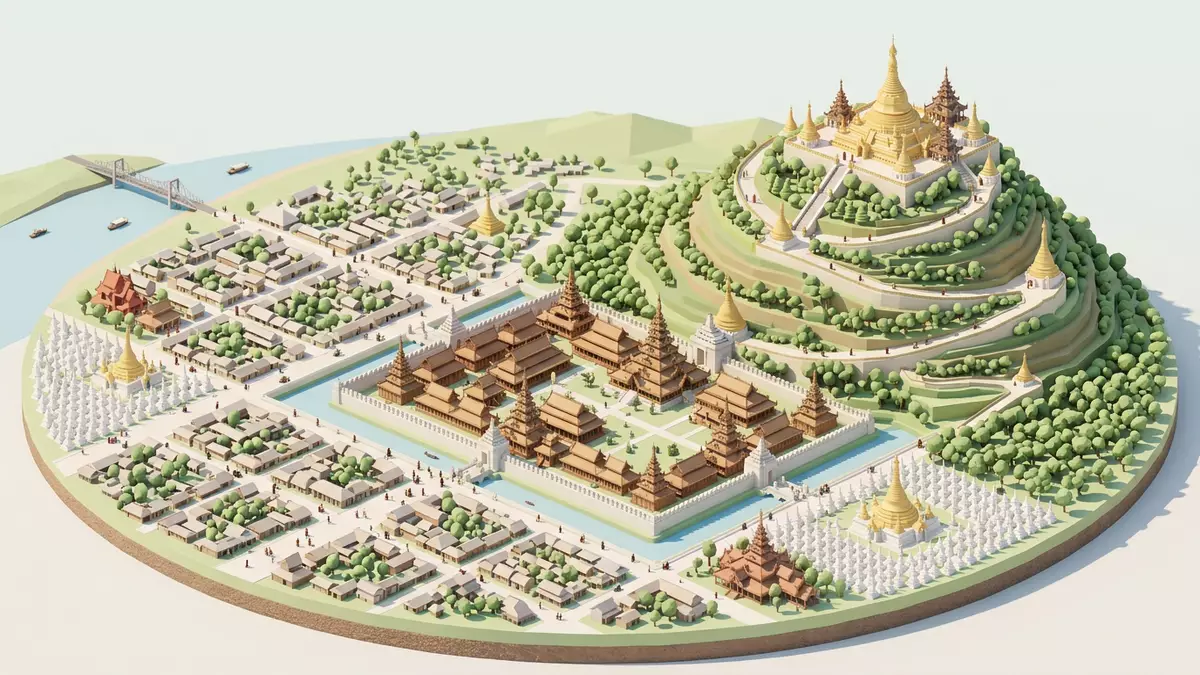
Mandalay Hill rises above the northern edge of Mandalay with pagodas, monasteries and a strong Buddhist identity. The city took its name from the hill, and King Mindon founded Mandalay at its foot in 1857.
Mandalay Hill and the city below
The hill is one of the most recognisable forms in the city’s layout. Its slopes carry a dense cluster of religious buildings, while the plain below opens into the wider urban grid. The relationship between summit and city is visible from many directions, and it gives Mandalay a clear vertical landmark.
The hill is linked to the history of the Konbaung dynasty and to the city’s foundation as a royal capital. King Mindon’s decision to establish Mandalay there fixed the hill’s place in the urban story, and the name travelled from landform to city.
Pagodas, monasteries and a Buddhist landscape
Mandalay Hill is covered with religious structures rather than a single monument. Pagodas, monasteries and shrines occupy the slopes, creating a layered sacred landscape that extends from the lower approaches to the upper paths.
The hill is also associated with pilgrimage and with the religious life of Burmese Buddhists. That association gives the place a use that is both local and national, and it helps explain why the hill remains more than a viewpoint.
A hill that names a city
Few landmarks give their name to an entire city, and Mandalay Hill does exactly that. The hill and the city are inseparable in local identity, with the landform standing behind the royal capital that grew beside it.
The connection with King Mindon and the year 1857 gives the place its historical frame. The hill is not only a backdrop to Mandalay; it is part of the city’s origin story and its most visible geographic marker.
Visiting Mandalay Hill: what travellers from Western Europe should know
- The hill lies north-east of central Mandalay, and it is reached by road from the city. The approach is urban at the base and steepens on the hill itself.
- The slopes carry many steps and a steady climb. Footwear and pace matter more than distance, because the path rises through a series of built terraces and stairways.
- Religious buildings stand across the hill, so the site has a strong monastic character. Respectful clothing is appropriate in temple areas.
- Nearby Mandalay, the royal city founded by King Mindon, forms the main reference point for orientation. The hill dominates views from the city and the surrounding plain.
- The official language is Burmese and the currency is the Myanmar kyat.
Searching for Mandalay Hill on social platforms
These links open searches for Mandalay Hill on each platform.
Frequently asked questions about Mandalay Hill
Where is Mandalay Hill?
Mandalay Hill stands in Mandalay, Myanmar, close to the city’s northern side. It is the hill from which the city took its name.
What does a visit involve?
A visit involves moving through a hillscape of pagodas, monasteries and stairways. The setting is urban at the base and religious across the slopes.
What makes Mandalay Hill distinctive?
Its strongest distinction is the link between landform and city. Mandalay grew at its foot in 1857, and the hill remains the city’s defining vertical landmark.


