
Mandalay Hill and the Buddhist skyline of Mandalay
Published on 09/16/2026 at 21:59 | Editorial responsibility: Rafael Müller, Editor-in-Chief AD HOC NEWS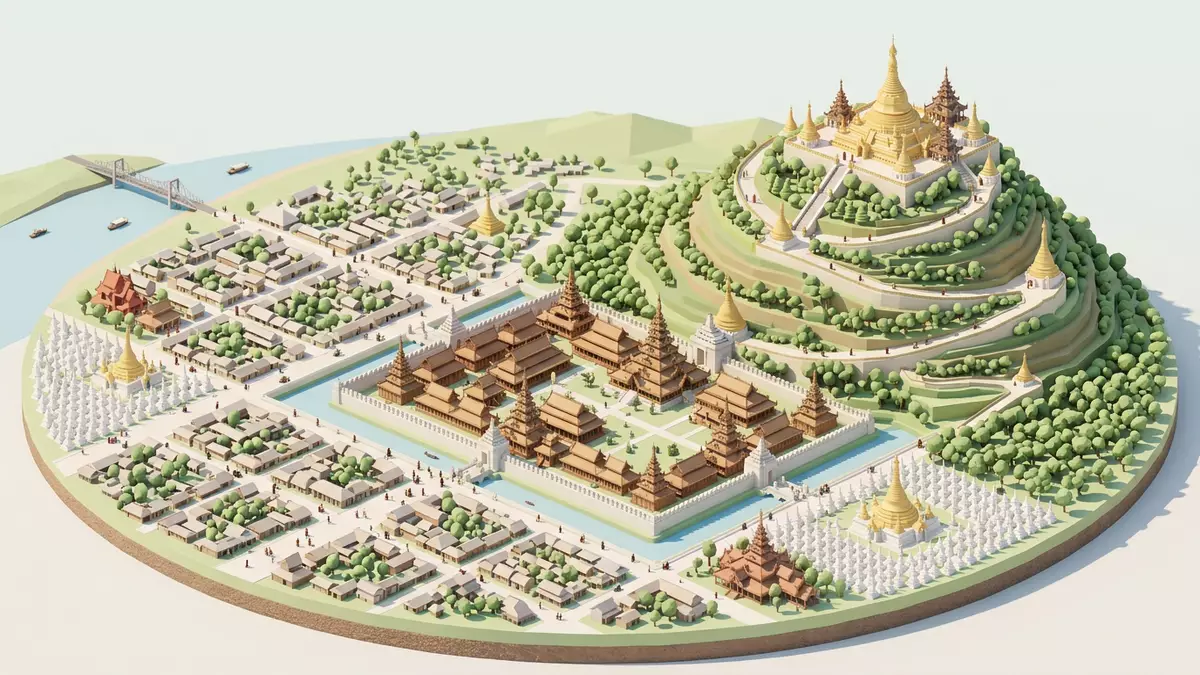
Mandalay Hill, rising above the northern edge of Mandalay in Myanmar, is a sacred height shaped by pagodas, monasteries and long covered stairways. The hill’s story is inseparable from the founding of Mandalay as the last royal capital of the Konbaung dynasty in the nineteenth century, when King Mindon established his city at its foot in 1857, fulfilling an old Buddhist prophecy about a metropolis of faith on this site. The hill has since been a major focus of Buddhist devotion and urban life, with shrines, statues and prayer halls spread along its slopes and summit.
A holy hill above the last royal capital
Mandalay Hill stands north of Mandalay’s old palace moat and marks the transition from the flat grid of the royal city to higher ground dotted with religious buildings. The hill reaches about 230 m (755 ft) above the surrounding plain, giving wide views over the city, the Ayeyarwady River and the countryside beyond.Mandalay Hill lies north of downtown Mandalay and is 230m high The Konbaung ruler King Mindon founded Mandalay at the foot of the hill in 1857, replacing Amarapura as his capital and making the new city the political centre of Burma until annexation by the British Empire in 1885.Mandalay was founded in 1857 by King Mindon and served as Burma’s final royal capital
The link between hill and city is reinforced by Buddhist legend. Stories tell that the historical Buddha visited the height with his disciple Ananda and foretold that a great city devoted to Buddhism would arise at its foot on the 2,400th anniversary of his teaching.King Mindon fulfilled a prophecy of founding a metropolis of Buddhism at the foot of Mandalay Hill King Mindon’s decision to set his palace and city beside the hill drew directly on this religious narrative, turning the slope into both a spiritual landmark and a backdrop to royal power.
Pagodas, monasteries and stairways on the slope
Mandalay Hill is known for its abundance of pagodas and monasteries, which line the paths climbing towards the summit and occupy terraces and ledges on the way up.Mandalay Hill is known for its abundance of pagodas and monasteries Many of these structures date from the nineteenth century, reflecting the period when Mandalay served as royal capital and when patronage from the court and religious donors shaped the skyline. Shrines house Buddha images in various postures, and standing statues mark episodes from the hill’s legends, including figures that point towards the palace site in reference to the prophecy about the future city.a huge standing Buddha image was built where the Buddha is said to have pointed to the Royal Palace
Access to the hill’s shrines and monasteries runs along stairways covered by simple roofed corridors, punctuated by rest platforms and small prayer halls. At the foot of the hill several important religious complexes stand close together. The Kuthodaw Pagoda, commissioned by King Mindon after the Fifth Buddhist Council, spreads hundreds of small white stupas around a central gilded structure to house marble slabs inscribed with the Pali Canon.Kuthodaw Pagoda at the foot of Mandalay Hill holds hundreds of marble slabs inscribed with Buddhist scriptures Nearby, the Sandamuni Pagoda gathers its own field of shrines, reinforcing the impression of the northern city as a continuous religious landscape anchored by the hill.
Mandalay Hill as a place of pilgrimage and viewpoint
For Burmese Buddhists Mandalay Hill has long been a place of pilgrimage, with visitors climbing to pay respect at the temples and pagodas and to participate in rituals such as washing revered Buddha images.Mandalay Hill has long been a holy mount and a major pilgrimage site for Burmese Buddhists The route up the hill passes shrines where offerings of flowers, candles and incense are made, and where monks and laypeople chant, meditate or quietly recite texts. In Mandalay’s religious life the hill forms a visible axis of devotion, rising above the palace site, the monastic quarters and the river.
The summit platforms provide panoramic views over Mandalay’s grid of streets, the reconstructed palace compound, the Kuthodaw and Sandamuni pagodas and the broad line of the Ayeyarwady River. From this height the rectangular layout of King Mindon’s city and the alignment of major religious sites become clear, giving the hill an interpretive role as well as a devotional one. The city’s foundation beside the slope, the presence of major scriptural pagodas at its base and the accumulation of monasteries and shrines along its flanks together make Mandalay Hill a key vantage point on the Buddhist and royal heritage of Mandalay.
Visiting Mandalay Hill: what travellers from Western Europe should know
- Mandalay Hill rises north of central Mandalay, beyond the old palace moat, and can be reached by road to the foot of the slope followed by a climb on foot or ascents using local transport links.
- The ascent runs along covered stairways with many steps and intermediate terraces; the route involves sustained climbing and passages through prayer halls, so footwear is removed in religious areas.
- The foot of the hill lies close to major religious complexes such as the Kuthodaw Pagoda and Sandamuni Pagoda, which stand within walking distance and share the same northern Mandalay setting.
- The official language is Burmese and the currency is the Myanmar kyat.
- Entry requirements depend on your nationality; UK travellers can check the FCDO travel advice at gov.uk/foreign-travel-advice, Irish travellers the Department of Foreign Affairs at ireland.ie.
Searching for Mandalay Hill on social platforms
These links open searches for Mandalay Hill on each platform.Frequently asked questions about Mandalay Hill
Where is Mandalay Hill?
Mandalay Hill stands at the northern edge of Mandalay in Myanmar, beyond the old palace moat and close to major pagoda complexes.
What can visitors expect on a visit to Mandalay Hill?
Visitors encounter covered stairways, shrines and monasteries along the climb, with Buddha images, pagodas and wide views from terraces and the summit platforms.
What makes Mandalay Hill distinctive among Mandalay’s religious sites?
The hill combines its role as a major Buddhist pilgrimage site with a vantage point over the planned royal city founded by King Mindon at its foot in 1857.


