
Manarola on the cliff edge of the Ligurian Sea
Published on 08/29/2026 at 19:28 | Editorial responsibility: Rafael Müller, Editor-in-Chief AD HOC NEWS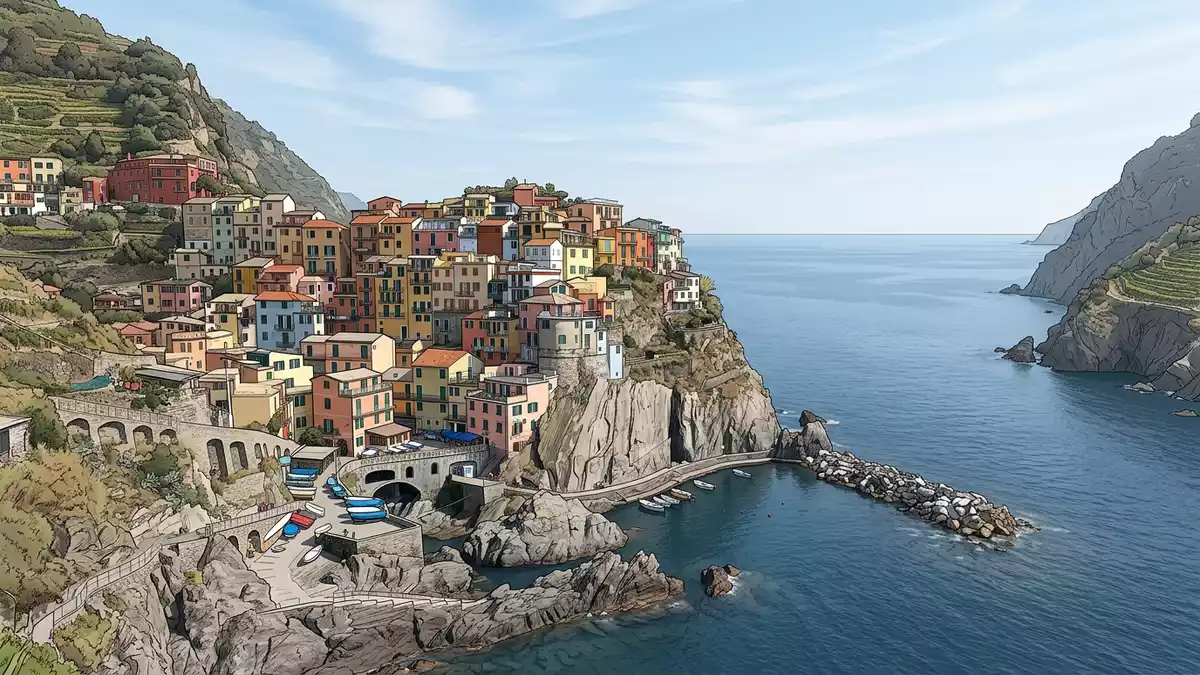
Manarola in Liguria is a compact village of pastel houses gathered on a rocky headland above the Ligurian Sea, one of the five historic Cinque Terre settlements in northern Italy. Its origins reach back to the medieval period under the Republic of Genoa, and the village forms part of Cinque Terre National Park, recognised as a UNESCO World Heritage Site.
Manarola and its cliffside setting
Manarola occupies a rocky promontory that projects into the Ligurian Sea, with most of the village stacked on steep slopes above a small inlet. The core of the settlement rises tens of metres above sea level, with houses and lanes climbing inland from the waterfront in tight terraces.built on a high rock The headland is enclosed by cliffs and cultivated hillsides, creating a setting in which buildings, vineyards and sea are closely interwoven.
As one of the Cinque Terre villages, Manarola lies within the coastal stretch between Riomaggiore and Corniglia in the province of La Spezia in Liguria.a frazione of Riomaggiore in Cinque Terre Narrow streets and stepped alleys run along the ridge and down towards the small harbour, where boats are drawn up on ramps beside the water. Above the houses, terraces cut into the slopes support vineyards and other crops, following the contours of the terrain.
From medieval stronghold to coastal village
Written records begin to mention Manarola in the thirteenth century, when local notarial documents and references to a castle appear under the influence of the Fieschi family and the Republic of Genoa.first recorded in 1261 with a castle noted in 1273 In this period Manarola functioned as a fortified coastal settlement, with defences facing both the sea and the slopes inland, and steep drops acting as natural protection on several sides.
By the fourteenth century, Manarola’s growing population led to the construction of the church of San Lorenzo in 1338, a small Gothic-style building that still stands on the upper part of the village.the church of San Lorenzo dating from 1338 Under Genoese rule, agriculture and maritime trade developed, with wine and oil from the surrounding terraces becoming important products. The hamlet later became part of Cinque Terre National Park, together with the neighbouring coastal villages.included within Cinque Terre National Park
Architecture, vineyards and the sea
The village fabric of Manarola consists of tall, narrow houses, many painted in bright pastel colours, aligned along the main street and side alleys. Several buildings take the form of tower houses, rising multiple storeys as they follow the slope, and are separated by lanes that thread between them and out towards the terraces.brightly coloured narrow tower-looking houses At the base of the village, near the water, a small piazza and harbour area provide access to the sea and storage for fishing boats.
Above Manarola, terraced vineyards mark the slopes, supported by stone walls and arranged in bands across the hillsides. Local production includes Sciacchetrà, a traditional wine associated with Cinque Terre and linked to the cultivation on these terraces.wines such as Sciacchetrà produced in surrounding vineyards Paths run through this agricultural landscape and connect Manarola with neighbouring settlements and viewpoints on the ridge. The combination of pastel façades, vineyards climbing above them and the dark rock descending to the sea gives the village a distinctive layered appearance.
Manarola within Cinque Terre
Manarola is one of five coastal villages that make up Cinque Terre, alongside Riomaggiore, Corniglia, Vernazza and Monterosso al Mare.one of the famous Cinque Terre villages It lies between Riomaggiore to the south and Corniglia to the north, with footpaths and coastal trails linking the settlements along the cliffs and slopes. A celebrated route from Manarola towards Riomaggiore is the Via dell’Amore, a scenic path above the sea that forms part of the wider network of Cinque Terre walking tracks.the via dell’amore path to Riomaggiore
As a hamlet of Riomaggiore, Manarola belongs administratively to that comune, yet retains its own identity and layout centred on the rocky spur and the small harbour. Railway access ties the village to La Spezia and the wider Ligurian coast, with a pedestrian tunnel linking the station to the houses and waterfront.pedestrian tunnel from the station Within the national park, protection extends both to the built fabric and to the terraces and paths that surround the settlement.
Visiting Manarola: what travellers from Western Europe should know
- Manarola lies on the Ligurian coast in northern Italy, within the municipality of Riomaggiore and Cinque Terre National Park; regional trains connect it with La Spezia and other Ligurian towns.
- The village is built on steep terrain, with stepped alleys, gradients and narrow streets; reaching upper viewpoints and terraces involves climbing stairways on the rocky slopes.
- Manarola’s small harbour, railway station and hillside paths sit close together, so short walks on foot connect the waterfront, the tunnel from the station and trails towards neighbouring villages.
- The official language is Italian and the currency is the euro.
Searching for Manarola on social platforms
These links open searches for Manarola on each platform.
Frequently asked questions about Manarola
Where is Manarola located?
Manarola is a coastal village in Liguria, northern Italy, forming part of the municipality of Riomaggiore and the Cinque Terre National Park on the Ligurian Sea.
What can visitors expect when exploring Manarola?
Visitors encounter steep lanes, brightly painted houses, a small harbour and terraced vineyards above the village, all set around a rocky promontory above the sea.
What makes Manarola distinctive among Cinque Terre villages?
Manarola’s compact layout on a high cliff, its medieval church of San Lorenzo and its surrounding vineyard terraces give it a characteristic layered relationship between architecture, agriculture and sea.


