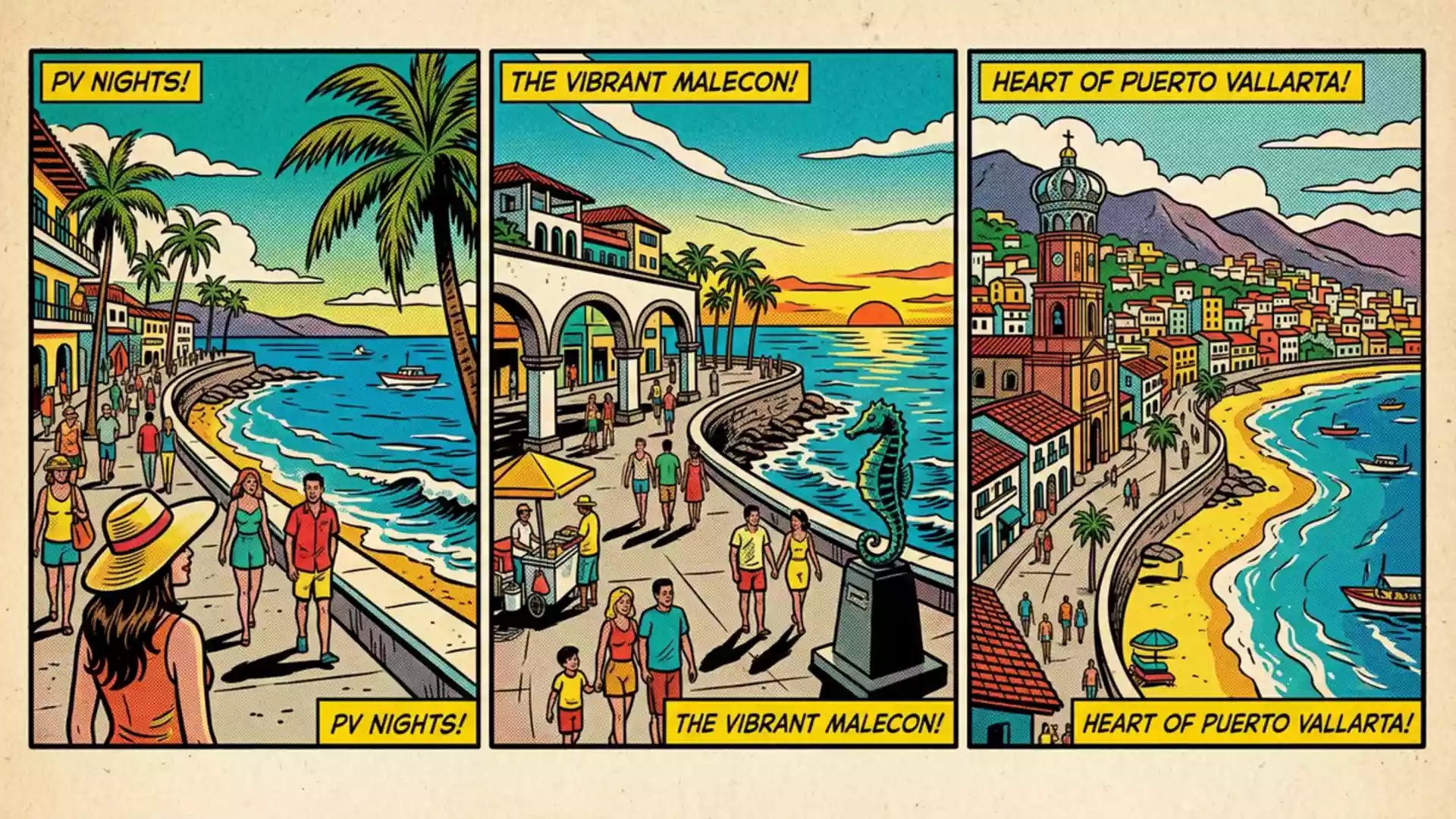
Malecon, Puerto Vallarta’s seafront promenade of art and ocean
Published on 08/21/2026 at 19:43 | Editorial responsibility: Rafael Müller, Editor-in-Chief AD HOC NEWS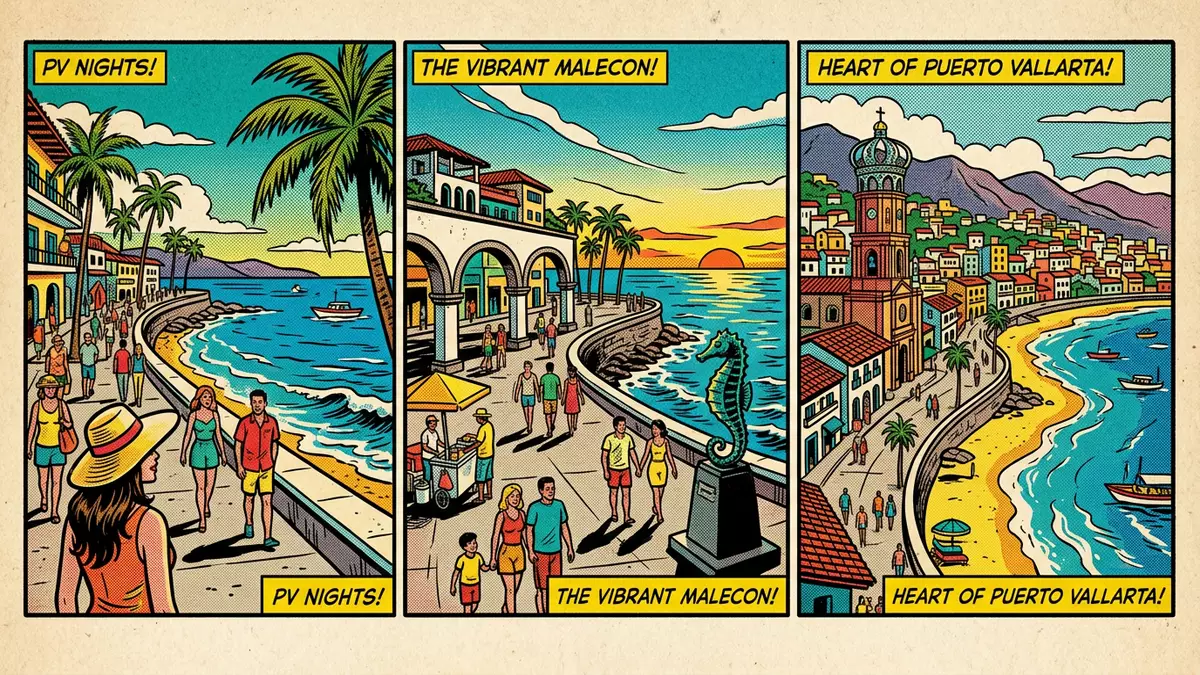
Malecon in Puerto Vallarta is a long seaside promenade that stretches between the historic centre of the city and the Pacific Ocean, lined with plazas, palms and public art. It began as a masonry breakwater in the 1930s and evolved over the twentieth century into the waterfront boardwalk known as “El Malecón”.
A waterfront built as a breakwater and turned into a promenade
The origins of Malecon lie in coastal engineering rather than leisure, when a sea wall and walkway were constructed in the mid-1930s to protect the harbour and define the shoreline.a first part built in 1935 The early section ran between the area now marked by the Los Arcos Amphitheatre and the old customs office, and was planted with palms and fitted with benches soon after completion.palm trees and seating added in 1936
Over the following decade Malecon was extended northwards towards Hotel Rosita, reaching a length of around 800 m (2,600 ft) along the bay front by the early 1950s.an 800 m boardwalk along the bay The promenade has carried several official names, including “Paseo de la Revolución” and “Paseo Díaz Ordaz”, before the everyday use of Malecon for the seafront took hold.earlier names such as Paseo Díaz Ordaz In the early twenty-first century the waterfront was comprehensively remodelled, making the core stretch a pedestrian zone with a broad paved surface and integrated landscaping where the city meets Banderas Bay.a refurbishment of the seafront by Trama Arquitectos
Bronze sculptures: an open-air gallery along the Pacific
One of the defining features of Malecon is the continuous line of sculptures that turns the waterfront into an outdoor art walk, with pieces at regular intervals along the promenade.bronze works lining the beach boardwalk The installation of the sculpture “El Niño sobre el Caballo de Mar” (“Boy on the Seahorse”) by Rafael Zamarripa in 1976 is widely noted as the starting point of this collection, giving Puerto Vallarta a distinctive symbol facing the ocean.the Boy on the Seahorse placed in 1976
Through the 1980s and 1990s the series expanded with works such as “Nostalgia” by José Ramiz Barquet, unveiled in 1984 as a seated couple in bronze, and “La Rotonda del Mar”, a group of fantastical chair-like figures by Alejandro Colunga from 1996.Nostalgia installed as the second sculpture in 1984 Sculptor Sergio Bustamante’s “En Busca de la Razón” (“In Search of Reason”), installed in 2000, rises as a tall ladder with human figures climbing towards an unseen goal, while Mathis Lidice’s spiral form “The Millennium” at the north end of the boardwalk symbolises the passage of time and human evolution.The Millennium and In Search of Reason among key works Newer pieces such as “El Unicornio de la Buena Fortuna” (“The Unicorn of Good Fortune”) by Aníbal Riebeling, added in 2011, show how Malecon continues to function as a curated strip of contemporary sculpture along the shore.the Unicorn of Good Fortune created in 1996 and installed on the promenade
Space, ocean and city: how Malecon frames Puerto Vallarta
Malecon runs along the waterfront of Puerto Vallarta’s central districts, with the city’s streets and plazas on one side and the open curve of Banderas Bay on the other.a half-mile boardwalk between town and ocean At the northern end the boardwalk is commonly described as beginning near Hotel Rosita on Calle 31 de Octubre, and it extends southward towards the Los Arcos Amphitheatre at Zaragoza Street, a performance space by the sea that acts as a focal point.the route between Hotel Rosita and Los Arcos
The paving is generally level and wide, with planted areas, low walls and occasional steps where the route meets plazas or changes height relative to the beach. Alongside the sculptures there are viewpoints over the bay, access points down to the sand and areas where the promenade opens into squares facing the sea. The combination of long, linear walkway and grouped sculptures makes Malecon a place where art, ocean and city space are closely intertwined.
Visiting Malecon: what travellers from Western Europe should know
- Malecon follows the shoreline of Puerto Vallarta on the Pacific coast of Mexico, running between the central streets and Banderas Bay and reached on foot from the surrounding districts.
- The promenade surface is generally flat and paved, with occasional steps near plazas and access points to the beach, so walking the length involves a sustained distance on foot along hard ground.
- English is widely used in tourism, but the official language is Spanish and the currency is the Mexican peso.
- Entry requirements depend on your nationality; UK travellers can check the FCDO travel advice at gov.uk/foreign-travel-advice, Irish travellers the Department of Foreign Affairs at ireland.ie.
Searching for Malecon on social platforms
These links open searches for Malecon on each platform.
Frequently asked questions about Malecon
Where is Malecon in Puerto Vallarta?
Malecon is the seafront promenade in Puerto Vallarta, Mexico, running along the edge of Banderas Bay between the central streets and the Pacific shoreline.
What can visitors expect when walking Malecon?
A walk along Malecon offers a paved waterfront route with bronze and stone sculptures, plazas, views over the bay and access points down to the beach.
What makes Malecon distinctive among seafront promenades?
Malecon stands out for its combination of twentieth-century breakwater origins and a continuous series of named sculptures that together form an open-air art gallery by the ocean.