
Maktabat al-Iskandariya and its tilted disc beside the Mediterranean
Published on 09/24/2026 at 10:46 | Editorial responsibility: Rafael Müller, Editor-in-Chief AD HOC NEWS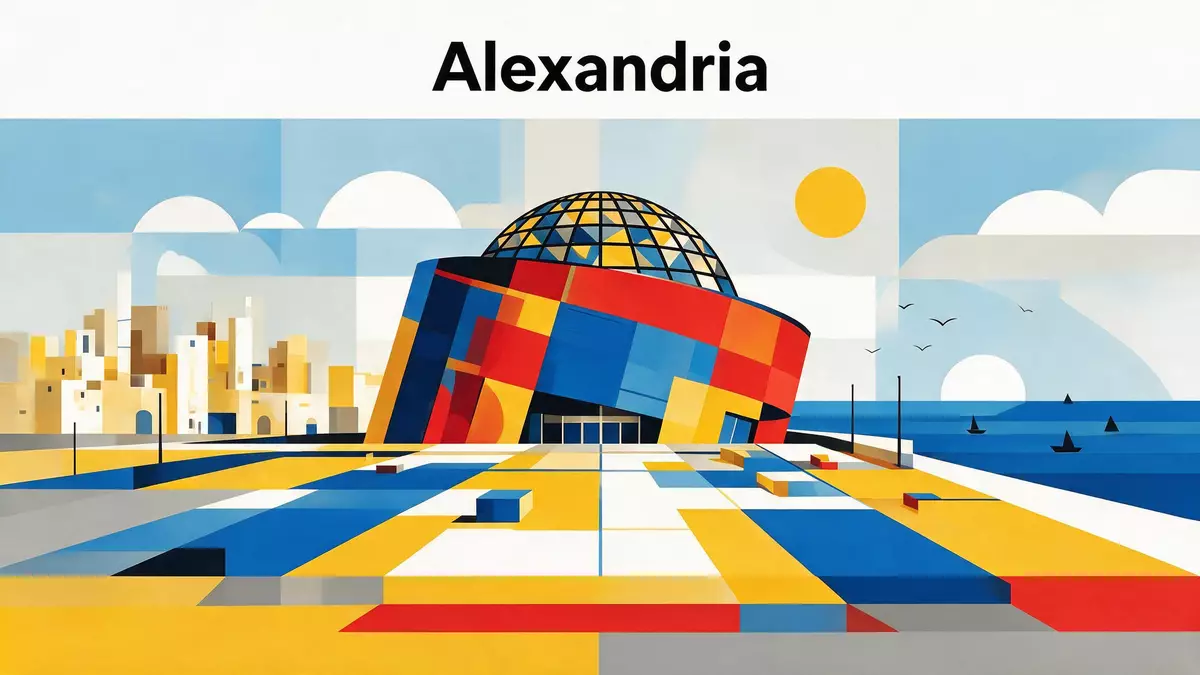
Maktabat al-Iskandariya rises beside the Mediterranean in Alexandria as a broad, tilted disc of stone and glass. The modern library opened in 2002, placing a working centre for books, research and culture within a building whose roof dominates the seafront.
A tilted disc of granite and glass
The building’s most recognisable feature is its inclined roof, set against the horizontal line of Alexandria’s coast. A circular granite wall anchors the complex, while the roof extends above the main reading room as a large plane of glass and metal.
Snøhetta won the international architectural competition for the project in 1989. The practice worked with Hamza Associates, forming the Snøhetta Hamza Consortium recorded for the completed building. The project received the Aga Khan Award for Architecture in the 2002–2004 cycle, and its listed size is 45,000 m².
The exterior carries writing from different cultures in the granite wall. Carved marks and scripts create a surface that belongs to architecture and visual art at once. The wall is not a flat backdrop: passages, bridges and changes in level interrupt its mass around the public areas.
Inside the great reading room
Below the inclined roof, the main reading room occupies a series of broad levels. Roof lights run across the interior, bringing daylight into a space organised around books, desks, terraces and stairways.
The reading room is part of a larger cultural complex. Museums, galleries, exhibition spaces, a planetarium, conference facilities and research areas extend beyond the shelves. The building therefore combines library functions with places for science, art, public lectures and cultural displays.
Maktabat al-Iskandariya is a modern institution, but its name reaches back to the ancient Library of Alexandria. The new building does not reproduce an ancient structure. Its identity comes from the meeting of a contemporary programme, a Mediterranean setting and a historical name.
The library’s collections and services serve study, research and public learning. Its interior includes specialist areas and facilities for preserving written material. The complex also contains spaces connected with manuscripts, digital resources and cultural programming.
Alexandria’s modern house of learning
The library stands in Alexandria’s waterfront district, close to the city’s corniche and Alexandria University. Port Said Street runs beside the complex, while the Mediterranean forms the open horizon beyond the building.
Its relationship with the sea is visible from outside. The roof rises from the ground as a sloping surface, and the building’s circular plan appears most clearly from elevated viewpoints across the surrounding streets. From the plaza, the roof reads as a wide architectural field rather than a conventional pitched covering.
The project belongs to the late twentieth-century revival of Alexandria as a centre of learning. Its international design process brought a Norwegian architectural practice into a major Egyptian civic project. The completed library opened on 16 October 2002, linking a precise date with a building that remains firmly rooted in Alexandria.
The complex also records the work of artists, engineers, local craftspeople and architects. Jorunn Sannes designed the concept for the stone wall, which was sculpted by Kristian Blystad with local stonemasons. Granite, glass, concrete and metal give the building a material vocabulary that differs from Alexandria’s older masonry monuments.
The result is neither a conventional library block nor a reconstruction of an archaeological ruin. It is a public building with a research library at its centre, a sloping roof above it and a monumental stone wall facing the city.
Visiting Maktabat al-Iskandariya: what travellers from Western Europe should know
- Maktabat al-Iskandariya is on Alexandria’s Mediterranean waterfront, beside the corniche and near Alexandria University. Port Said Street runs alongside the complex.
- The building contains stairs, terraces and changes of level around the main reading room. The broad interior is arranged beneath the inclined roof.
- The surrounding city is Arabic-speaking, and the national currency is the Egyptian pound.
- Entry requirements depend on your nationality; UK travellers can check the FCDO travel advice at gov.uk/foreign-travel-advice, Irish travellers the Department of Foreign Affairs at ireland.ie.
Searching for Maktabat al-Iskandariya on social platforms
These links open searches for Maktabat al-Iskandariya on each platform.
Frequently asked questions about Maktabat al-Iskandariya
Where is Maktabat al-Iskandariya?
The library is in Alexandria, Egypt, beside the Mediterranean waterfront and near Alexandria University. Port Said Street borders the complex.
What can visitors expect inside?
The complex includes a major reading room beneath the inclined roof, along with museums, galleries, exhibition areas, a planetarium and conference facilities.
What makes the building distinctive?
Its defining features are the tilted disc-like roof, the circular granite wall and the broad reading room beneath glass and metal roof lights. Snøhetta designed the building, which opened in 2002.


