
Maktabat al-Iskandariya and its sun?disc library on the Alexandria seafront
Published on 08/27/2026 at 15:23 | Editorial responsibility: Rafael Müller, Editor-in-Chief AD HOC NEWS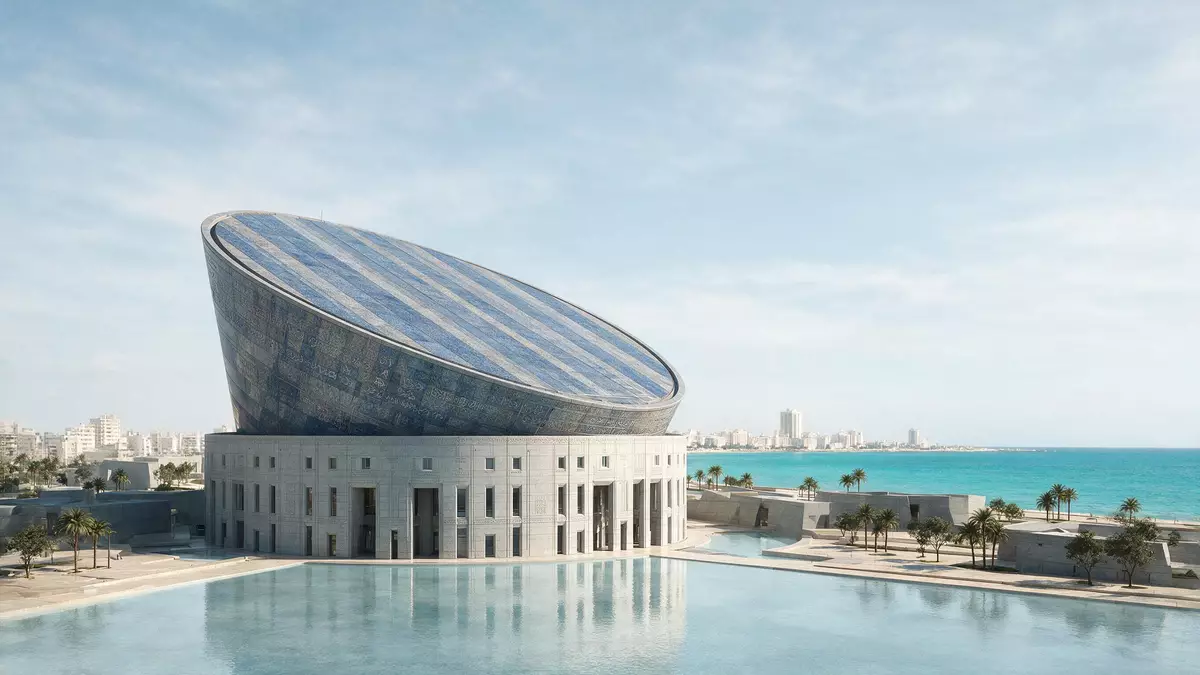
Maktabat al-Iskandariya in Alexandria is a major library and cultural complex on the Mediterranean shore, centred on a striking circular building that rises from the ground like a tilted sun?disc. Conceived as a modern remembrance of the ancient Library of Alexandria, it occupies a site close to the city’s eastern harbour and brings together books, archives and public spaces in a single seafront ensemble from the turn of the twenty?first century.
A tilted disc of light on the shore
The most visible part of Maktabat al-Iskandariya is its main library building, designed by the Norwegian architecture practice Snøhetta as a large circular structure inclined towards the Mediterranean Sea.designed by Snøhetta The disc is substantial in size, spanning around 160 m (525 ft) in diameter and reaching a height of about 32 m (105 ft) at its highest edge.160 m in diameter Part of the structure descends below ground level, so that several levels of the library are set into the earth beneath the rising edge of the roof.
The roof itself forms a wide, shallow disc that suggests a sun emerging from the sea, a motif emphasised by its position just inland from the waterfront.disk-shaped roof suggests the sun It is clad in aluminium and glass panels arranged in a pattern that recalls a microchip, bringing together references to ancient symbolism and contemporary technology in a single surface. Around the building, an open plaza and a shallow reflecting pool mark out the circular footprint, and a footbridge links the complex towards the campus of the University of Alexandria.
A vast terraced reading room and cascading collections
Beneath the tilted disc of Maktabat al-Iskandariya lies an extensive reading room, laid out over seven terraced levels that cascade downwards from the upper floor towards the deepest part of the building.seven cascading levels The space provides thousands of reader seats and generous shelf space, designed to accommodate several million books with the possibility of further expansion. The shelving arrangement places older materials on the lower levels, so that later publications rest physically on a foundation of earlier works.
Natural light enters the reading room from above through the roof’s glazed panels, reaching down across the stepped floors and workstations. Slender columns rise through the space, some with capitals shaped in forms that recall lotus flowers, linking the contemporary interior to motifs associated with historic Egyptian architecture.pillars topped with lotus flowers The result is a single, continuous hall where research desks, open stacks and circulation routes share one volume rather than being divided into separate rooms.
Granite inscriptions and a twentieth?century revival
One of the defining features of Maktabat al-Iskandariya is the great exterior wall formed from thousands of granite panels carved with characters from many writing systems around the world.granite panels bearing characters These inscriptions run across the circular retaining wall that holds back the earth around the library’s subterranean levels, turning the outer surface into a monumental frieze of global scripts.
The idea of creating Maktabat al-Iskandariya as a revival of the ancient Library of Alexandria was proposed in the 1970s by Mostafa El?Abbadi, a professor at the University of Alexandria.Mostafa El-Abbadi in 1972 An international design competition followed in the late 1980s, won by Snøhetta in 1989, and construction of the library complex began in the mid?1990s.competition won in 1989 Building work was completed in 2001 and the complex was officially inaugurated on 16 October 2002, marking the arrival of a new cultural landmark on the Alexandria waterfront.inaugurated on 16 October 2002
Beyond the main library: a wider cultural campus
Maktabat al-Iskandariya is more than a single building. The complex brings together several linked structures around an esplanade, including a spherical planetarium and a conference centre connected to the main library by underground passages.planetarium and Conference Centre Within the library itself there are specialised facilities for the digital preservation of rare books and manuscripts, as well as a school of library and information science.
The site houses museums and permanent exhibitions such as an Antiquities Museum and a Manuscript Museum, together with galleries and spaces for cultural programmes.museums and exhibitions In 2004 the project received an Aga Khan Award for Architecture, underlining its role as a significant piece of contemporary design in the region.Aga Khan Award in 2004 Taken together, these elements make Maktabat al-Iskandariya a multi?layered cultural hub, where research, preservation and public engagement share the same seafront setting.
Visiting Maktabat al-Iskandariya: what travellers from Western Europe should know
- Maktabat al-Iskandariya stands in the Shatby district of Alexandria on the Mediterranean coast, alongside the Faculty of Arts campus of the University of Alexandria and near the city’s eastern harbour.
- The main buildings rise several storeys above ground while other levels extend below, and moving through the complex involves long internal ramps and staircases connecting the cascading floors of the reading hall.
- The library complex lies within Alexandria in Egypt, where the official language is Arabic and the currency is the Egyptian pound (EGP).
- Entry requirements depend on your nationality; UK travellers can check the FCDO travel advice at gov.uk/foreign-travel-advice, Irish travellers the Department of Foreign Affairs at ireland.ie.
Searching for Maktabat al-Iskandariya on social platforms
These links open searches for Maktabat al-Iskandariya on each platform.
Frequently asked questions about Maktabat al-Iskandariya
Where is Maktabat al-Iskandariya located in Alexandria?
Maktabat al-Iskandariya stands in the Shatby district of Alexandria on Egypt’s Mediterranean coast, beside the eastern harbour and close to the University of Alexandria.
What can visitors expect inside the library complex?
Visitors encounter a large terraced reading room under a tilted disc roof, together with museums, exhibitions, a planetarium, a conference centre and preservation facilities.
What makes Maktabat al-Iskandariya distinctive among modern libraries?
Its inclined circular form, granite wall inscribed with global scripts, vast cascading reading hall and seafront setting create a combination of architecture and scholarship that is closely tied to Alexandria.


