
Luxor Temple and the living stone of ancient Thebes
Published on 08/31/2026 at 06:34 | Editorial responsibility: Rafael Müller, Editor-in-Chief AD HOC NEWS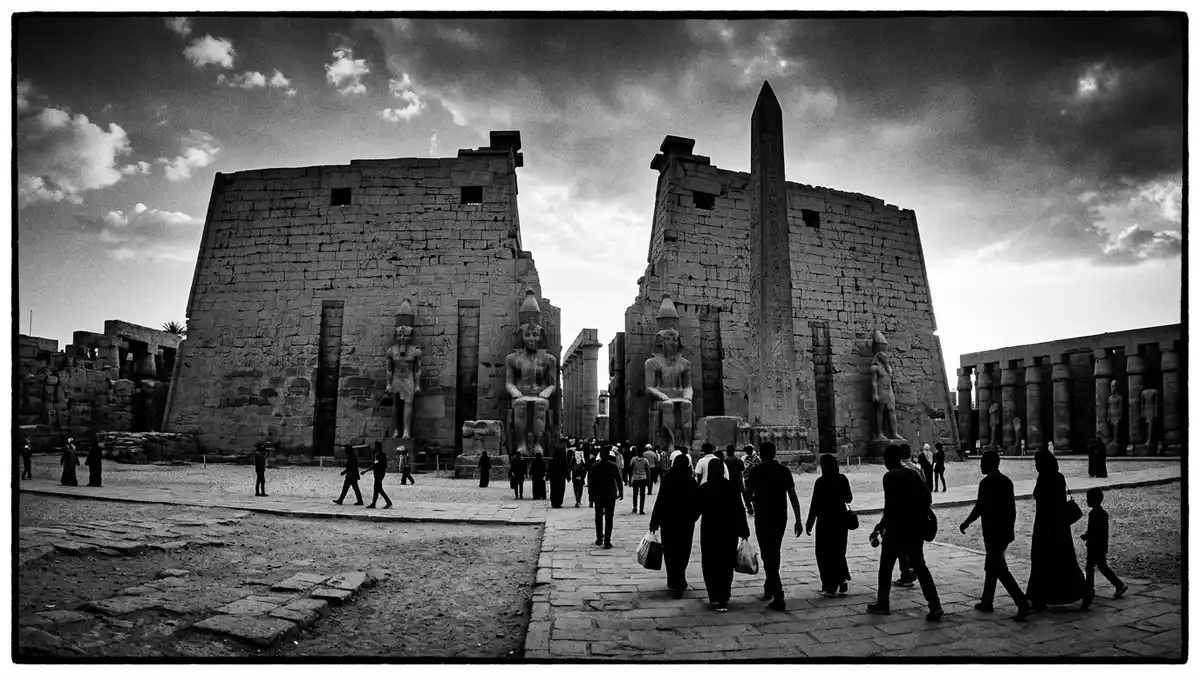
Luxor Temple in Luxor, Egypt is a vast New Kingdom stone complex on the east bank of the Nile, where ancient sanctuaries, colonnades and later religious buildings share one monumental enclosure. Built in the late eighteenth dynasty and developed through the nineteenth dynasty, it stands within ancient Thebes as a ceremonial focus linked to nearby Karnak by a route lined with sphinxes.
A New Kingdom temple at the heart of Thebes
Luxor Temple stands in the centre of modern Luxor on the eastern bank of the Nile River, occupying ground that formed the southern part of ancient Thebes.southern part of ancient Thebes Its ancient Egyptian name, Ipet-resyt, is translated as “Southern Sanctuary”, reflecting its position within this wider ritual landscape.
The temple complex belongs to the New Kingdom period of Egypt, with its main sections dating to the eighteenth and nineteenth dynasties in the second millennium BC.Eighteenth Dynasty The core structure is associated with Pharaoh Amenhotep III, who ruled in the late eighteenth dynasty, while later rulers of the nineteenth dynasty added imposing gateways, courts and statuary, so that the architecture records a sequence of royal interventions over centuries.Amenhotep III and Ramesses II
Processional stone: avenue, pylon and colonnade
Luxor Temple forms a deliberate progression of spaces, beginning with a great stone pylon that frames the entrance and leading through a sequence of courts and roofed colonnades towards inner sanctuaries. The first pylon, with colossal statues attributed to Ramesses II beside its doorway, still dominates the approach from the north.Ramesses II pylon One of the original pair of obelisks that once stood here was later removed and now stands in Paris, leaving its companion in place at Luxor.
In front of the pylon, the temple is linked to Karnak Temple by a processional way bordered by sphinxes, forming a stone avenue several kilometres long.processional way bordered with sphinxes Passing through the entrance, visitors encounter a court built by Ramesses II and then a long columned hall and sun court associated with Amenhotep III.Amenhotep III colonnade and court The stone columns rise in regular rows, carrying carved reliefs of ritual scenes that include festival processions and royal offerings, giving the architecture a rhythmic, ceremonial character.
Sanctuaries, later chapels and a mosque within the walls
Deep within Luxor Temple lie sandstone sanctuaries dedicated to the Theban triad of Amun, Mut and Khonsu, embodying the religious focus of the New Kingdom city.dedicated to Mut, Khonsu and Amun Reliefs carved on the walls record festival rituals such as the Opet Festival, during which the cult statues of the gods were carried between Karnak and Luxor, and include scenes completed in the reign of Tutankhamun that show detailed ceremonial sequences.festival scenes around 1330 BCE
The temple’s enclosure has also accommodated later religious structures, including Roman-period chapels and a mosque raised over parts of the ancient court, so that stone columns from the New Kingdom stand alongside later masonry and plaster. This layering of buildings within one perimeter makes Luxor Temple a visible record of religious continuity and change in Luxor, with pharaonic, classical and Islamic elements sharing a single monumental space.
Visiting Luxor Temple: what travellers from Western Europe should know
- Luxor Temple stands on the east bank of the Nile in Luxor in southern Egypt, within walking distance of the riverfront streets and central districts.
- The complex is largely floored in stone, with long axial routes and spacious courts; exploring it involves walking over uneven surfaces and climbing short flights of steps.
- Luxor Temple lies a few kilometres south of Karnak Temple, and the two are linked by the restored avenue of sphinxes, making it straightforward to visit both complexes in one area.
- The official language is Arabic and the currency is the Egyptian pound.
- Entry requirements depend on your nationality; UK travellers can check the FCDO travel advice at gov.uk/foreign-travel-advice, Irish travellers the Department of Foreign Affairs at ireland.ie.
Searching for Luxor Temple on social platforms
These links open searches for Luxor Temple on each platform.
Frequently asked questions about Luxor Temple
Where is Luxor Temple located?
Luxor Temple is located in Luxor in southern Egypt, on the east bank of the Nile River within the historic area that formed ancient Thebes.east bank of the Nile River
What should visitors expect when exploring Luxor Temple?
Visitors can expect a sequence of monumental stone spaces, including an entrance pylon with colossal statues, wide courts, roofed colonnades and inner sanctuaries decorated with reliefs.
What makes Luxor Temple distinctive among Egyptian temples?
Luxor Temple is distinctive for its combination of New Kingdom ritual architecture, later Roman and Islamic additions and its processional link to Karnak along an avenue lined with sphinxes.


