
Ludi Yan and the limestone chambers of Guilin
Published on 09/21/2026 at 13:11 | Editorial responsibility: Rafael Müller, Editor-in-Chief AD HOC NEWS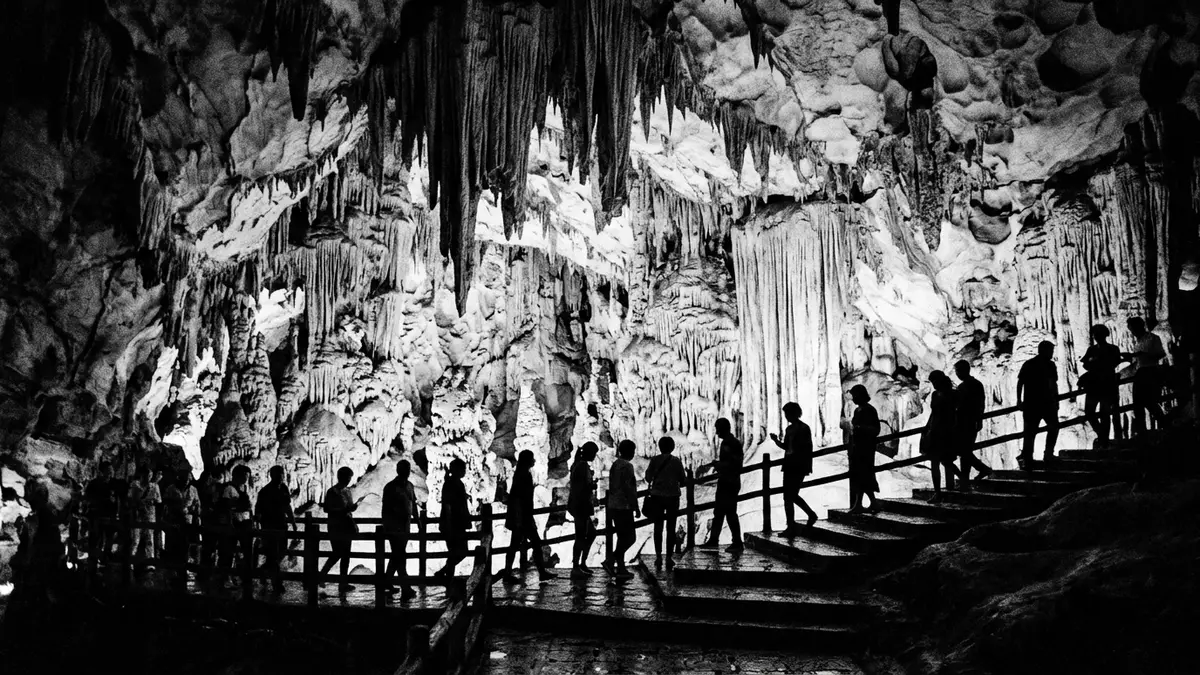
Ludi Yan in Guilin is the English name used for Reed Flute Cave, a limestone cave known for its chambers, stalactites and long record of inscriptions. Its most distinctive feature is the contrast between the dark rock interior and the carved and written traces left across centuries.
Limestone chambers beneath Guangming Hill
The cave lies in Xiufeng District, within Guilin in Guangxi, and is reached as a cave site rather than a built monument. Its rock galleries are formed in limestone, with the usual karst shapes visible in the walls and ceiling.
The site name ties it to local reeds, and the alternative English name has long been used alongside Ludi Yan. The cave belongs to Guilin’s karst landscape, where stone and water have produced large underground spaces that visitors move through on foot.
Tang-era writing on the walls
One of Ludi Yan’s strongest historical anchors is the surviving writing on the walls, much of it from the Tang dynasty. The earliest dated inscription is from 792 AD, and the cave preserves a broader sequence of carved texts from later dynasties as well.
Those inscriptions make the cave more than a geological formation. They turn the chambers into a record of travel, memory and literary use, with Tang dynasty inscriptions standing beside the limestone scenery.
A cave that belongs to Guilin’s karst world
Ludi Yan sits within a wider Guilin landscape of hills and caves, and the setting is part of its identity. The underground space is limestone through and through, with chambers, passages and formations that give the site its physical depth.
The cave’s cultural layer is as important as its geology. The inscriptions and the named historical period connect the site to a long habit of visiting and recording the place, while the rock forms keep the focus on what can be seen inside the cave.
Visiting Ludi Yan: what travellers from Western Europe should know
- The cave is in Xiufeng District, Guilin, in Guangxi. It is reached as a cave site within the city rather than as a separate mountain route.
- The terrain is underground limestone, with uneven passages and chambers. The visit takes place on foot, and the route follows the cave interior.
- English is not an official language there, and the currency is the Chinese yuan.
- Entry requirements depend on your nationality; UK travellers can check the FCDO travel advice at gov.uk/foreign-travel-advice, Irish travellers the Department of Foreign Affairs at ireland.ie.
Searching for Ludi Yan on social platforms
These links open searches for Ludi Yan on each platform.
Frequently asked questions about Ludi Yan
Where is Ludi Yan?
Ludi Yan is in Guilin, in Guangxi, China, within Xiufeng District. It is a limestone cave associated with the city’s karst scenery.
What does a visit involve?
A visit centres on the underground cave interior, with chambers, passages and rock formations. The experience is architectural only in the broad sense of moving through a natural stone space.
What makes Ludi Yan distinctive?
The cave combines limestone scenery with Tang-dynasty inscriptions, including a dated inscription from 792 AD. That pairing of geology and written history gives the place its particular character.


