
Luang Prabang’s layered streets and temple roofs
Published on 08/28/2026 at 21:03 | Editorial responsibility: Rafael Müller, Editor-in-Chief AD HOC NEWS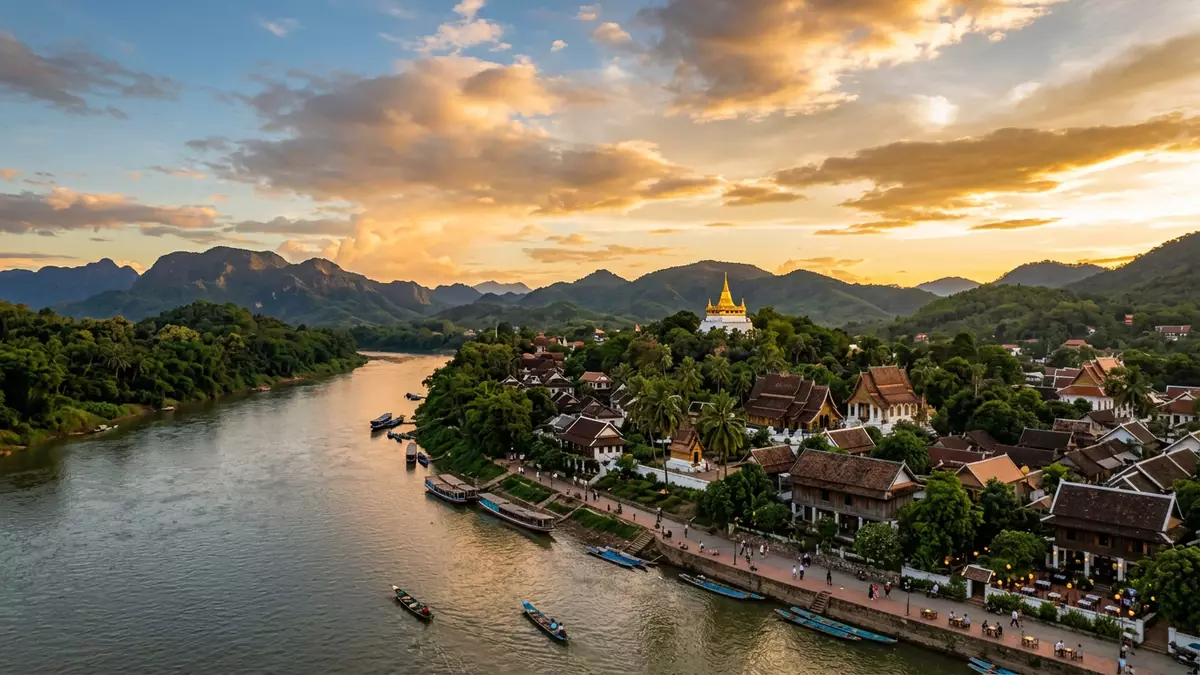
Luang Prabang is a town in northern Laos with a World Heritage-listed centre shaped by Lao religious architecture and French colonial streets. Its most striking quality is the way temples, wooden houses and masonry facades share the same compact peninsula.
Temple roofs and colonial streets in Luang Prabang
The town’s protected core was inscribed on the World Heritage List in 1995, and the designation reflects a rare urban mixture rather than a single monument. Wat Xieng Thong, built in 1559 and 1560 under King Setthathirath, gives the older Lao layer a visible focal point.
French colonial villas and civic buildings add another layer to the streetscape, especially where their shutters, verandas and stucco fronts stand beside temple compounds. UNESCO describes Luang Prabang as an outstanding example of the fusion of traditional Lao architecture and European colonial-era building forms.
Phou Si and the river peninsula
Phou Si rises from the town centre as a wooded hill, with paths and stairs leading to the summit area. The land around Luang Prabang sits between the Mekong and Nam Khan rivers, and the peninsula setting gives the streets a clear edge on all sides.
The town’s setting matters because water, elevation and built fabric sit close together. From the riverbanks to the temple compounds, the landscape keeps the settlement compact and legible, with monuments and houses arranged in short visual sequences.
Living heritage in a compact town
Luang Prabang is not a museum town frozen into one period. Buddhist monasteries, royal-era buildings and ordinary timber houses continue to shape the daily character of the streets, with the heritage zone preserving both religious and domestic architecture.
The result is a town where scale stays modest and materials remain varied. Teak, plaster, tile and brick appear in close proximity, and the streets present a continuous record of Lao urban life across several centuries.
Visiting Luang Prabang: what travellers from Western Europe should know
- Luang Prabang is in northern Laos, and Luang Prabang International Airport serves the town. The centre sits on a peninsula between the Mekong and Nam Khan rivers.
- The hill of Phou Si involves stairs and an uphill climb. The town’s streets are compact, and many heritage buildings stand close together.
- English is widely used in tourism, while Lao is the official language and the kip is the currency.
- Luang Prabang is a UNESCO World Heritage Site, so the town’s core follows heritage protection rules that shape the streetscape.
Searching for Luang Prabang on social platforms
These links open searches for Luang Prabang on each platform.
Frequently asked questions about Luang Prabang
Where is Luang Prabang?
Luang Prabang is in northern Laos, on a peninsula between the Mekong and Nam Khan rivers. It is a town with a protected historic core.
What does a visit involve?
The town is compact, with temples, heritage houses and colonial buildings close together. Phou Si adds a steep, elevated element to the centre.
What makes Luang Prabang distinctive?
Its defining feature is the blend of Lao religious architecture and French colonial urban form. The result is a townscape with strong continuity across different periods.


