
Luang Prabang between rivers: a town of temples and colonial villas
Published on 09/04/2026 at 18:34 | Editorial responsibility: Rafael Müller, Editor-in-Chief AD HOC NEWS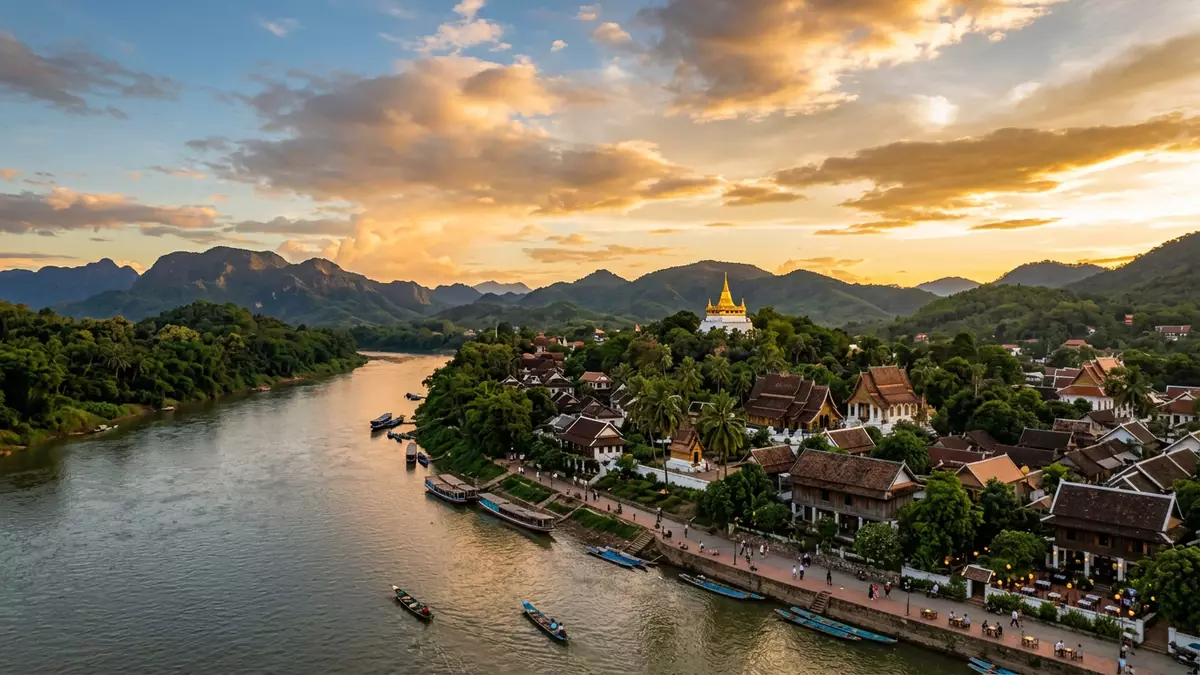
Luang Prabang in northern Laos is a river town where Buddhist monasteries, traditional wooden houses and French colonial villas line narrow streets on a peninsula between two rivers. Recognised as a cultural World Heritage site in 1995, it preserves an urban landscape that brings together Lao royal heritage and colonial-era planning.
A royal town at the meeting of two rivers
Luang Prabang lies in a mountainous region of northern Laos, at the confluence of the Mekong and Nam Khan rivers. The historic centre occupies a slender peninsula formed by these rivers, with water on two sides and hills rising beyond. The setting links built structures with riverfront terraces, gardens and patches of wetlands along the banks.the confluence of the river Mekong and the river Khan Luang Prabang served for centuries as the royal and religious centre of one of the Lao kingdoms, with palaces, administrative buildings and monasteries clustered close together.the capital of the Lan Xang kingdom between the fourteenth and sixteenth centuries
The town’s present layout reflects that layered history. Royal compounds and temple complexes occupy prominent positions along the peninsula, while residential quarters and commercial streets extend towards the tip. The Mekong carries river traffic and marks one edge of the World Heritage core, while the Nam Khan curves around the other side, giving the old town a clear boundary between water and densely built streets.a peninsula formed by the two rivers
World Heritage townscape: Lao timber and colonial brick
The Town of Luang Prabang is inscribed on the UNESCO World Heritage List as site number 479, under cultural criteria ii, iv and v. The inscription from December 1995 highlights how the townscape combines Lao vernacular architecture with nineteenth and twentieth-century European colonial buildings, and how that ensemble remains remarkably well preserved.outstanding example of the fusion of traditional architecture and Lao urban structures with those built by the European colonial authorities The protected area covers a compact core of streets and riverfronts where houses, shops, temples and civic buildings sit in close proximity.area 820 ha with buffer zone 12,560 ha
Traditional Lao houses in Luang Prabang are typically built from wood and bamboo, raised off the ground on posts. Their long sides align with the river, with a large interior space used for living and sleeping and a balcony along one side used for daytime activity.the traditional Lao house, unchanged for centuries, is made from wood and bamboo and is raised off the ground Below the house, the open space historically provided shelter for animals and carts and space for weaving. As construction styles shifted, many of these lower areas were enclosed with walls to create additional rooms, but the elevated structure remains a defining element of the town’s wooden architecture.
Temples, palaces and shop-houses
Luang Prabang contains numerous Buddhist monasteries and temples, with richly decorated wooden pagodas forming a distinctive skyline along the peninsula. These religious complexes sit beside former palaces and administrative buildings associated with the Lao monarchy and the period of the French protectorate. Together they reflect the town’s role as both a royal seat and a centre of Buddhism in the region.defended royal administrative complex with adjacent temples and monasteries
In the early twentieth century, Chinese merchants settled on the peninsula and invested in trade, commissioning large villas that drew on both local and colonial influences. French colonial authorities and Lao elites introduced brick construction for government buildings, schools, hospitals and rebuilt palaces, often designed in Saigon and transported as plans.government buildings, schools and hospitals designed in Saigon and built in brick Commercial shop-houses combining brick with wattle and daub walls transformed parts of the centre during the 1930s, while later decades brought concrete shop-houses with flat roofs and several storeys, adding a further layer to the town’s architectural mix.
Visiting Luang Prabang: what travellers from Western Europe should know
- Luang Prabang lies in northern Laos, north-northwest of Vientiane, on a peninsula between the Mekong and Nam Khan rivers. It is reached by road and by air through Luang Prabang’s airport.
- The historic core consists of narrow streets and riverfront paths, with many temples, houses and villas fronting directly onto the street. Walking involves uneven surfaces and frequent short flights of steps within temple compounds and older buildings.
- The Mekong and Nam Khan rivers border the old town, and several viewpoints and paths lie on slopes rising above the peninsula. Moving between riverside terraces and hilltop viewpoints requires steady climbing on foot.
- The official language is Lao and the currency is the Lao kip.
- Entry requirements depend on your nationality; UK travellers can check the FCDO travel advice at gov.uk/foreign-travel-advice, Irish travellers the Department of Foreign Affairs at ireland.ie.
Searching for Luang Prabang on social platforms
These links open searches for Luang Prabang on each platform.
Frequently asked questions about Luang Prabang
Where is Luang Prabang and what kind of place is it?
Luang Prabang is a town in northern Laos, occupying a peninsula between the Mekong and Nam Khan rivers. It is the capital of Luang Prabang Province and a designated UNESCO World Heritage site.
What should travellers expect on a visit to Luang Prabang?
Travellers encounter Buddhist monasteries, royal-era buildings and colonial villas along compact streets, with riverfront terraces and nearby hills providing varied viewpoints over the townscape and surrounding mountains.
What makes Luang Prabang distinctive among Southeast Asian towns?
Luang Prabang is distinctive for its combination of Lao timber houses, richly decorated pagodas and French colonial brick buildings in a single preserved townscape, recognised internationally through its 1995 World Heritage inscription.


