
Luang Prabang between mountains and Mekong
Published on 09/09/2026 at 22:42 | Editorial responsibility: Rafael Müller, Editor-in-Chief AD HOC NEWS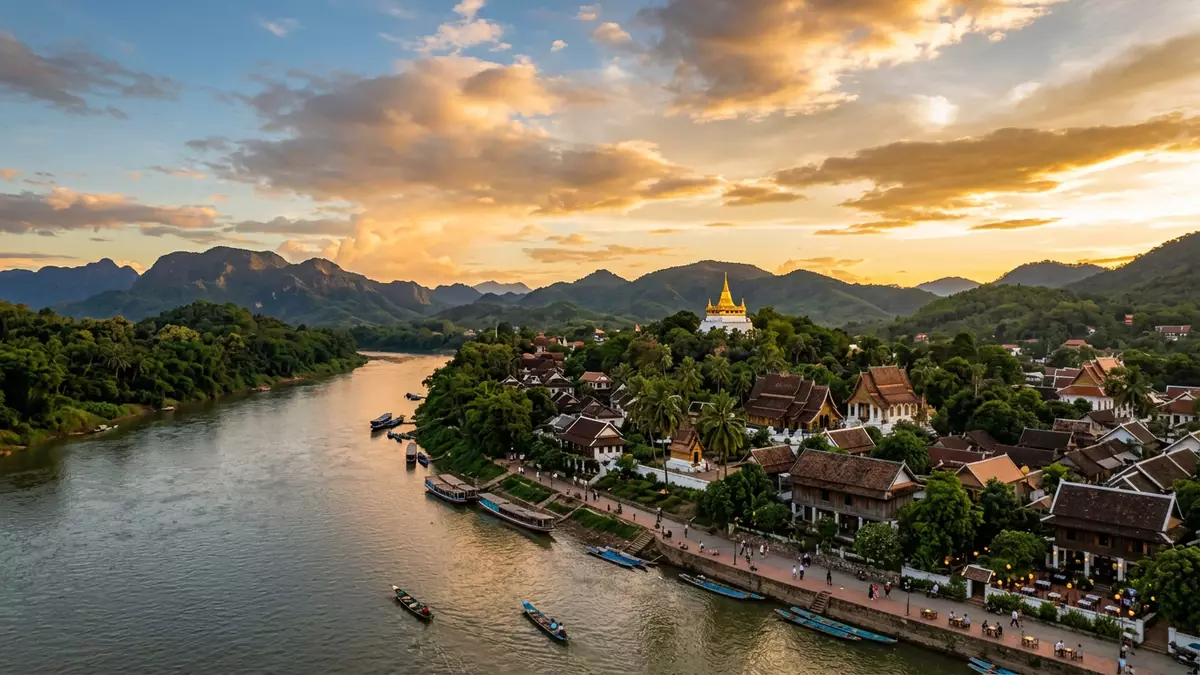
Luang Prabang is a riverside town in northern Laos where Buddhist monasteries, timber houses and colonial-era villas share a narrow peninsula between mountains and two rivers. At the centre of this compact settlement lies a historic core recognised as a UNESCO World Heritage Site since 1995, a designation that anchors the town’s reputation for layered architecture and enduring ritual life.World Heritage Site since 1995
A royal capital shaped by rivers and mountains
Luang Prabang sits in a mountainous region of northern Laos at the meeting of the Mekong and Nam Khan rivers, a geography that defines both its outline and its outlook.meeting of the Mekong and Nam Khan rivers The old town occupies a peninsula formed by the two waterways, with riverfront streets running along the banks and short lanes linking the water to the interior blocks.
For several centuries Luang Prabang served as a royal capital of the Lan Xang kingdom, a role that concentrated palaces, monasteries and administrative buildings in the town.royal capital of the Lan Xang kingdom The city’s name refers to the sacred Buddha image Phra Bang, associated with the region’s royal and religious authority, and its streets still carry this history in the form of monasteries known as wats, processional routes and ceremonial spaces.sacred Buddha image Phra Bang
Timber houses, wats and colonial villas
What distinguishes Luang Prabang in architectural terms is the way traditional Lao timber construction sits alongside brick and stucco buildings from the period of French colonial rule. Vernacular houses raised off the ground on timber supports, with balconies and shaded living spaces, line residential streets, while monasteries with tiered roofs and gilded ornament occupy prominent plots.vernacular houses raised off the ground
From the late nineteenth century French administrators introduced brick government buildings, schools and hospitals, along with villas and shop-houses laid out on a grid of streets.brick government buildings, schools and hospitals Over time, Lao aristocratic residences were rebuilt using these techniques, combining timber structures with wattle-and-daub walls and later brick. The protected area defined in the World Heritage listing covers a significant portion of the town and brings together monasteries, administrative buildings and dwellings in a single cultural landscape.protected area defined in the World Heritage listing
UNESCO recognition and living heritage
When the Town of Luang Prabang was inscribed on the UNESCO World Heritage List in December 1995, the decision highlighted the fusion of traditional Lao architecture with urban and architectural forms from Europe in the nineteenth and twentieth centuries.fusion of traditional Lao architecture with European forms The inscription also emphasised the close relationship between the built environment and the surrounding natural landscape, including riverbanks, wetlands and the mountainous backdrop.relationship between built environment and natural landscape
Within the protected townscape, Buddhist monasteries maintain ritual practices that date back many generations, and timber houses continue to define residential quarters even where lower levels have been enclosed to create additional rooms.Buddhist monasteries maintain ritual practices This coexistence of living religious communities, vernacular architecture and colonial-era structures is a central part of Luang Prabang’s character as a World Heritage town.
Visiting Luang Prabang: what travellers from Western Europe should know
- Luang Prabang lies in northern Laos on a peninsula between the Mekong and Nam Khan rivers, reached by air via Luang Prabang International Airport and by road from other Lao towns.
- The historic core consists of compact streets with uneven surfaces, riverbank paths and monastery compounds, so walking involves short slopes, steps and crossings between paved and unpaved areas.
- The surrounding region is mountainous, and views from higher points in the town take in hills, river valleys and the rooftops of monasteries and houses.
- Laos is outside the UK, Ireland and the EU. Entry requirements depend on your nationality; UK travellers can check the FCDO travel advice at gov.uk/foreign-travel-advice, Irish travellers the Department of Foreign Affairs at ireland.ie.
- The official language is Lao and the currency is the Lao kip.
Searching for Luang Prabang on social platforms
These links open searches for Luang Prabang on each platform.
Frequently asked questions about Luang Prabang
Where is Luang Prabang?
Luang Prabang is in northern Laos, in a mountainous region where the Mekong and Nam Khan rivers meet.
What should travellers expect when visiting Luang Prabang?
Travellers encounter a compact riverside townscape with Buddhist monasteries, timber houses, colonial-era streets and riverfront paths framed by hills.
What makes Luang Prabang distinctive among Southeast Asian towns?
Luang Prabang is distinctive for its World Heritage-listed fusion of Lao vernacular architecture, Buddhist monasteries and French colonial urbanism set in a riverside mountain landscape.


