
Louvre Abu Dhabi and its floating dome of light
Published on 09/23/2026 at 18:46 | Editorial responsibility: Rafael Müller, Editor-in-Chief AD HOC NEWS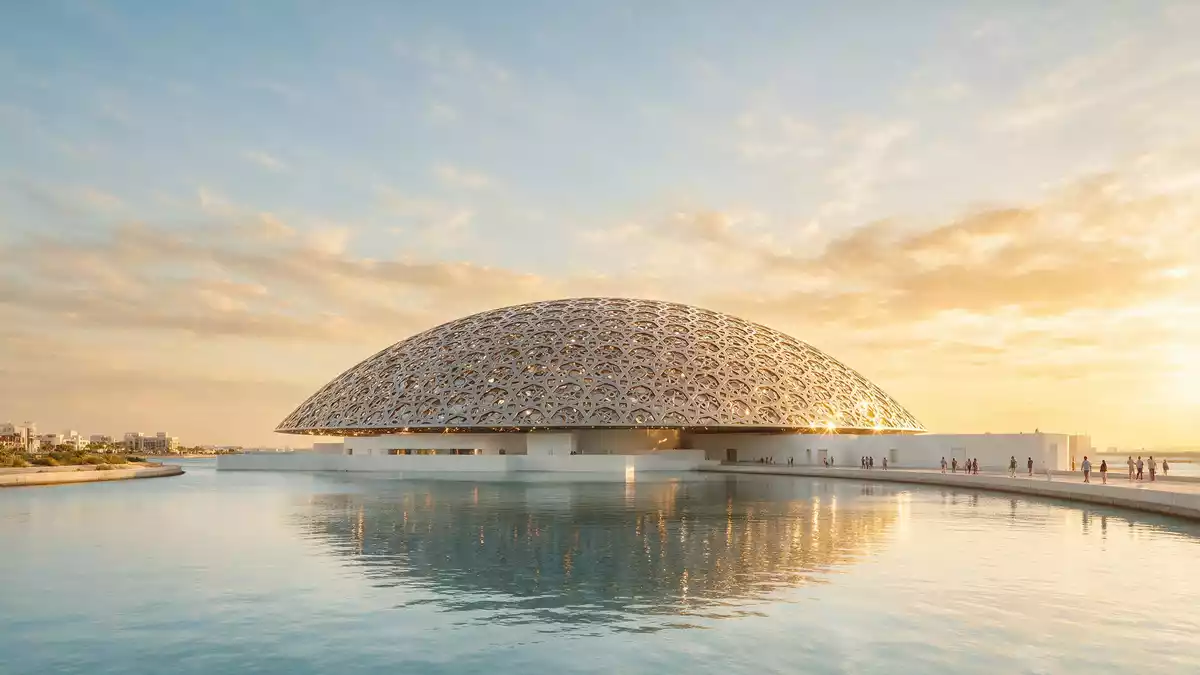
Louvre Abu Dhabi is a museum city on Saadiyat Island, where white buildings meet the sea beneath a vast silvery dome. Designed by French architect Jean Nouvel, the museum opened to the public on 11 November 2017.
A museum city beneath a vast dome
The building spreads across the waterfront as a group of low white structures linked beneath one roof. Jean Nouvel shaped the complex as an Arab medina, with passages, courtyards and galleries arranged as an urban landscape.
The dome measures 180 metres across and contains 7,850 metal stars arranged in layered geometric patterns. Daylight passes through the openings between them and falls across the buildings, walkways and water below. The architecture therefore remains visible throughout a visit, not only from outside.
The museum’s galleries, exhibition spaces, Children’s Museum, auditorium, restaurants and research facilities form part of this larger composition. Louvre Abu Dhabi is both an art museum and a place of movement between enclosed rooms, shaded paths and the waterfront.
Jean Nouvel’s architecture between sand and sea
Jean Nouvel is the architect behind Louvre Abu Dhabi and the Arab World Institute in Paris. At Saadiyat, his design combines contemporary construction with features associated with Arabic architecture, including compact white buildings and patterned shade.
The waterfront museum city sits within Abu Dhabi’s Saadiyat Cultural District. The sea appears between the structures, while the dome stretches across the complex as a single architectural canopy.
White walls, dark joints and metallic surfaces create a restrained palette. The stars in the dome form the most intricate element, while the buildings beneath it remain low and clearly separated. This contrast gives the complex its recognisable profile without relying on a tall central tower.
The dome rises up to 40 metres above sea level and weighs about 7,500 tonnes. Its scale can be read from the promenades, where the roof extends across the museum city and frames views towards the water.
Art across cultures and centuries
Louvre Abu Dhabi presents works from different regions and periods beside one another. The collection covers human history from prehistory to modern and contemporary art, with objects arranged around themes that cross geographical borders.
The museum’s inauguration in 2017 established a permanent cultural institution in the United Arab Emirates. Loans from French museums, including the Musée du Louvre, Musée d’Orsay and Centre Pompidou, appear alongside works belonging to Louvre Abu Dhabi.
Ancient objects, religious works, paintings, sculptures and contemporary pieces share the galleries. Their arrangement places different civilisations within the same museum experience, with themes connecting objects across continents and centuries.
The museum contains 23 permanent galleries and temporary exhibition spaces. A Children’s Museum, auditorium and research centre extend its programme beyond the permanent displays, while restaurants and promenades connect the cultural spaces with the waterfront setting.
The result is an institution where architecture and collection remain closely connected. The dome belongs to the visible landscape of the visit, while the galleries provide a sequence of encounters with objects made in different places and historical periods.
Visiting Louvre Abu Dhabi: what travellers from Western Europe should know
- Louvre Abu Dhabi stands on Saadiyat Island within Abu Dhabi’s Saadiyat Cultural District. It is reached from the city by road, taxi or public transport serving the island.
- The museum is arranged across low buildings, galleries, courtyards and waterfront promenades beneath the dome. Walking between these spaces forms part of the physical layout.
- The United Arab Emirates’ official language is Arabic, and its currency is the UAE dirham.
- Entry requirements depend on your nationality; UK travellers can check the FCDO travel advice at gov.uk/foreign-travel-advice, Irish travellers the Department of Foreign Affairs at ireland.ie.
Searching for Louvre Abu Dhabi on social platforms
These links open searches for Louvre Abu Dhabi on each platform.Frequently asked questions about Louvre Abu Dhabi
Where is Louvre Abu Dhabi?
Louvre Abu Dhabi is on Saadiyat Island in Abu Dhabi’s Saadiyat Cultural District, beside the Arabian Gulf waterfront.
What can visitors expect inside?
Visitors find permanent galleries, temporary exhibitions, a Children’s Museum, an auditorium and displays spanning prehistory to contemporary art.
What makes the museum distinctive?
Jean Nouvel’s museum city is covered by a 180-metre dome containing 7,850 metal stars. White buildings, water and patterned daylight define the architectural setting.


