
Louvre Abu Dhabi and its floating dome of light
Published on 09/18/2026 at 21:21 | Editorial responsibility: Rafael Müller, Editor-in-Chief AD HOC NEWS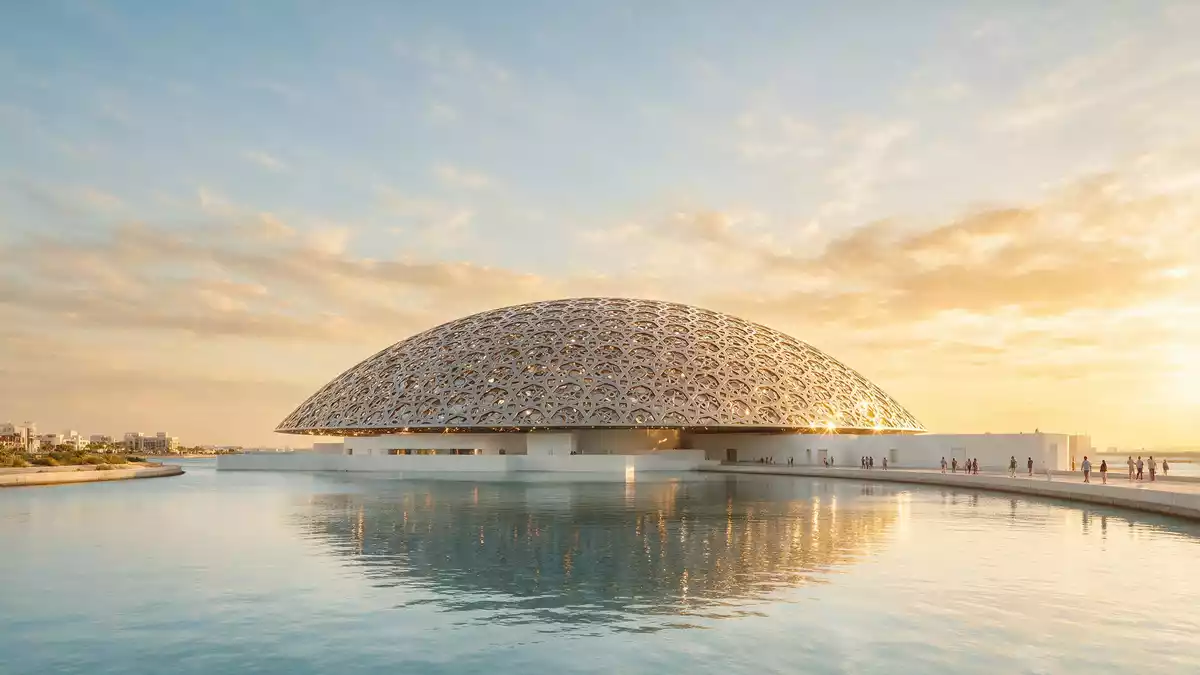
Louvre Abu Dhabi on Saadiyat Island in Abu Dhabi is a museum of art and artefacts from many cultures, housed beneath a vast dome that appears to float above the water. Opened in November 2017 and designed by French architect Jean Nouvel, it has become a landmark of the United Arab Emirates through the way architecture, light and landscape are woven together.
A museum city beneath Jean Nouvel’s dome
Louvre Abu Dhabi stands in the Saadiyat Cultural District, a planned arts quarter on Saadiyat Island linked to the Abu Dhabi mainland by Sheikh Khalifa Bridge.Saadiyat Cultural District The museum opened to visitors in November 2017 as the first Louvre-branded institution outside France, under an intergovernmental agreement that transfers the Louvre name and long-term loans from Paris to Abu Dhabi for a defined period.intergovernmental agreement with France
Jean Nouvel conceived Louvre Abu Dhabi as a low-rise museum city of white pavilions grouped along the waterfront, with galleries, plazas and walkways arranged like a compact urban quarter.museum city of white pavilions Above this ensemble rises the museum’s most recognisable feature, a steel dome measuring around 180 m (591 ft) across and formed from multiple layers of geometric metal patterns that create a dense lattice when seen from below.180 metre-wide dome The dome covers most of the complex and is supported on hidden columns, so that the roof seems to hover over the museum buildings and the water channels between them.
Light, water and the “rain of light” effect
The relationship between dome, light and water is central to the experience of Louvre Abu Dhabi. The steel lattice is built from eight layers of overlapping metal stars cut in different sizes and angles, producing thousands of openings through which sunlight can pass.eight layers of geometric metal stars As the sun moves across the sky, the shifting light falls onto the plazas, causeways and pavilions below in scattered patches that have given rise to the phrase “rain of light”.
From ground level the visitor sees water channels running between the buildings, with some facades reaching directly down to the sea and others set back behind terraces. The reflections of the dome’s lattice on the water and pale surfaces add further layers to the visual effect. The dome’s mass is substantial, weighing around 7,500 tonnes, a figure that has been likened to the steel frame of the Eiffel Tower in Paris.dome weight comparison Despite this, its presence from within the museum feels delicate, because the openings break up its surface into intricate patterns of light and shadow.
Collections that cross cultures and periods
Louvre Abu Dhabi presents itself as a universal museum, showing artworks and artefacts from different civilisations side by side rather than in separate national galleries.universal museum Around 23 permanent galleries are arranged chronologically and thematically, moving from early human settlements and belief systems through classical empires, trade routes and global exchanges to contemporary art.23 permanent galleries The displays combine items from the museum’s own collection with loans from institutions in France and other partners, including works associated with the Musée du Louvre in Paris.
Objects include sculpture, painting, manuscripts, decorative arts and archaeological finds from regions such as Europe, the Middle East, Africa and Asia. Religious artefacts from different faith traditions can be seen in proximity, and scientific instruments and maps are shown alongside artworks that reflect similar ideas. This cross-cultural arrangement emphasises connections between periods and places, while the architecture consistently frames views out to the sea and across the museum city, keeping the relationship between the galleries and their island setting in view.
Visiting Louvre Abu Dhabi: what travellers from Western Europe should know
- Louvre Abu Dhabi stands on Saadiyat Island, north-east of central Abu Dhabi, reached by road across Sheikh Khalifa Bridge along Sheikh Khalifa Bin Zayed Al Nahyan Highway E12.
- The museum complex consists of multiple pavilions and outdoor walkways under the large dome, with steps and ramps between levels and some routes running beside or above water.
- The museum sits close to the shoreline of the Arabian Gulf, with other cultural projects planned or built in the Saadiyat Cultural District on the same island.
- The official language is Arabic and the currency is the United Arab Emirates dirham.
- Entry requirements depend on your nationality; UK travellers can check the FCDO travel advice at gov.uk/foreign-travel-advice, Irish travellers the Department of Foreign Affairs at ireland.ie.
Searching for Louvre Abu Dhabi on social platforms
These links open searches for Louvre Abu Dhabi on each platform.
Frequently asked questions about Louvre Abu Dhabi
Where is Louvre Abu Dhabi located?
Louvre Abu Dhabi is located on Saadiyat Island in Abu Dhabi, within the Saadiyat Cultural District near the shore of the Arabian Gulf.
What can visitors expect inside the museum?
Visitors find a series of galleries and public spaces arranged like a small waterfront city, showing artworks and artefacts from many cultures and historical periods.
What makes Louvre Abu Dhabi distinctive among museums?
The museum’s vast patterned dome, its interplay of light and water, and its cross-cultural presentation of collections give it a character that is closely tied to its island setting.


