
Lotus Temple in Delhi: a marble lotus for the Bahá’í faith
Published on 08/16/2026 at 14:37 | Editorial responsibility: Rafael Müller, Editor-in-Chief AD HOC NEWS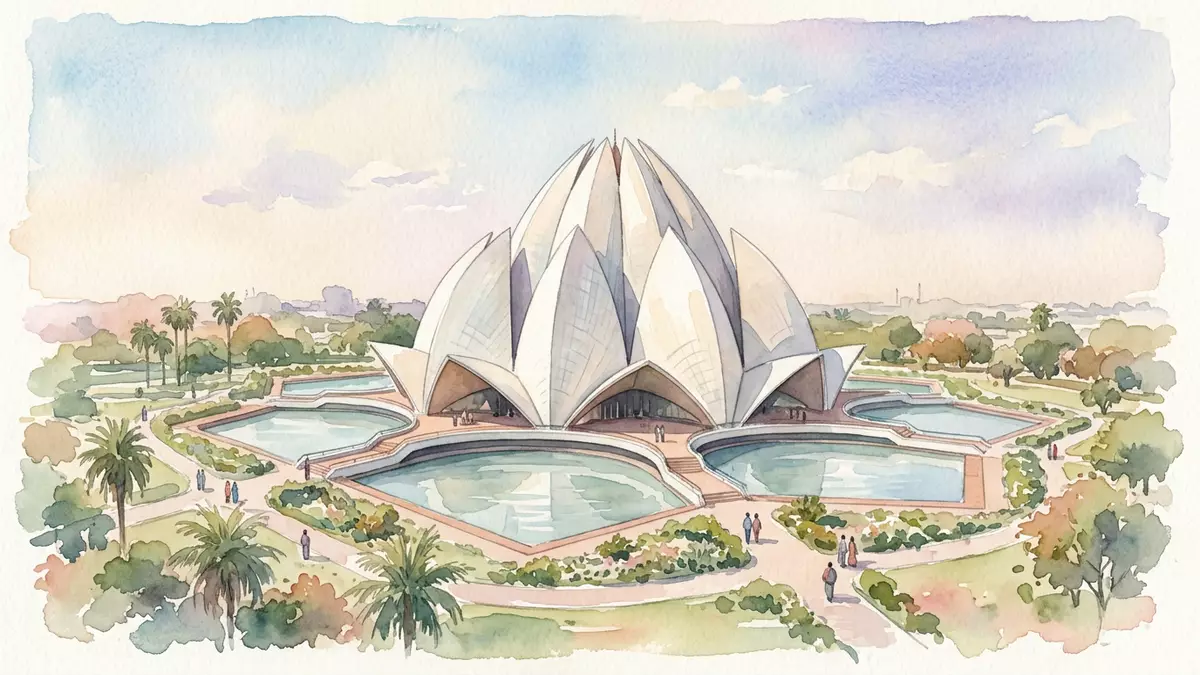
Lotus Temple in Delhi is a Bahá’í House of Worship shaped as a giant lotus flower in white marble, completed in 1986 to a design by architect Fariborz Sahba.
A lotus rendered in concrete and marble
Lotus Temple stands in the Bahapur area of Kalkaji in South Delhi, on a landscaped site that was developed as the Bahá’í House of Worship for the Indian subcontinent.Bahapur, Kalkaji, New Delhi The building follows the Bahá’í rule that every House of Worship must be nine-sided and surrounded by gardens, giving it a clear geometric order beneath the floral form.nine-sided plan and gardens
The structure is formed from twenty-seven free-standing concrete shells that read as “petals”, arranged in three rings of nine around a central hall.27 marble petals grouped into clusters of three Over these shells every visible surface is clad in white Makrana marble from Rajasthan, the same quarry region that supplied the Taj Mahal, so the temple appears as a luminous white flower rising above its pools and lawns.white Makrana marble cladding
Ninefold symmetry and the Bahá’í House of Worship
The Bahá’í faith sets only a few architectural rules for its Houses of Worship: the building must have nine sides, be surrounded by gardens and welcome people of all religions into a single hall for silent prayer or meditation.Bahá’í House of Worship rules Lotus Temple follows this pattern exactly, with a nine-sided central prayer hall and nine entrances, making it a radial plan without a distinguished front façade.Bahá’í temple in New Delhi
The number nine recurs throughout the design as a symbol with special meaning in Bahá’í teaching, where it stands for completeness and unity. The twenty-seven petals are grouped into three ranks of nine: entrance leaves shelter the nine doorways, outer leaves fold away from the centre and inner leaves curve inward to enclose the hall. Around the base, nine reflecting pools trace the outline of the lotus and mirror the marble structure above, extending the ninefold geometry into the landscape.petal arrangement and nine pools
Construction, architect and interior space
The temple was commissioned in the 1970s and built between 1980 and 1986, with the completed building dedicated to worship in December 1986.construction period and dedication Iranian-born architect Fariborz Sahba, who later worked from Canada, developed the design and oversaw the project with engineering input from firms including Flint and Neill and the ECC Group of Larsen & Toubro.Fariborz Sahba and main contractor
Inside, the central hall rises to a height of around 34 m (112 ft) beneath the inner ring of petals and provides fixed seating for about 1,300 people, with additional standing room around.central hall height and seating The hall is free of figurative decoration and ritual furnishings, in keeping with Bahá’í practice; its focus is the volume of space itself, surrounded by gardens on a site of about 26 acres in Bahapur.site area and hall
Visiting Lotus Temple: what travellers from Western Europe should know
- Lotus Temple stands in Bahapur near the Kalkaji district in South Delhi, a short walk from Kalkaji Mandir and Okhla NSIC stations on the city’s metro network.
- The approach runs through gardens with paved paths, and the prayer hall is reached via stairways and covered porches beneath the outer ring of concrete and marble petals.
- The official language is Hindi and the currency is the Indian rupee.
- Entry requirements depend on your nationality; UK travellers can check the FCDO travel advice at gov.uk/foreign-travel-advice, Irish travellers the Department of Foreign Affairs at ireland.ie.
Searching for Lotus Temple on social platforms
These links open searches for Lotus Temple on each platform.
Frequently asked questions about Lotus Temple
Where is Lotus Temple in Delhi?
Lotus Temple is in Bahapur near Kalkaji in South Delhi, on a landscaped site that forms the Bahá’í House of Worship for the Indian subcontinent.
What should visitors expect inside?
Visitors enter a central prayer hall beneath the inner petals, with fixed seating and a quiet atmosphere for individual prayer or meditation without formal ritual.
What makes the architecture of Lotus Temple distinctive?
The temple’s architecture is defined by its lotus form in white marble, built from twenty-seven petal-like shells arranged around a nine-sided hall with nine entrances and pools.


