
Lotus Temple and its marble petal form in Delhi
Published on 09/03/2026 at 22:37 | Editorial responsibility: Rafael Müller, Editor-in-Chief AD HOC NEWS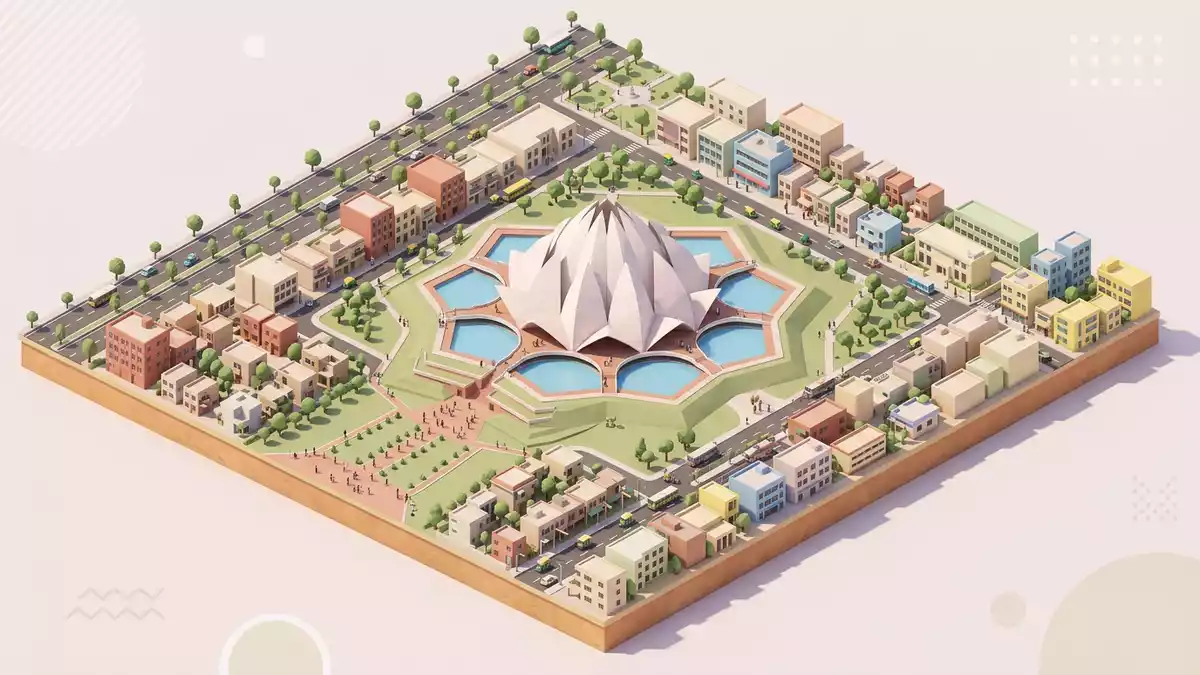
Lotus Temple in Delhi is a Bahá’í House of Worship completed in 1986 and designed by Fariborz Sahba. Its white marble petal form makes the building legible from across the gardens and along the approach from Kalkaji.
Marble petals on a Bahá’í plan
The temple belongs to the Bahá’í Faith and stands among the best-known houses of worship linked with that tradition. The building was completed in 1986, and its formal opening took place in December of that year.
Its exterior is built from white marble and arranged as a cluster of petal-like shells. The composition has become the defining image of the site and gives the building a floral profile that reads clearly against the Delhi skyline.
Bahá’í house of worship completed in 1986
Fariborz Sahba and the temple’s setting
Fariborz Sahba, an Iranian architect, is the name most closely tied to the building. The temple stands in Kalkaji, in southern Delhi, where the surrounding grounds soften the geometry of the structure with lawns and water.
The temple is also known as the Bahá’í House of Worship, which helps place it within a wider religious and architectural tradition. Its plan and exterior finish give it a measured symmetry, while the name Lotus Temple captures the shape that visitors first recognise.
designed by Fariborz Sahba New Delhi, India
A modern landmark in Delhi’s religious landscape
Delhi contains many places of worship, yet Lotus Temple stands apart through its late twentieth-century form and its use of marble as a repeated visual theme. The building’s petals, central hall and pools create a calm sequence of shapes rather than a single façade.
The temple’s identity is tied to Bahá’í worship and to the language of symmetry, whiteness and open access that marks that faith’s houses of worship. The result is a building that reads as both religious architecture and a modern civic landmark.
Bahá’í House of Worship marble petals
Visiting Lotus Temple: what travellers from Western Europe should know
- Lotus Temple stands in Kalkaji, in southern Delhi. Kalkaji Mandir metro station is the closest named station in the available information.
- The approach is level rather than mountainous, and the grounds are laid out as gardens around the building.
- The building is a Bahá’í House of Worship, so the interior is organised around a central prayer hall rather than an altar-focused sanctuary.
- The marble exterior is the defining feature from outside. The petal-like shells and the pools around the temple give the site its recognisable outline.
Searching for Lotus Temple on social platforms
These links open searches for Lotus Temple on each platform.
Frequently asked questions about Lotus Temple
Where is Lotus Temple?
Lotus Temple is in Kalkaji, in southern Delhi, India. It is a Bahá’í House of Worship.
What does a visit involve?
The experience centres on the building itself, its gardens and the central prayer hall. The architecture is the main draw, rather than a large complex of separate rooms.
What makes Lotus Temple distinctive?
The temple is distinguished by its white marble petals and its 1986 completion under Fariborz Sahba. Its form gives Delhi one of its most recognisable modern religious buildings.


