
Longshan Si in Taipeh: a living tapestry of faith and craft
Published on 09/15/2026 at 08:18 | Editorial responsibility: Rafael Müller, Editor-in-Chief AD HOC NEWS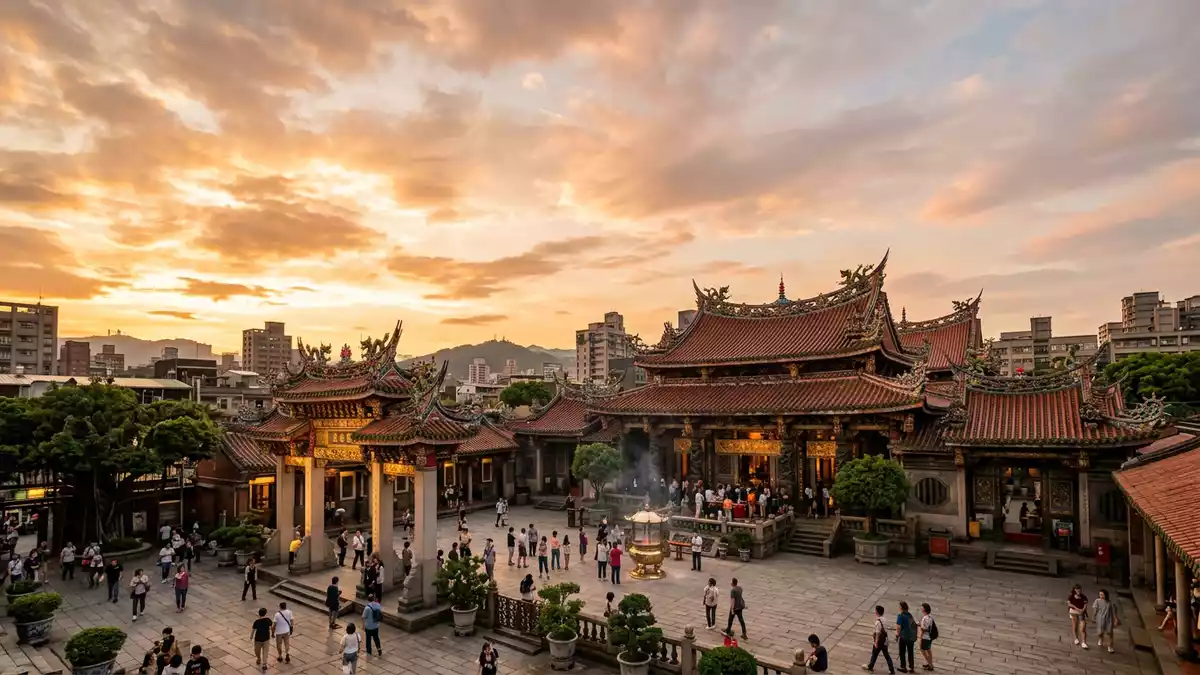
Longshan Si in Taipeh stands as a temple complex where dense carvings, incense smoke and overlapping deities share the same courtyards. Founded in 1738 under Qing rule and rebuilt in the early twentieth century, it remains one of Taiwan’s most intricately crafted religious spaces.
A courtyard temple shaped by centuries
Longshan Si was established in 1738 by immigrants from Fujian, who settled in the historic Manka district of Taipeh and raised a branch temple modelled on a shrine in Quanzhou.Built in 1738 under Qing rule, it became a centre of worship and self-organisation for traders and families arriving from the Chinese mainland.Immigrants from Jinjiang, Nan'an and Hui'an gathered here around the image of Avalokiteshvara, known locally as Guanyin.
The temple that visitors encounter dates largely from a comprehensive reconstruction carried out between 1919 and 1924 under the Japanese administration of Taiwan.Architect Wang Yi-shun led the 1919–24 rebuilding with master carpenters and stone workers, reshaping Longshan Si into a compact ensemble of halls and courtyards aligned on a north–south axis. The present layout follows southern Fujian temple traditions, with a main ceremonial hall flanked by side towers and a rear hall enclosing further altars.
Wood, stone and ceramic detail at every turn
Architecture at Longshan Si is rich in timber framing, carved stone and ceramic ornament. The entrance gateway leads into a front hall where wooden beams and brackets are packed with figures from Chinese opera and mythology. Along the roofline, cut-and-paste porcelain figures known as jiannian form miniature battle scenes and processions, a hallmark of late Qing decorative craft that was renewed during the twentieth-century rebuilding.Late-Qing jiannian sculptures sit above elaborately carved doors and lattice windows.
Stone elements carry equal weight. Dragon pillars forged in bronze stand beside granite columns, reflecting both Qing-era forms and later additions during Japanese rule.Bronze dragon pillars and ornamental columns frame the main hall, where altars are faced in stone and wood in complex relief. Courtyards between the halls contain tiled floors and smaller shrines, while the roofs fold into layered ridges that emphasise the temple’s compact square plan.
Guanyin at the centre of a many-deity temple
Longshan Si is dedicated primarily to Guanyin, the bodhisattva of compassion, whose central image has been venerated since the eighteenth century. Around this figure, worship at the temple encompasses a wide range of Taoist and folk deities, from Mazu, the protector of sailors, to gods associated with health, fortune and examinations.A mixture of Buddhist and Taoist deities share altars in the main and rear halls, making Longshan Si a compact survey of religious practice in Taipeh over nearly three centuries.
Devotional life is structured around offerings, divination and festival processions. Incense burners stand before each major altar, and visitors see tables laden with fruit, flowers and candles. The temple’s survival through earthquakes, storms and the 1945 bombing of Taipeh, after which the main building was repaired and rebuilt, has given it recognised historic status; Longshan Si is protected as a national monument within Taiwan’s system of cultural heritage sites.Designation as a national monument reflects both its age and its layered architectural fabric.
Visiting Longshan Si: what travellers from Western Europe should know
- Longshan Si stands in the Wanhua district of Taipeh, historically known as Manka, near the Tamsui River. It is reached by urban metro services that stop at Longshan Temple Station.
- The temple complex combines covered halls with open courtyards, reached by flights of stone steps and paved walkways that can be busy with worshippers.
- In wet season weather, tiled roofs and open courtyards channel rain into stone drains, so visitors cross areas that can be slick underfoot.
- Longshan Si lies within Taiwan, where the official language is Mandarin Chinese and the currency is the New Taiwan dollar.
- Entry requirements depend on your nationality; UK travellers can check the FCDO travel advice at gov.uk/foreign-travel-advice, Irish travellers the Department of Foreign Affairs at ireland.ie.
Searching for Longshan Si on social platforms
These links open searches for Longshan Si on each platform.
Frequently asked questions about Longshan Si
Where is Longshan Si located in Taipeh?
Longshan Si stands in the historic Wanhua district of Taipeh, close to the Tamsui River and served by the city’s metro at Longshan Temple Station.
What should visitors expect during a visit?
Visitors encounter a sequence of timber and stone halls around courtyards, with dense carvings, incense offerings and active altars devoted to Buddhist, Taoist and folk deities.
What makes Longshan Si distinctive among Taiwan’s temples?
Its combination of eighteenth-century foundations, 1919–24 reconstruction under architect Wang Yi-shun and richly layered carvings and jiannian ceramics gives Longshan Si an unusually complex architectural and devotional character.


