
Longshan Si in Taipeh: a courtyard temple layered in time
Published on 09/05/2026 at 07:39 | Editorial responsibility: Rafael Müller, Editor-in-Chief AD HOC NEWS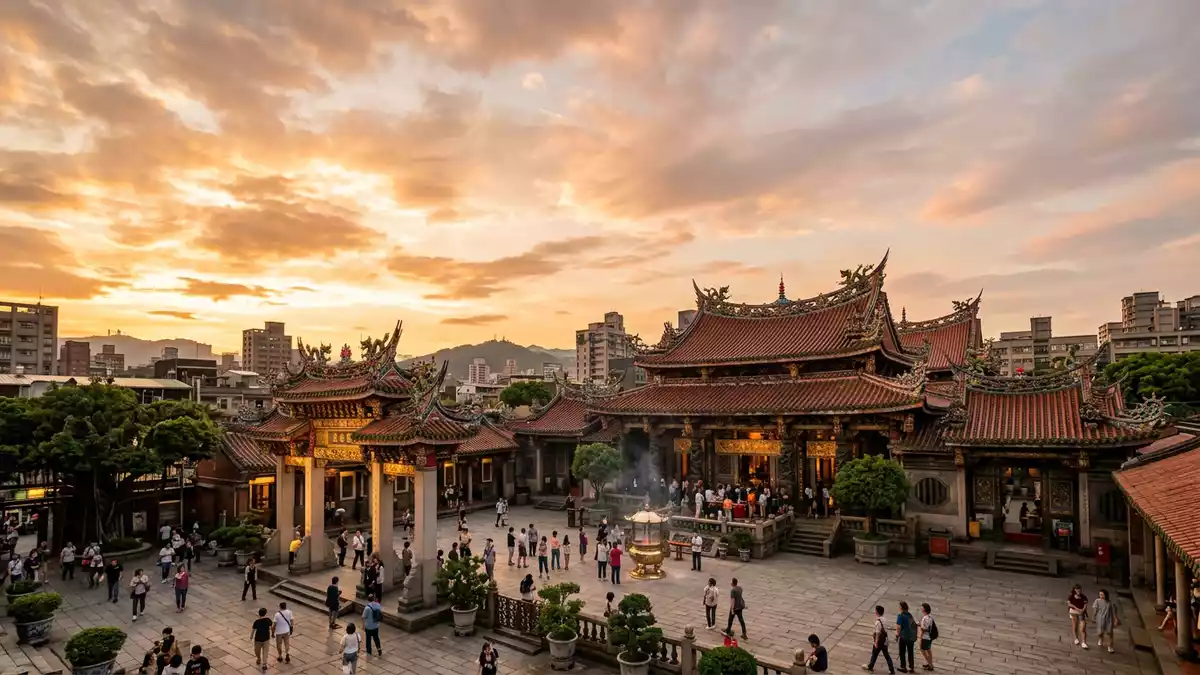
Longshan Si in Taipeh is a historic temple complex in the Wanhua district, first constructed in 1738 by Han Chinese settlers from Fujian under Qing rule. The layout, courtyards and richly carved roofs make it one of the clearest surviving pictures of early Taipei as a religious and social centre.
A temple that grew with early Taipei
Longshan Si stands in Wanhua, the district historically known as Mengjia or Bangka, which formed the core of eighteenth- and nineteenth-century Taipei. It was built in 1738 by settlers from Fujian who had established themselves in the Manka area during the Qing Dynasty and wanted a place of Buddhist worship and assembly.built in 1738 The temple is dedicated above all to Guanyin, also known as Avalokiteshvara, the bodhisattva of compassion whose statue was brought from Jinjiang Longshan Temple in Fujian and became the centre of devotion here.dedicated to Avalokiteshvara
From the eighteenth century onwards Longshan Si functioned not only as a religious space but also as an important place for local organisation. In the Qing period it served as a centre of religion, self-governance and self-defence for residents of Mengjia, hosting meetings and community deliberations alongside ritual activity.centre of religion and self-governance Over time the temple’s status as a municipal-level historic site has reinforced its role as a reference point for understanding how Han Chinese settlement shaped early Taipei.municipal-level historic site
Courtyards, halls and a classic Minnan layout
Architecturally, Longshan Si follows the traditional southern Fujian, or Minnan, temple type, organised around a sequence of open courtyards and halls. The complex is laid out in a three-section plan with a front hall, a middle hall and a rear hall, flanked by side structures sometimes described metaphorically as protective “dragons” on either side of the main axis.three-section design This axial arrangement and its surrounding colonnades create a roughly square overall footprint that is characteristic of major Taiwanese temples of the Qing period.entire structure forming a complete square
The surfaces of Longshan Si are dense with timber carving and painted decoration. Carved beams and rafters support tiled roofs, and stone columns and plinths anchor the main halls. The front courtyard leads to the main worship hall, where Guanyin’s shrine stands among side altars devoted to other Buddhist and folk deities; this mixture of Buddhist and local religious figures reflects the blending of traditions in Taiwan. Roof ridges carry elaborate decorative groups, while the eaves shelter lanterns, incense burners and tables laid out for offerings. Walking through the complex, the sequence of spaces from entrance to rear hall makes the changing scale of the building clear, from the bustle of the outer courtyard to the more enclosed atmosphere of the inner sanctuaries.
Reconstruction and the hand of Wang Yi-shun
The present appearance of Longshan Si is the result of repeated rebuilding. The original eighteenth-century structures suffered damage from earthquakes and heavy rainfalls between 1760 and 1870, and a comprehensive reconstruction took place in the early twentieth century.damage between 1760 and 1870 Between 1919 and 1924 a major rebuilding programme was carried out under the direction of Wang Yi-shun, a temple architect from southern Fujian whose work left a lasting mark on Taiwanese religious architecture.renovated under architect Wang Yi-shun Many of the structural and decorative features visible today date to this reconstruction period.
Longshan Si has also lived through twentieth-century conflict. In 1945, during the Second World War, the temple was struck and damaged by American bombers, losing parts of its main hall and artworks; restoration only resumed in 1955 as Taipei recovered economically from the war.hit and damaged by American bombers Subsequent work, including the rebuilding of the main hall in 1957, consolidated Longshan Si as a protected historic site, and the combination of eighteenth-century origin, early twentieth-century reconstruction and post-war repairs gives the complex its layered character as both an active temple and a record of Taipei’s urban history.main hall rebuilt in 1957
Visiting Longshan Si: what travellers from Western Europe should know
- Longshan Si stands on Guangzhou Street in the Wanhua district of Taipeh, south-west of the newer city centre, and is reached by local metro and bus services.
- The temple complex is organised around paved courtyards and stone steps, with covered walkways linking the front hall, main hall and rear hall.
- Wanhua is one of the oldest districts of Taipeh, and streets around Longshan Si contain traditional shops and markets alongside later urban development.
- The official language is Mandarin Chinese and the currency is the New Taiwan dollar.
- Entry requirements depend on your nationality; UK travellers can check the FCDO travel advice at gov.uk/foreign-travel-advice, Irish travellers the Department of Foreign Affairs at ireland.ie.
Searching for Longshan Si on social platforms
These links open searches for Longshan Si on each platform.
Frequently asked questions about Longshan Si
Where is Longshan Si located in Taipeh?
Longshan Si is in the Wanhua district of Taipeh, historically known as Mengjia or Bangka, on Guangzhou Street south-west of the later city centre.
What can visitors expect when entering Longshan Si?
Visitors move from an entrance courtyard through successive halls laid out along a central axis, passing altars, incense burners and richly decorated timber and stone structures.
What makes Longshan Si distinctive among temples in Taiwan?
Its combination of eighteenth-century foundation, Minnan courtyard plan and early twentieth-century reconstruction under Wang Yi-shun ties living religious practice to the architectural history of Taipei.


