
Longmen Shiku in Luoyang, a river gorge of carved stone Buddhas
Published on 09/12/2026 at 19:59 | Editorial responsibility: Rafael Müller, Editor-in-Chief AD HOC NEWS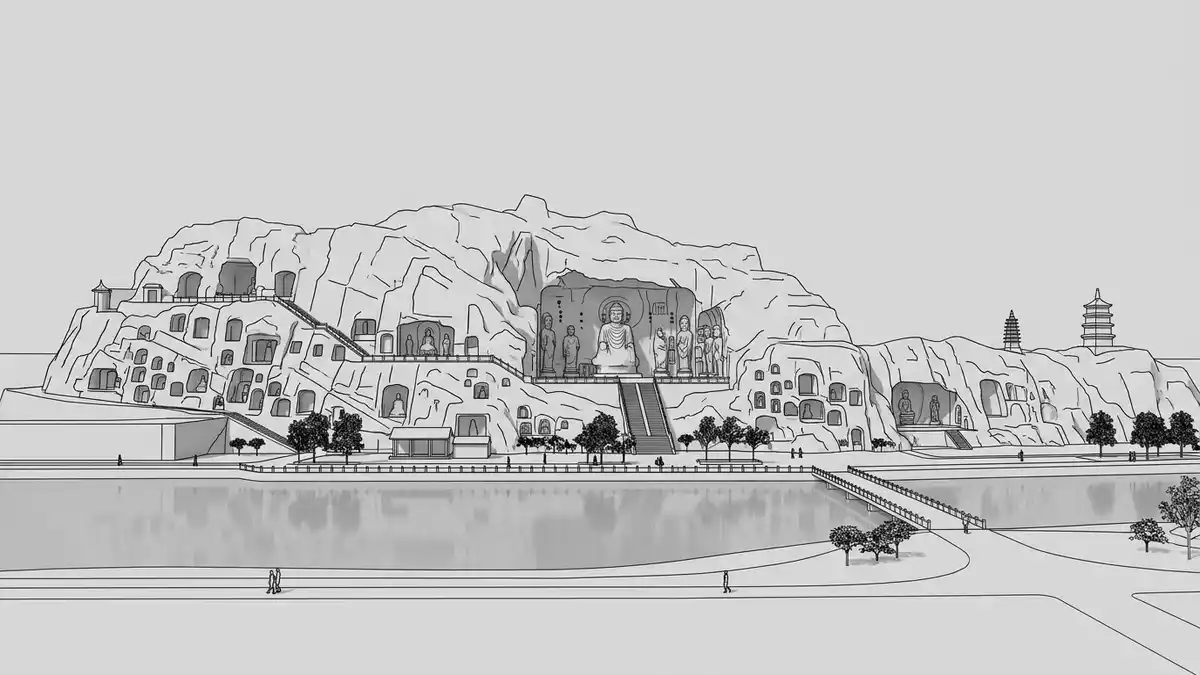
Longmen Shiku, known in English as the Longmen Grottoes, is a limestone cliff landscape on the Yi River south of Luoyang where Buddhist caves and statues have been carved directly into the rock across centuries. Created as a major devotional site from the Northern Wei period onwards and inscribed on the UNESCO World Heritage List in 2000, it condenses more than a millennium of Chinese Buddhist stone carving into a single river gorge.
Cliffs turned into a carved Buddhist landscape
The core of Longmen Shiku is a narrow stretch of valley where limestone cliffs rise on both banks of the Yi River, their surfaces cut with caves, niches and inscriptions instead of left as bare rock. The grotto zone lies roughly south of central Luoyang, in Luolong District of Henan Province, forming a distinct cultural landscape along the river and its low hills.Luolong District in Henan The place name Longmen, “Dragon Gate”, refers historically to this gorge, which once marked a southern approach to Luoyang and later lent its name to the carved site itself.Dragon Gate gorge
Walking along the river, the cliffs reveal an almost continuous belt of carving, from small niches containing a single seated Buddha to broad cave fronts filled with large-scale figures framed by architectural motifs in stone. The rock is fine-grained limestone, a material that takes detail well but weathers into softened edges, so many carvings show both sharp incisions and a patina of age on the same surface.fine-grained limestone sculptures The overall impression is of a gorge in which the natural cliff has been turned into a long gallery of stone images.
Dynasties, dates and the making of the grottoes
Carving at Longmen Shiku began in the Northern Wei Dynasty, when Emperor Xiaowen relocated his capital to Luoyang in 493 and the site became a focus for Buddhist patronage.Northern Wei carving began around 493 Work continued through successive regimes, with a particular flourishing during the Tang Dynasty of the seventh to ninth centuries, so the cliffs preserve a sequence of styles linked to these periods.Northern Wei and Tang periods In total the grottoes form a complex made over roughly four centuries of intense activity, even though carving and restoration occurred beyond that span.
The scale of the undertaking emerges in the numbers recorded for the site. Surveys describe more than 2,000 caves and niches and a very large body of stone inscriptions, along with tens of thousands of individual sculptures carved into the limestone.caves, niches and steles Many of the major caves date from well-documented campaigns, such as work in the later seventh century, and carry dedicatory texts that tie the imagery on the walls to known historical figures and specific years.
Images, inscriptions and the experience along the Yi River
The images at Longmen Shiku range from small Buddhas and bodhisattvas in simple niches to grand ensembles where a central figure dominates a carved space, surrounded by guardians, celestial beings and donors. Carving spans both sides of the Yi River, with cliffs on East Hill and West Hill carrying much of the sculptural programme; stretches of grottoes extend for about 1 km along the river as recorded in cultural descriptions.grottoes along the Yishui River In some caves, the figures are carved so that they appear in tiers rising with the cliff, while in others they occupy broad wall surfaces at eye level.
Beyond sculpted imagery, Longmen Shiku is notable for its density of inscriptions cut into the same limestone, recording donors, prayers and sometimes regulations relating to the site. Accounts describe several thousand inscribed tablets and a large volume of carved text, making the grottoes an important source for the study of Buddhist practice and calligraphy alongside art history.memorial steles and inscriptions Moving through the gorge, the combination of statues, reliefs and written stone surfaces turns the cliff into a layered archive in which image and text share the same rock face.
Visiting Longmen Shiku: what travellers from Western Europe should know
- Longmen Shiku lies south of Luoyang in Henan Province, China, with the grottoes concentrated along the Yi River in Luolong District and reached via local roads from the city.
- The carved area occupies limestone hills on both sides of the river, and visiting the grottoes involves walking along riverside paths and climbing stairways that lead up and down the cliff.
- The Yi River and surrounding terrain form part of a wider cultural landscape, with Luoyang’s urban districts lying to the north and other historic sites in the region reachable by road and rail from the city.
- The official language is Chinese and the currency is the renminbi.
- Entry requirements depend on your nationality; UK travellers can check the FCDO travel advice at gov.uk/foreign-travel-advice, Irish travellers the Department of Foreign Affairs at ireland.ie.
Searching for Longmen Shiku on social platforms
These links open searches for Longmen Shiku on each platform.
Frequently asked questions about Longmen Shiku
Where is Longmen Shiku located?
Longmen Shiku is located in Luolong District, south of Luoyang in Henan Province, China, with grottoes carved into limestone cliffs along both banks of the Yi River.
What can visitors expect when exploring Longmen Shiku?
Visitors walk beside the Yi River and along paths on East Hill and West Hill, encountering caves, niches, large Buddhist statues and extensive stone inscriptions carved directly into the limestone cliffs.
What makes Longmen Shiku distinctive among cave sites?
Longmen Shiku stands out for the continuity and density of its Northern Wei and Tang Dynasty Buddhist stone carving, the large number of recorded caves and inscriptions, and its setting in a river gorge landscape close to Luoyang.


