
Longji Titian and the terraced slopes above Guilin
Published on 08/30/2026 at 13:00 | Editorial responsibility: Rafael Müller, Editor-in-Chief AD HOC NEWS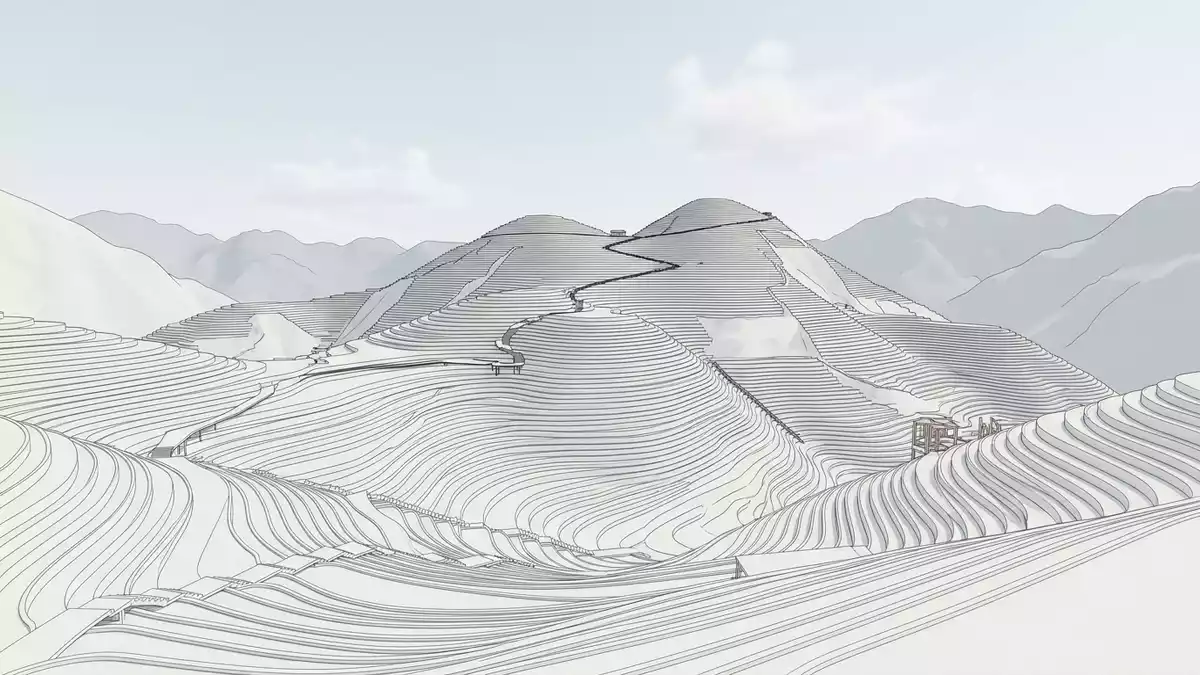
Longji Titian is a terraced rice landscape north of Guilin, spread across the slopes of Longji Mountain in Longsheng County. Its stepped fields make the hill sides read as a single cultivated form, shaped by water, earth and narrow ledges.
Terraced fields across Longji Mountain
The terraces occupy the flanks of Longji Mountain in Longji Town, within Longsheng Various Nationalities Autonomous County in the Guangxi Zhuang Autonomous Region. The fields run from valley level towards the ridges, with bands of cultivation wrapping the contours of the mountain. Longji Mountain
The name Longji refers to a dragon’s spine, and the terraces reflect that image in their long curves across the slopes. The place is associated with the Yuan, Ming and Qing dynasties, a period that gives the landscape its historical depth as well as its agricultural one. Yuan and Qing dynasties
Water, height and village edges
Seen from higher ground, the terraces form arcs and bands that follow the mountain’s shape. The elevation rises from around 300 m (984 ft) to more than 800 m (2,625 ft), giving the fields a wide vertical range across the hillside. elevation of the terraces
Ping’an Zhuang Village, Jinkeng Dazhai and Longji Ancient Zhuang Village belong to the wider terrace landscape. Paths and stairways connect homes, fields and viewpoints, while the villages sit between forested slopes and cultivated strips of land. Ping’an Zhuang Village
Longji Titian as a farming landscape
Longji Titian is closely linked to Zhuang and Yao communities in the mountains north of Guilin. Their terracing created a farming system in which the fields follow the contours of the hills and the water moves through a network of paddies and channels. Zhuang and Yao communities
Flooded paddies reflect the sky, while planted fields turn the slopes into layered green surfaces. The result is a landscape that changes in appearance with the agricultural cycle but keeps the same underlying geometry of narrow ledges and embankments.
Visiting Longji Titian: what travellers from Western Europe should know
- Longji Titian lies north of Guilin in Longsheng County, and road access leads towards Longji Town and the terrace villages.
- The terrain consists of steep hillsides, stepped fields and stairways between terraces. Walking here means dealing with height and uneven ground.
- The main named village areas are Ping’an, Dazhai and Longji Ancient Zhuang Village, each set within the wider terrace system.
- The official language is Chinese and the currency is the Chinese yuan.
- Conditions on the mountain change with the seasons; the local cable-car operators and alpine clubs provide information.
Searching for Longji Titian on social platforms
These links open searches for Longji Titian on each platform.
Frequently asked questions about Longji Titian
Where is Longji Titian?
Longji Titian lies in Longji Town, Longsheng County, north of Guilin in Guangxi, southern China. It sits on the slopes of Longji Mountain.
What does a visit involve?
The terraces are reached by road and explored on foot along paths and stairways between fields and village areas. The setting is rural, steep and layered.
What defines the place?
The defining feature is the terraced pattern itself, set across a large elevation range and linked to Zhuang and Yao agricultural practice. The landscape reads as a mountain worked into narrow horizontal bands.


