
Longhu Ta in Kaohsiung: dragon and tiger pagodas on Lotus Pond
Published on 08/31/2026 at 12:12 | Editorial responsibility: Rafael Müller, Editor-in-Chief AD HOC NEWS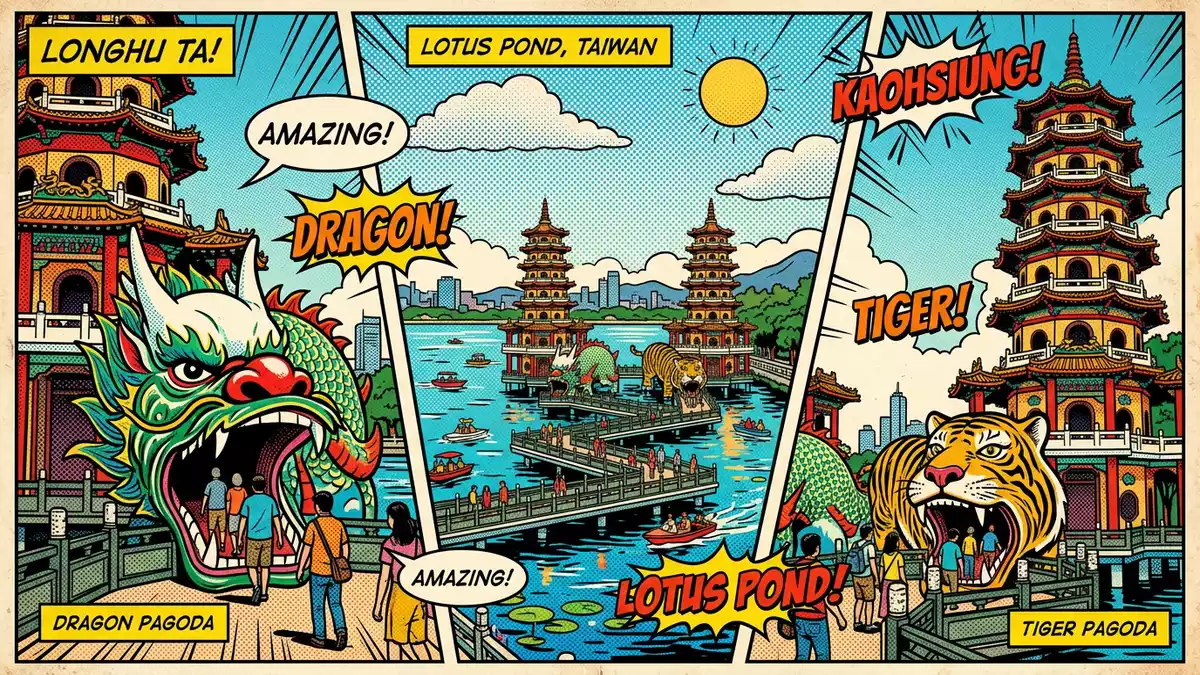
Longhu Ta in Kaohsiung is a pair of brightly coloured pagodas on the shore of Lotus Pond, fronted by a dragon and a tiger that turn religious architecture into a walkable story. Completed in 1976, the twin towers bring late twentieth-century temple construction into a historic district of southern Taiwan, adding vivid animal figures to an already dense lakeside landscape of shrines and pavilions.
Pagodas, animals and a walk into symbolism
Longhu Ta centres on two multi-storey pagoda towers rising from platforms set out over the water of Lotus Pond in Zuoying District, a northern part of Kaohsiung in southern Taiwan.The Dragon and Tiger Pagodas stand as a temple complex, with one tower associated with a dragon and the other with a tiger, their figures extending towards the shore in the form of large sculpted bodies and wide-open jaws.Lotus Lake in Zuoying District From the lakeside promenade, bridges or causeways lead directly into the mouths of these creatures, so that a visit begins by stepping through the dragon and ends by emerging from the tiger.
Each tower follows the general outline of a traditional Chinese pagoda, with stacked levels, projecting roofs and decorative details, but the ensemble around them heightens the sense of narrative. Inside the dragon and tiger corridors, wall panels show scenes tied to Taiwanese folk religion, moral stories and temple lore, so that the walk becomes a sequence of images before the visitor reaches the pagodas themselves.Dragon and Tiger Pagodas twin towers Outside, painted surfaces use strong reds, greens and yellows that contrast with the more restrained colour schemes of some neighbouring temple buildings around the lake.
Lotus Pond and the late twentieth-century temple landscape
Lotus Pond, also called Lotus Lake, is an artificial body of water lined with religious sites, and Longhu Ta forms one element in this broader temple landscape in Zuoying District.Longhu Ta pagoda in Zuoying The Dragon and Tiger Pagodas were built in 1976, adding a distinctly late twentieth-century layer to an area that already included older complexes linked by bridges and walkways around the shore.dragon and tiger towers on Lotus Pond Their vivid animal guardians sit alongside structures such as pavilions, smaller shrines and other towers that reflect different moments in Kaohsiung’s religious and urban history.
The location in Bidong Village within Zuoying means that Longhu Ta is part of a district known both for its historic significance and its transport links, including the presence of major rail stations serving Kaohsiung.Bidong Village, Zuoying District Around the lake, the path network creates a continuous circuit, and the pagodas stand on the southwestern side of the water among other temples, forming one of several points where causeways reach into the pond. From certain stretches of the shore, the twin towers, dragon and tiger appear in line with other lakeside structures, emphasising how the complex blends into a wider, carefully arranged scenic area.
Views over Kaohsiung and details of the towers
Each of the two towers at Longhu Ta rises through multiple storeys, with internal staircases leading up through successive levels towards viewing platforms that look out over Lotus Pond and the surrounding cityscape.Dragon and Tiger Pagoda seven-storey tower The upper levels of the pagodas, topped with decorative finials, create vertical accents above the relatively low buildings near the lakeshore, and from their balconies visitors can see temple roofs, water and the broader urban fabric of Kaohsiung.
Inside, the towers contain further religious imagery and structural details that echo their external themes, including statues and painted scenes linked to the dragon and tiger motifs. The combination of internal stairways, enclosed rooms and open balconies makes the climb through each pagoda a progression from lakeside walkway to higher vantage points, with the dragon and tiger figures below marking the beginning and end of the route through the complex.Inside Kaohsiung’s Drachen-und-Tiger-Pagoden
Visiting Longhu Ta: what travellers from Western Europe should know
- Longhu Ta stands beside Lotus Pond in Zuoying District, a northern part of Kaohsiung in southern Taiwan, and is reached via city transport connections to stations serving Zuoying.
- The complex involves walking along lakeside promenades, crossing bridges or causeways and moving through corridors inside the dragon and tiger figures and the pagoda towers, with staircases inside the towers.
- Lotus Pond lies in Kaohsiung, where the official language is Mandarin Chinese and the currency is the New Taiwan dollar.
- Entry requirements depend on your nationality; UK travellers can check the FCDO travel advice at gov.uk/foreign-travel-advice, Irish travellers the Department of Foreign Affairs at ireland.ie.
Searching for Longhu Ta on social platforms
These links open searches for Longhu Ta on each platform.
Frequently asked questions about Longhu Ta
Where is Longhu Ta located in Kaohsiung?
Longhu Ta stands beside Lotus Pond in Bidong Village, Zuoying District, in the northern part of Kaohsiung in southern Taiwan.
What can visitors expect when walking through Longhu Ta?
Visitors usually enter through the dragon’s mouth, follow a corridor lined with painted panels and emerge from the tiger, then climb the pagoda towers via internal staircases.
What makes Longhu Ta distinctive among Lotus Pond’s temples?
The combination of twin pagoda towers with large dragon and tiger figures, bright colour schemes and lakeside setting gives Longhu Ta a particularly bold visual presence among the surrounding temples.


