
London Eye and the slow rotation of London’s skyline
Published on 09/17/2026 at 11:06 | Editorial responsibility: Rafael Müller, Editor-in-Chief AD HOC NEWS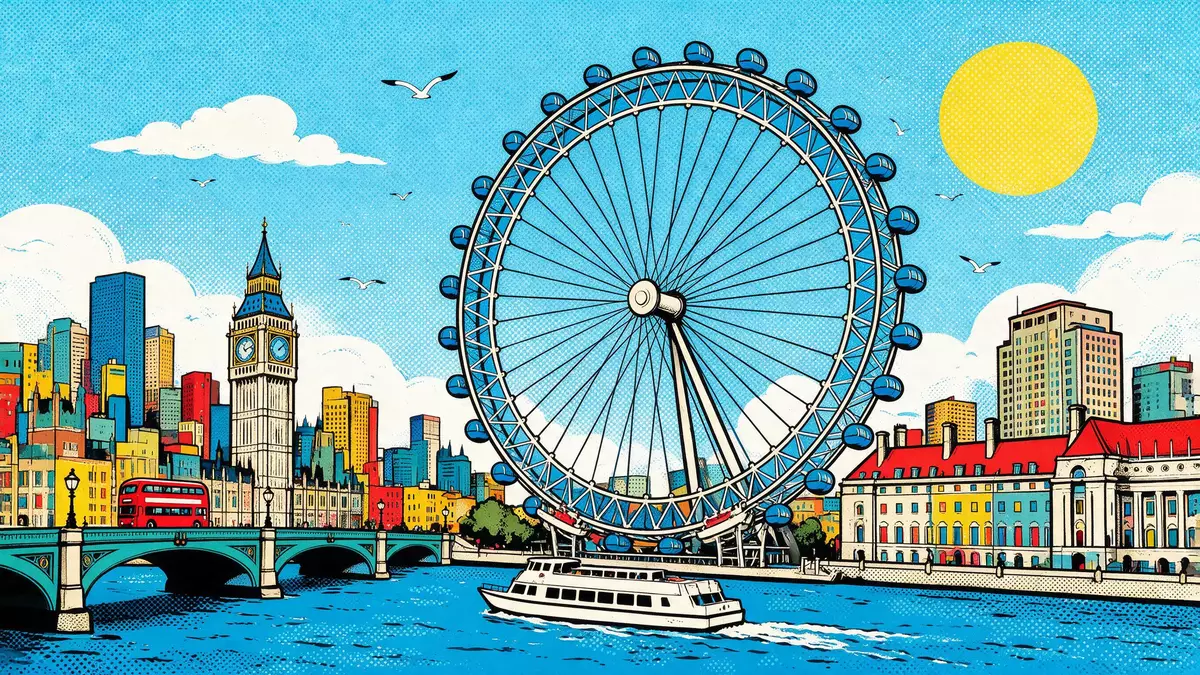
London Eye is a giant observation wheel on the South Bank of the River Thames in London, lifting enclosed glass capsules above the river and the rooftops in a slow, continuous rotation. Rising to about 135 m (443 ft), it has become a landmark of the Lambeth waterfront since it opened to the public in March 2000, offering broad views across central London from a single moving structure.
A cantilevered wheel beside the Thames
London Eye stands beside the Thames near Westminster Bridge, attached to the riverside façades of County Hall and facing the Houses of Parliament across the water. The wheel is a cantilevered observation structure, supported only on one side by a large steel frame and anchored to foundations close to the riverbank.revolving observation wheel The overall height of about 135 m (443 ft) places the rim of the wheel well above nearby buildings, and the diameter of roughly 120 m (394 ft) creates a wide circle against the skyline.135 metres tall with a 120-metre diameter
The wheel stands on the riverside terrace of the Riverside Building at County Hall, in the London Borough of Lambeth, a short distance downstream from the Palace of Westminster.towering above the South Bank From the pavement by the river, the main support frame rises at an angle, its legs leaning over the water to meet the central hub of the wheel. The structure is made of pale steel members arranged in a series of triangles and radial spokes, giving the rim a delicate appearance despite its size.
Design, construction and the Millennium
London Eye was designed by the architect team David Marks and Julia Barfield, who developed the concept in the 1990s for London’s millennium celebrations.designed by David Marks and Julia Barfield The structure was inaugurated on 31 December 1999 and opened to public visitors on 9 March 2000, marking the turn of the millennium with a new piece of engineering on the Thames.inaugurated in December 1999 and opened in March 2000 The wheel was initially known as the Millennium Wheel, reflecting its link to the year 2000, before the name London Eye came into general use.
Technically, the wheel belongs to the category of cantilevered observation structures, distinguished from traditional Ferris wheels by their one-sided support and large, enclosed capsules.cantilevered observation wheel on the South Bank Engineering texts describe how the rim, spokes and hub form a giant tensioned wheel, with cables radiating from the central hub out to the rim, distributing forces evenly around the circle. The result is a slender-looking ring that nonetheless carries significant loads from the capsules and their passengers.
Capsules, rotation and views
Around the outer edge of London Eye, a series of fully glazed passenger capsules is attached to the rim, each mounted on its own support so that it remains level as the wheel turns. There are 32 capsules, each representing one of London’s boroughs, and they are numbered from 1 to 33, omitting the number 13.32 high-tech glass pods The capsules are large enough for groups to stand and move around inside, with seating along the edges and clear panels giving an unobstructed view.
The wheel rotates slowly, completing a full turn in about 30 minutes at a speed of roughly 0.9 km (0.6 miles) per hour.leisurely pace of about 0.9 kilometres per hour Because of this measured movement, boarding usually takes place while the wheel keeps turning, with passengers stepping into the capsules from a platform that follows the curve of the rim. From the upper part of the rotation, on a clear day, the view extends across central London and out towards Windsor Castle, while nearby landmarks such as Big Ben, the Houses of Parliament, St Paul’s Cathedral and Buckingham Palace sit within the immediate panorama.views to London landmarks and beyond
Visiting London Eye: what travellers from Western Europe should know
- London Eye stands on the South Bank of the Thames in Lambeth, next to County Hall and close to Westminster Bridge, and is reached on foot from nearby rail and Underground stations.
- The approach from the riverside walkway includes broad external steps and level paved areas; boarding involves walking across a gently moving platform into the enclosed capsules.
- London is in the United Kingdom, where the official language is English and the currency is the pound sterling.
- From the wheel, the river curves past Westminster and towards Waterloo Bridge, with other central London sights within walking distance along the embankment.
Searching for London Eye on social platforms
These links open searches for London Eye on each platform.
Frequently asked questions about London Eye
Where is London Eye located in London?
London Eye is on the South Bank of the River Thames in the London Borough of Lambeth, next to County Hall and near Westminster Bridge.
What should visitors expect during a rotation?
Visitors stand inside large glass capsules that move slowly around the rim of the wheel, with a full rotation taking about 30 minutes at a gentle, continuous pace.
What makes London Eye distinctive among city viewpoints?
Its cantilevered design, single giant wheel and enclosed capsules combine into a moving viewpoint around 135 m (443 ft) above the river, giving a broad circular view of London.


