
London Eye and the quiet drama of London’s riverside wheel
Published on 08/26/2026 at 16:19 | Editorial responsibility: Rafael Müller, Editor-in-Chief AD HOC NEWS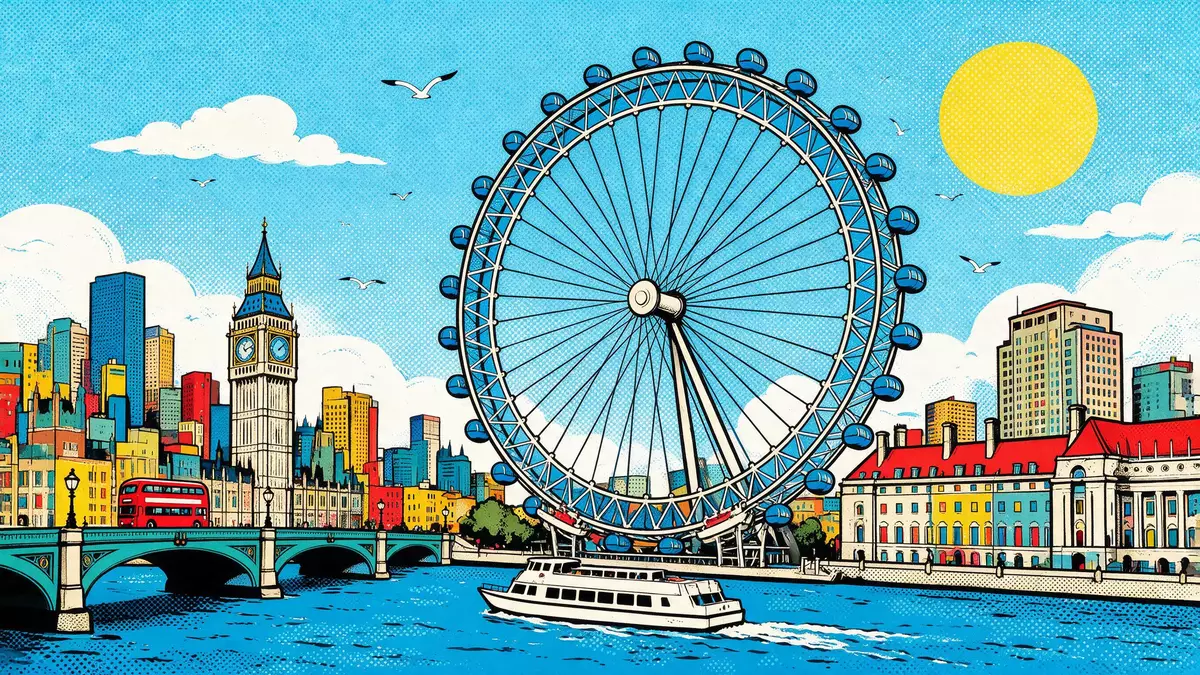
Rising above the South Bank of the River Thames, London Eye turns a familiar fairground form into an immense riverside landmark, its steel wheel set beside the water and the lawns of Jubilee Gardens. The cantilevered structure, standing 135 m (443 ft) tall with a wheel diameter of 120 m (394 ft), has become a fixed point in London’s skyline and a frame through which the city’s towers, domes and terraces are seen from above.Standing at 135 metres tall
A riverside wheel anchored to the Thames
London Eye stands on the western edge of Jubilee Gardens on the South Bank, in the London Borough of Lambeth, between Westminster Bridge and Hungerford Bridge.Located at the western end of Jubilee Gardens The wheel’s outline rises behind the riverside walkway known as Queen’s Walk, with water, bridges and the Houses of Parliament forming its immediate backdrop. From the riverside the structure reads as an immense circle of tubular steel held upright beside the riverbank, supported on one side by a large A-frame that leans back towards the land.
The observation wheel is classed as a cantilevered structure, meaning it is supported from one side rather than from both, an arrangement that leaves the riverward side visually open.Cantilevered observation wheel on the South Bank The rings and radial cables form a lattice of white-painted steel, while the passenger capsules sit around the rim like glass bubbles. At ground level the base blends into Jubilee Gardens and the neighbouring Riverside Building, creating a transition from lawn and trees to steel and glass that is crossed by paths, ramps and staircases.
Capsules, rotations and the experience of height
Around the wheel, thirty-two sealed passenger capsules form the points from which the city is observed.The wheel features 32 cabins Each capsule is mounted outside the main rim and is designed to remain level as the wheel turns, so the floor becomes a slowly moving viewing platform rather than a sloping surface. The capsules use glass extensively, with wide areas of transparent wall giving clear views across the river and along the line of bridges and rooftops.
The wheel’s rotation is slow, taking about 30 minutes for a full circuit, and the movement is continuous.A full rotation takes 30 minutes As the capsules rise, the view expands from immediate details of the Thames embankments and nearby buildings to wider sweeps of central London, with landmarks such as Buckingham Palace and Westminster Abbey visible from higher points on clear days.Landmarks visible from its peak The sense of height is reinforced by the wheel’s position close to the riverbank, where the contrast between water level and capsule level is easy to read.
Millennium origins and a permanent presence
London Eye was conceived as a structure marking the turn of the millennium and is traditionally dated to a formal opening on 31 December 1999, with public access beginning in March 2000.Formally opened on 31 December 1999 At the time of its completion the wheel was the tallest of its type, and the form “Millennium Wheel” reflected its connection to the celebrations around the year 2000.Originally known as the Millennium Wheel
The structure’s initial planning consent treated it as a temporary addition to the skyline, but its role beside the Thames and its integration with Jubilee Gardens and the South Bank have made it a lasting part of the city’s riverside landscape.Initially designed to be a temporary structure The wheel’s design and construction involved off-site fabrication of major components, which were then assembled and raised into position over the river, an engineering process that underlined the scale of the finished structure.Constructed flat and pulled up in 1998 Since its opening, London Eye has become one of the most recognisable built forms in London, representing a distinct period in the city’s architectural and engineering history.
Visiting London Eye: what travellers from Western Europe should know
- London Eye stands on the South Bank of the River Thames, at the western side of Jubilee Gardens in the London Borough of Lambeth, opposite the Palace of Westminster.
- The wheel is reached along level riverside paths and paved areas, with staircases and ramps linking the riverside walk to the base and the neighbouring Riverside Building.
- Waterloo Station, a major National Rail and London Underground interchange, lies inland from the South Bank and provides rail and Underground access to the area around London Eye.
- The official language is English and the currency is the pound sterling.
Searching for London Eye on social platforms
These links open searches for London Eye on each platform.
Frequently asked questions about London Eye
Where is London Eye located in London?
London Eye stands on the South Bank of the River Thames in the London Borough of Lambeth, at the western side of Jubilee Gardens between Westminster Bridge and Hungerford Bridge.
What does a visit to London Eye involve?
A visit centres on boarding one of the enclosed glass capsules, which rotate slowly around the wheel, giving around half an hour of changing views across the river and central London.
What makes London Eye distinctive among city landmarks?
Its height, cantilevered structure and riverside position combine to form a prominent wheel that both shapes the skyline and serves as an elevated vantage point over London’s historic and modern architecture.


