
Livraria Lello and the sculpted staircase of Porto
Published on 09/03/2026 at 08:17 | Editorial responsibility: Rafael Müller, Editor-in-Chief AD HOC NEWS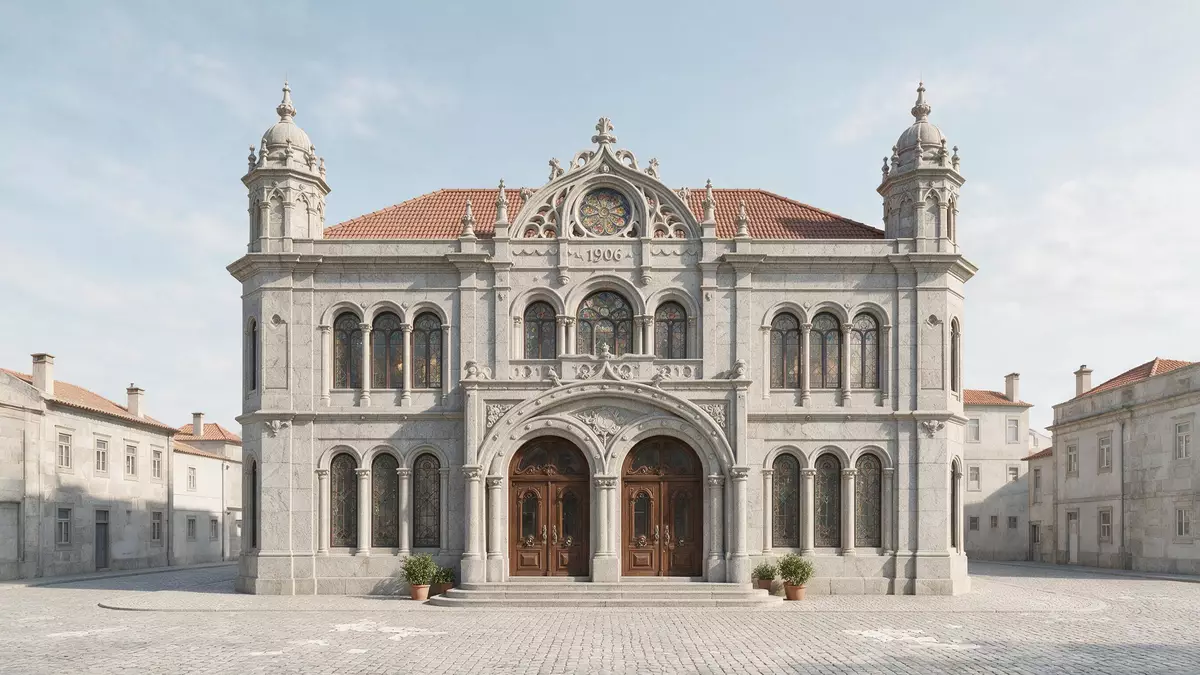
Livraria Lello in Porto is a working bookshop and a piece of theatrical architecture, where a sculpted staircase, stained glass and carved woodwork turn the act of browsing into a spatial experience. Opened on 13 January 1906 in a neo-Gothic building by Portuguese engineer Francisco Xavier Esteves, it links a long-running book trade with one of the most distinctive interiors in Portugal.
A neo-Gothic façade on Rua das Carmelitas
Livraria Lello stands on Rua das Carmelitas, in central Porto, a short walk from the Clérigos Tower and the university buildings around Praça de Lisboa.R. das Carmelitas 144, Porto is the formal address often cited for the bookshop, placing it within the dense urban fabric of the old city centre. The building presents a narrow street frontage, flanked by other shops, yet the composition of the façade gives it a clear identity even in a busy streetscape.
The exterior is widely described as neo-Gothic with Art Nouveau influences, a mix visible in pointed forms and flowing ornament.Neo-Gothic architecture enriched with Art Nouveau shapes the way the façade reads from the street. Above the ground-floor entrance, sculpted stonework frames a large window that brings daylight towards the upper level. Painted figures associated with Art and Science appear on the frontage in some descriptions, tying the decoration directly to the world of books and ideas.Figures representing Science and Art help viewers read the façade as a celebration of knowledge rather than merely a signboard for a shop.
Inside the sculpted world of books
Stepping inside Livraria Lello brings a sudden change of scale, from the flat geometry of the street to an interior where surfaces bend, twist and layer around a central void. Bookshelves climb the walls, and carved timber surrounds the circulation space, framing views between the ground floor and the upper gallery. A stained glass skylight above the main hall washes the interior with coloured light and carries the Latin motto “Decus in Labore”, commonly translated as “Dignity in Work”.A large stained glass window with the motto anchors the ceiling composition and identifies the space as more than purely commercial.
The most striking feature is the central staircase, which rises in a sweeping curve from the ground floor to the upper level. Its underside and balustrades are modelled with a sculptural freedom that makes the structure read almost as a piece of furniture on a grand scale. Although many visitors read it as carved wood, the stair was built using reinforced concrete, a relatively advanced material in Porto at the beginning of the twentieth century.One of the first concrete staircases built in Portugal is how the bookshop itself describes this element. The concrete core is then finished so that the surfaces align visually with the surrounding timber, blurring the line between structure and ornament.
Book trade, concrete and twentieth-century Porto
The story of Livraria Lello as a company reaches back into the nineteenth century and to Ernesto Chardron, a French bookseller and publisher active in Porto. Chardron’s firm, associated with works by authors such as Camilo Castelo Branco and Eça de Queirós, grew into an important presence in the Portuguese book world.Ernesto Chardron’s nineteenth-century publishing house was eventually acquired by brothers José and António Lello in the 1890s, giving them both a catalogue and an existing clientele. The commercial continuity from Chardron to the Lello firm means that the 1906 building crowns a longer trajectory rather than a sudden appearance.
Francisco Xavier Esteves, the engineer behind the new building, worked with reinforced concrete at a time when it was still novel in the city’s architecture.The Lello bookstore as one of Porto’s early reinforced-concrete structures is a recurring point in architectural accounts. Esteves combined this modern structural material with the more historicist language of pointed tracery, ornate timber and stained glass. The result is a building that connects the industrial capabilities of the early twentieth century with a façade and interior that speak the language of Gothic revival and Art Nouveau. Inside, busts of Portuguese writers such as Antero de Quental, Eça de Queirós and Guerra Junqueiro appear along the shelves,busts of renowned Portuguese writers linking the architecture directly to the national literary canon.
Visiting Livraria Lello: what travellers from Western Europe should know
- Livraria Lello stands on Rua das Carmelitas in central Porto, close to the Clérigos Tower and the university buildings around Praça de Lisboa. The nearest São Bento railway station connects the area with other parts of the city.
- The entrance from Rua das Carmelitas leads directly into the bookshop’s ground floor. Inside, the central staircase includes several flights, and the upper gallery is reached only by stairs.
- The official language in Portugal is Portuguese and the currency is the euro.
- Livraria Lello lies within the European Union. Entry requirements depend on your nationality; UK travellers can check the FCDO travel advice at gov.uk/foreign-travel-advice, Irish travellers the Department of Foreign Affairs at ireland.ie.
Searching for Livraria Lello on social platforms
These links open searches for Livraria Lello on each platform.Frequently asked questions about Livraria Lello
Where is Livraria Lello located in Porto?
Livraria Lello stands on Rua das Carmelitas in central Porto, close to the Clérigos Tower and the university buildings around Praça de Lisboa.
What can visitors expect inside Livraria Lello?
Visitors encounter a richly ornamented interior with high bookshelves, a sweeping reinforced-concrete staircase finished to resemble carved wood, and a stained glass skylight bearing the motto “Decus in Labore”.
What makes Livraria Lello distinctive among bookshops?
The combination of a neo-Gothic and Art Nouveau architectural language, an early concrete structure, and close links to Porto’s publishing history gives Livraria Lello a character that is unusual among bookshops.


