
Livraria Lello and its sculpted world of books in Porto
Published on 09/08/2026 at 15:23 | Editorial responsibility: Rafael Müller, Editor-in-Chief AD HOC NEWS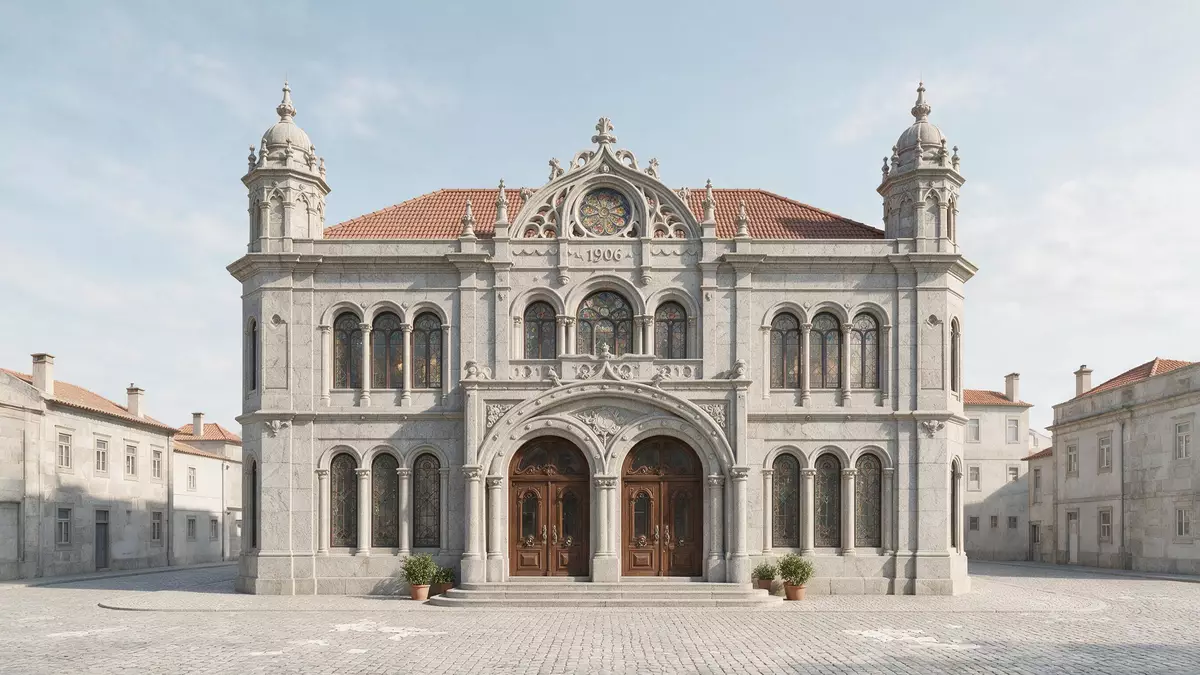
Livraria Lello in Porto is a bookshop where architecture and literature share the stage, a neo?Gothic structure whose carved surfaces and sweeping staircase make the building itself part of the visit. Opened on 13 January 1906 and attributed to engineer Francisco Xavier Esteves, it belongs to an early twentieth?century moment when publishers and booksellers in Portugal were giving their premises conspicuously decorative facades and interiors.
A neo?Gothic facade in Rua das Carmelitas
Livraria Lello stands at number 144 Rua das Carmelitas in Porto’s historic centre, between neighbouring townhouses and close to the baroque Torre dos Clérigos, so the bookshop reads as one piece within a dense urban block of narrow streets and mid?rise buildings.Rua das Carmelitas, 144 From the street the facade presents a composition shaped by Gothic revival vocabulary: pinnacles rising above the roofline, vertical elements that frame the central bay, and tracery above the upper windows that adds a fine?grained pattern to the wall surface.mixed neo?Gothic and Art Nouveau elements
Art Nouveau currents are visible alongside this Gothic outline, particularly in the flowing lines of painted decoration and the way ornamental motifs intertwine with structural members. The facade integrates figurative reliefs, stained glass and typography, linking the exterior directly to the world of books and publishing without resorting to literal signage alone.Neo-Gothic with Art Nouveau characteristics Set among more restrained frontages on the street, Livraria Lello’s elevation still reads as an emphatically ornamental piece of early twentieth?century architecture.
Inside the sculpted world of books
Crossing the threshold, the visitor enters a single?volume interior organised around a central staircase, with bookcases rising along the walls and galleries running at upper level. The structural framework makes extensive use of timber, with moulded balustrades, panelled ceilings and carved supports combining to give the interior a layered, almost theatrical character.mixed Neo-Gothic and Art Nouveau elements inside The staircase itself, celebrated in countless photographs, curves through the space and links the ground floor to the gallery, and its underside and balustrades are treated as surfaces for ornamental carving rather than plain structural members.
Light filters down from stained glass overhead, including a prominent window that incorporates the bookshop’s name and emblem, so colour and pattern play against the warm tone of the timber and the line of the shelving.joinery and stained glass unparalleled in the country Cast?iron and reinforced?concrete elements are also part of the construction, reflecting the period in which the building was erected, when such materials were becoming common in Porto’s commercial architecture.reinforced concrete structure Books occupy wall?mounted shelves, freestanding units and tables, so that the merchandise and the architectural surfaces together form a continuous field of texture.
From Chardron’s enterprise to a classified monument
The commercial story behind Livraria Lello reaches back to the nineteenth century and to the Livraria Internacional de Ernesto Chardron, a bookshop and publishing house founded in Porto in 1869, which laid the foundations for later activity by the Lello family.Livraria Internacional de Ernesto Chardron, founded in 1869 Over subsequent decades the business changed hands and eventually came under the control of brothers José and António Lello, who developed it as both a retail bookshop and a publishing concern before commissioning new premises on Rua das Carmelitas.brothers José and António Lello
The present building was designed by Francisco Xavier Esteves and inaugurated on 13 January 1906 at an event attended by writers, artists and public figures, including Guerra Junqueiro and Aurélio Paz dos Reis, a pioneer of Portuguese cinema.opening on 13 January 1906 under Francisco Xavier Esteves In 2013 the Portuguese authorities classified Livraria Lello as a Monument of Public Interest, recognising it as an important example of Portuguese eclectic architecture that integrates stained glass and timber work of notable quality.Monument of Public Interest classification in 2013 The bookshop therefore stands both as a working retail space and as part of Portugal’s protected architectural heritage.
Visiting Livraria Lello: what travellers from Western Europe should know
- Livraria Lello is located at Rua das Carmelitas 144 in Porto, in the historic centre near the Torre dos Clérigos and the university district, and is reached on foot from nearby streets and squares.
- The building’s interior is arranged on multiple levels linked by the central staircase and further steps, so a visit involves walking between floors on stairways that can feel narrow when many people are present.
- Porto lies on the Douro River in northern Portugal and is served by Francisco Sá Carneiro Airport and both suburban and mainline railway services, with urban transport bringing travellers to the vicinity of Rua das Carmelitas.
- The official language is Portuguese and the currency is the euro.
Searching for Livraria Lello on social platforms
These links open searches for Livraria Lello on each platform.
Frequently asked questions about Livraria Lello
Where is Livraria Lello in Porto?
Livraria Lello stands at Rua das Carmelitas 144 in Porto’s historic centre, near the Torre dos Clérigos and within walking distance of other central landmarks.
What can visitors expect inside Livraria Lello?
Visitors encounter a multi?level bookshop arranged around a sculpted central staircase, with shelves, galleries, stained glass and carved timber forming a unified, highly decorated interior.
What makes Livraria Lello distinctive among bookshops?
Livraria Lello is distinctive because its early twentieth?century building by Francisco Xavier Esteves merges neo?Gothic and Art Nouveau forms, earning classification as a Monument of Public Interest as well as continuing to function as a working bookshop.


