

Lineas de Nazca, the great geoglyphs of the Peruvian desert
Published on 09/17/2026 at 13:06 | Editorial responsibility: Rafael Müller, Editor-in-Chief AD HOC NEWS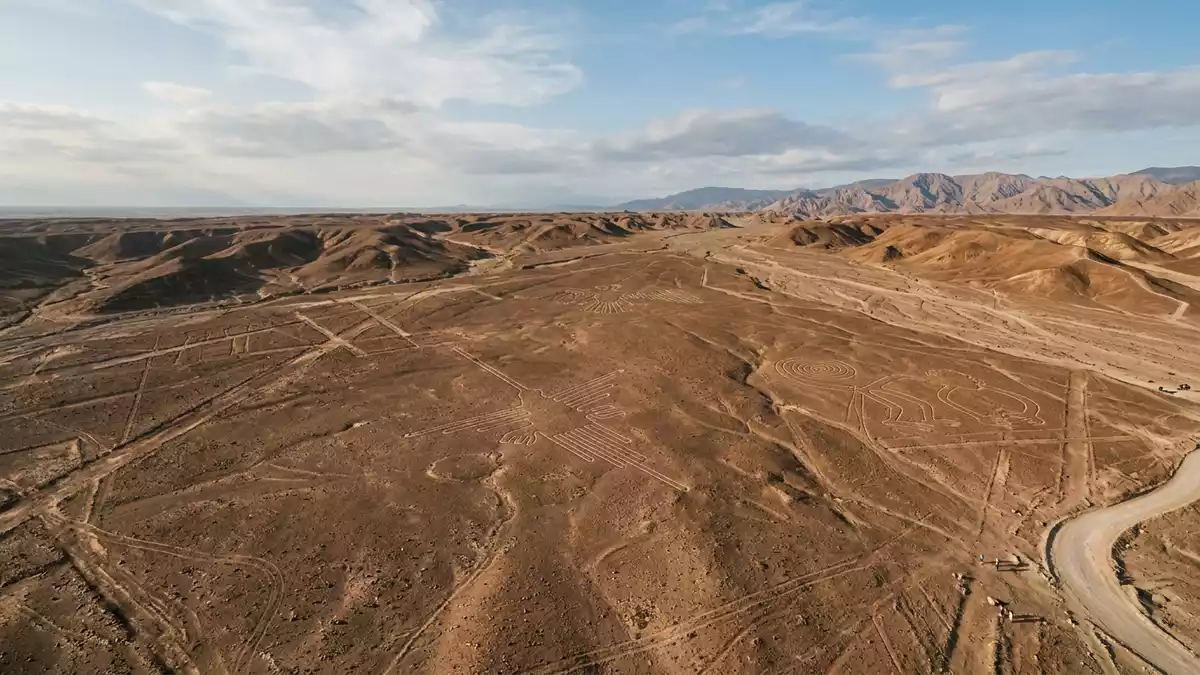
The Lineas de Nazca, better known internationally as the Nazca Lines, form an immense field of ancient ground drawings in the desert near Nazca in southern Peru. Stretching across the coastal plain between Nazca and Palpa, these geoglyphs were created by pre-Columbian cultures between roughly the first millennium BC and the first millennium AD, leaving a landscape-scale record on the pampas that remains visible from the air.
A desert plain turned into a drawn landscape
The Lineas de Nazca lie on a high, dry plateau of the Nazca Desert, part of the coastal plain of the Ica region about 400 km south of Lima. The plateau, known as the Pampas de Jumana, extends for more than 80 km between Nazca and Palpa, forming an open expanse where the geoglyphs spread across the ground.high arid plateau The climate is extremely arid, with minimal rainfall, a factor that has helped preserve the lines for centuries.
Each figure is formed by removing the dark, oxidised pebbles that cover the desert surface and exposing the lighter soil underneath, creating a contrast that reads as a line from above.clearing away the dark red top soil The technique is simple in principle yet demands coordinated work on the ground to keep the lines straight over long distances and maintain proportions in the larger figures.
Ancient cultures and the timescale of the geoglyphs
The geoglyphs belong mainly to the Nazca culture, an Andean society that flourished in southern Peru during the Early Intermediate Period, roughly from 200 BC to around AD 600.Nazca culture c. 200 BCE–600 CE Some earlier figures in the region are associated with the Paracas culture, indicating that drawing on the desert plain was a practice spanning several centuries and at least two cultural traditions.
UNESCO describes the Lines and Geoglyphs of Nasca and Palpa as a cultural property inscribed on the World Heritage List in 1994, recognising their archaeological significance and the scale of the landscape they occupy.inscribed on the World Heritage List in 1994 The protected area covers around 450 km² of desert plains and low foothills where hundreds of figures have been identified.cover about 450 km2
Lines, shapes and figures on the Nazca plateau
The Lineas de Nazca comprise several types of geoglyphs, ranging from long straight lines to geometric patterns and stylised representations of animals and plants.straight lines, geometric patterns and animal figures Some lines run across the plateau for kilometres, cutting through low hills and shallow valleys, while geometric forms include trapezoids, spirals and other angular shapes laid out on the desert surface.
Animal figures such as birds, a spider and a monkey have become among the most recognised images of the Nazca plateau, their outlines formed by single continuous paths cut into the gravel. From ground level, many of these figures are difficult to discern in full, but their proportions unfold when viewed from surrounding higher terrain or from aircraft, revealing the scale at which the designers worked across the open desert.
Visiting Lineas de Nazca: what travellers from Western Europe should know
- The Lineas de Nazca lie near the town of Nazca in southern Peru’s Ica region, on the coastal desert plain some distance south of Lima and inland from the Pacific.
- The geoglyphs occupy an exposed plateau of desert gravel and low hills, with viewpoints on higher ground and access routes that cross open terrain under strong sun.
- The official language is Spanish and the currency is the Peruvian sol.
- Entry requirements depend on your nationality; UK travellers can check the FCDO travel advice at gov.uk/foreign-travel-advice, Irish travellers the Department of Foreign Affairs at ireland.ie.
Searching for Lineas de Nazca on social platforms
These links open searches for Lineas de Nazca on each platform.
Frequently asked questions about Lineas de Nazca
Where are the Lineas de Nazca located?
The Lineas de Nazca are located on the Nazca Desert plateau between Nazca and Palpa in southern Peru’s Ica region, on the arid coastal plain.
What can visitors expect to see at the site?
Visitors encounter long straight lines, geometric figures and large animal and plant shapes cut into the desert gravel, spread across an expansive plateau of dry ground.
What makes Lineas de Nazca distinctive among archaeological sites?
The site is distinctive because the geoglyphs form a coordinated landscape of drawings visible at the scale of the desert, created over centuries by ancient cultures.


