
Lineas de Nazca and the vast canvas of the Peruvian desert
Published on 08/29/2026 at 09:04 | Editorial responsibility: Rafael Müller, Editor-in-Chief AD HOC NEWS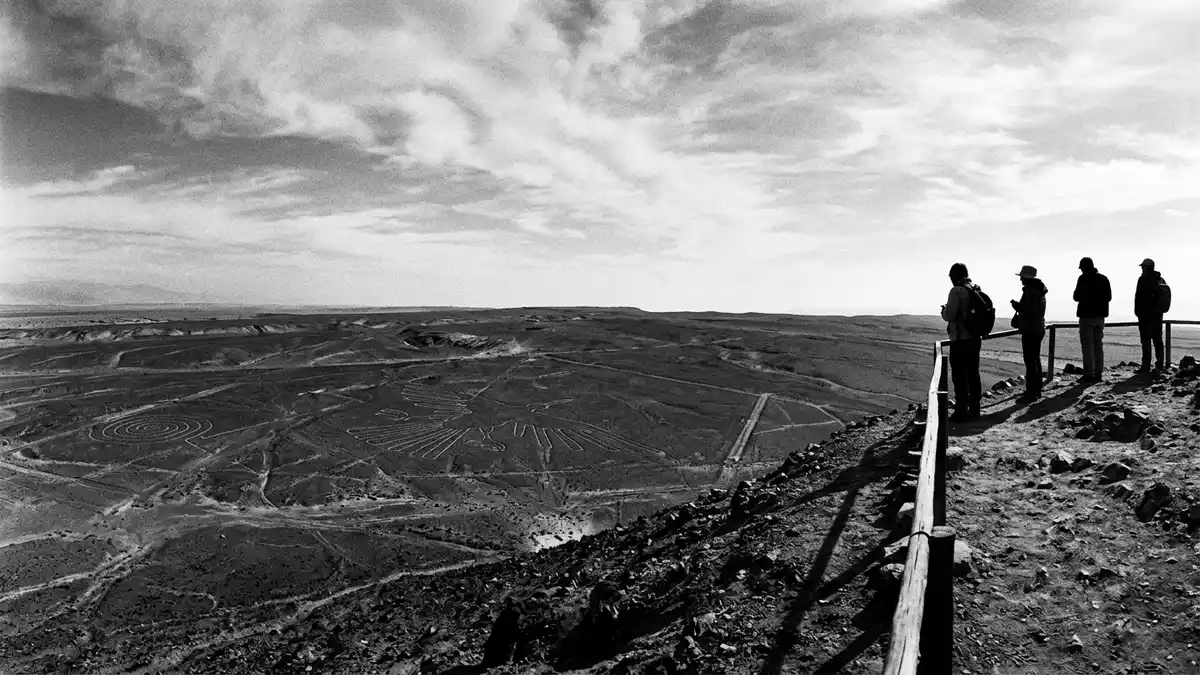
Lineas de Nazca in southern Peru is a colossal artwork drawn directly onto an arid desert plateau, turning the pampas between Nazca and Palpa into an open-air gallery of lines, animal figures and geometric forms created by pre-Hispanic societies between the first millennium BC and the first millennium AD.
A desert plateau turned into a giant drawing
The Nazca Desert forms part of the coastal plain of southern Peru, a high, dry plateau that stretches for many kilometres between Nazca and Palpa and lies several hundred kilometres south of Lima. On this plateau the ground is covered with dark, reddish pebbles, and the geoglyphs of Lineas de Nazca were created by removing these stones to expose the paler soil beneath, producing sharply defined designs that stand out against the surrounding desert surface.the pale underlying soil The combination of aridity and minimal wind on this plateau has preserved the geoglyphs over many centuries.
The geoglyphs occupy a broad area of desert plains associated with the Rio Grande de Nasca basin and Pampas de Jumana, forming a cultural landscape that extends across tens of thousands of hectares. Within this landscape lie thousands of individual lines and figures, including long straight alignments that run across the plateau for many kilometres and more compact concentrations of designs gathered in rectangular zones near desert hamlets. The setting is open and exposed, with low hills rising from the plain and distant Andean foothills visible beyond the plateau.the desert plains of the basin river of Rio Grande de Nasca
Ancient geoglyphs and their makers
Lineas de Nazca consist of geoglyphs created between about 500 BC and AD 500, a period that saw the Paracas phase followed by the Nazca phase of activity on the plateau.two major phases of the Nazca lines These designs are associated with the Nazca culture, which flourished in southern Peru in the first millennium AD, and with earlier Paracas communities that were already shaping the desert surface several centuries before. Over roughly 2,000 years of intermittent activity, generations of inhabitants etched animals, plants, imaginary beings and geometric figures into the ground, turning the plateau into a ritual and symbolic landscape.for nearly 2,000 uninterrupted years
The figures themselves range from simple straight lines and bands to complex zoomorphic and anthropomorphic forms, many of them large enough to be best appreciated from the air. Among them are representations of creatures such as birds and spiders, alongside stylised plants and abstract shapes whose geometry extends over several kilometres. The combined length of the straight lines reaches well beyond 1,000 km, and the full ensemble covers many tens of square kilometres of desert plateau, making Lineas de Nazca one of the largest known assemblies of geoglyphs in the world.the combined length of all the lines
Lineas de Nazca as a protected cultural landscape
In 1994 Lineas de Nazca and the associated geoglyphs of Palpa and Pampas de Jumana were inscribed on the UNESCO World Heritage List under the title “Lines and Geoglyphs of Nasca and Palpa”, recognising them as an outstanding example of the magical?religious world of ancient societies on the Peruvian south coast.Lines and Geoglyphs of Nasca and Palpa The inscription identifies the area as a cultural site and records its extent in hectares, its location in the Ica Region and its association with pre-Hispanic ritual practices and astronomical expressions.
The protected area forms a defined zone on the desert plateau where geoglyphs are found both on the open pampas and on adjacent slopes and low hillsides. Within this zone, long straight alignments, sweeping bands and large figures co-exist with lesser-known, smaller relief-style designs that follow ancient trails and paths. The combination of broad plateau lines and hillside figures gives travellers a sense of how the entire landscape was used as a medium for symbolic marking over many centuries, and why it is treated as a single cultural landscape rather than a collection of isolated drawings.Nasca geoglyphs have intrigued scientists
Visiting Lineas de Nazca: what travellers from Western Europe should know
- Lineas de Nazca lie near the town of Nazca in the Ica Region of southern Peru, several hundred kilometres south of Lima along the coastal Pan?American Highway.
- The plateau where the geoglyphs are found is an arid desert plain with loose stones underfoot and little natural shade, and some viewpoints require walking short distances on uneven ground.
- The surrounding region forms part of the Peruvian coastal desert, with high daytime temperatures and strong sunlight, and vantage points are exposed to wind and dust on the open plateau.
- The official language is Spanish and the currency is the Peruvian sol.
- Entry requirements depend on your nationality; UK travellers can check the FCDO travel advice at gov.uk/foreign-travel-advice, Irish travellers the Department of Foreign Affairs at ireland.ie.
Searching for Lineas de Nazca on social platforms
These links open searches for Lineas de Nazca on each platform.
Frequently asked questions about Lineas de Nazca
Where are Lineas de Nazca?
Lineas de Nazca are located on the Nazca Desert plateau in the Ica Region of southern Peru, between Nazca and Palpa and several hundred kilometres south of Lima.
What can travellers expect on a visit?
Travellers encounter an arid desert landscape with long straight lines and large figures etched into the ground, viewed from desert viewpoints and, in some cases, from elevated platforms.
What makes Lineas de Nazca distinctive?
Lineas de Nazca are distinctive as a vast concentration of ancient geoglyphs created over centuries by pre-Hispanic cultures, covering a large desert plateau with thousands of designs.


