
Lineas de Nazca and the desert drawings of southern Peru
Published on 09/12/2026 at 15:58 | Editorial responsibility: Rafael Müller, Editor-in-Chief AD HOC NEWS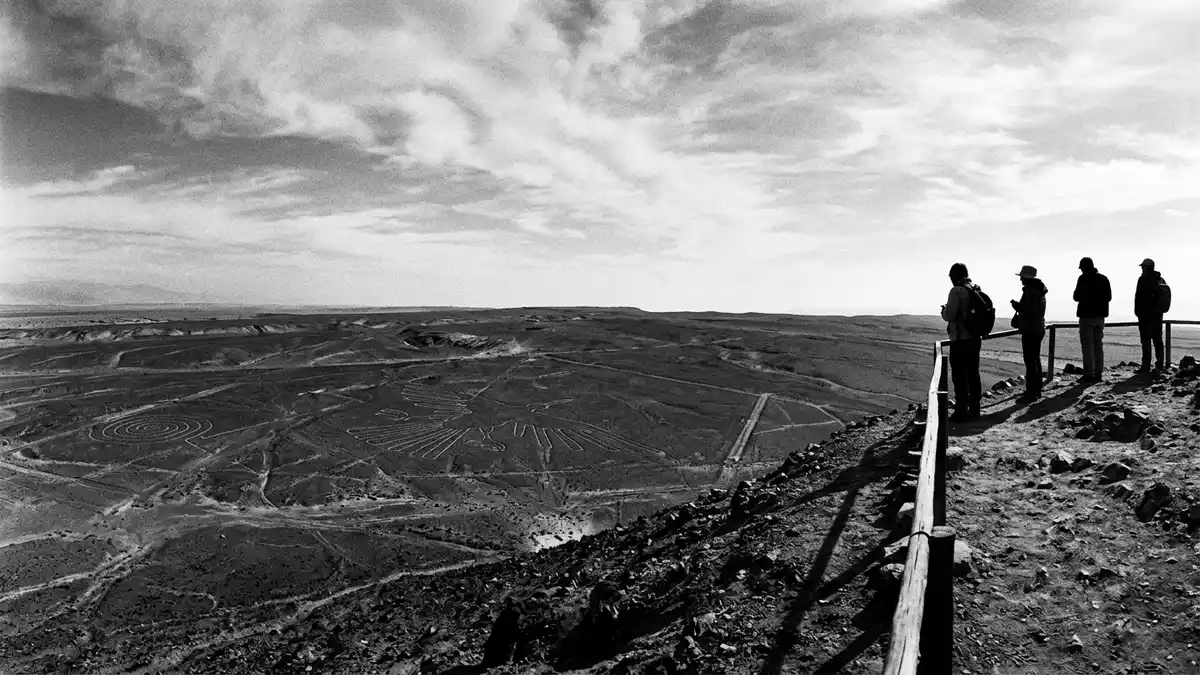
Lineas de Nazca, better known in English as the Nazca Lines, form a vast field of ancient geoglyphs etched into the desert plateau near Nazca in southern Peru. The lines and figures belong to pre-Hispanic societies whose activity on this high, arid plain is dated between about 500 BC and AD 500, and the site has been recognised as a UNESCO World Heritage Site since 1994.
A desert canvas between Andes and Pacific
Lineas de Nazca lie on the coastal desert of southern Peru, on a plateau between the towns of Nazca and Palpa in the Ica Region. The plateau forms part of the wider arid Peruvian coastal plain, about 400 km south of Lima, and stretches across pampas such as Jumana and San José where the ground is covered in a dark layer of pebbles.
The geoglyphs themselves are created by removing this darker surface to reveal lighter soil beneath, producing lines that stand out against the surrounding desert. Over an area measured in hundreds of square kilometres, the result is a landscape where straight lines, geometric forms and figurative drawings run across the plateau, visible as coherent designs when seen from above.arid Peruvian coastal plain
Ancient geoglyphs and their forms
Lineas de Nazca are composed of geoglyphs ranging from simple straight lines to complex zoomorphic and plant forms. Sources describing the site count more than 800 straight lines alongside hundreds of geometric shapes and several dozen animal, plant and human figures, all created by shallow incisions in the desert floor.over 800 straight lines Commonly cited figures include a hummingbird, a monkey, a spider and various birds, with some individual drawings extending for hundreds of metres across the ground.figures such as the hummingbird
Archaeological studies link the bulk of the geoglyphs to the Nazca culture, which flourished on the south coast of Peru in the first millennium AD, while some lines and figures predate this period and are attributed to earlier cultures such as the Paracas. The geoglyphs were created over several centuries, and in places later lines intersect or overlap earlier ones, adding to the density of designs on the ground.Nazca culture on the south coastcreated between 1 and 700 CE
World Heritage status and the wider landscape
Lineas de Nazca form part of the property officially inscribed on the World Heritage List as “Lines and Geoglyphs of Nasca and Palpa”. UNESCO describes the site as an outstanding group of geoglyphs that covers about 450 km² within the desert plains of the Nasca and Palpa provinces.Lines and Geoglyphs of Nasca and Palpa This inscription, made in 1994, reflects both the extraordinary scale of the drawings and their role within the ritual and cultural life of ancient societies on the Peruvian south coast.designated a UNESCO World Heritage Site in 1994
The surrounding landscape combines the flat desert plateau with low Andean foothills and the broader coastal strip facing the Pacific Ocean. Within this setting, Lineas de Nazca sit among other archaeological sites of the Ica Region, contributing to a wider cultural landscape of temples, settlements and geoglyph fields that extends along the south Peruvian coast.pampas of Jumana between Nazca and Palpa
Visiting Lineas de Nazca: what travellers from Western Europe should know
- Lineas de Nazca lie near the town of Nazca in the Ica Region of southern Peru, with geoglyphs extending towards Palpa along the coastal plateau and beside major overland routes.
- The plateau where the geoglyphs are found is a dry, open desert plain with exposed soil and pebbles, and viewpoints involve standing on elevated structures or nearby slopes rather than on level urban ground.
- Lineas de Nazca are in Peru, where the official language is Spanish and the currency is the Peruvian sol.
- Entry requirements depend on your nationality; UK travellers can check the FCDO travel advice at gov.uk/foreign-travel-advice, Irish travellers the Department of Foreign Affairs at ireland.ie.
Searching for Lineas de Nazca on social platforms
These links open searches for Lineas de Nazca on each platform.
Frequently asked questions about Lineas de Nazca
Where are Lineas de Nazca located?
Lineas de Nazca are in the Nazca Desert of southern Peru, on the pampas between Nazca and Palpa in the Ica Region, about 400 km south of Lima.
What can visitors expect when viewing Lineas de Nazca?
Visitors encounter a dry desert plateau marked by long straight lines and large figures on the ground, observed from elevated viewpoints that reveal the overall designs.
What makes Lineas de Nazca distinctive among archaeological sites?
The combination of hundreds of large geoglyphs, their creation between about 500 BC and AD 500, and their inscription as a UNESCO World Heritage Site gives Lineas de Nazca a distinctive place in the archaeology of the Peruvian south coast.


