
Lineas de Nazca and the desert drawings of southern Peru
Published on 09/08/2026 at 18:23 | Editorial responsibility: Rafael Müller, Editor-in-Chief AD HOC NEWS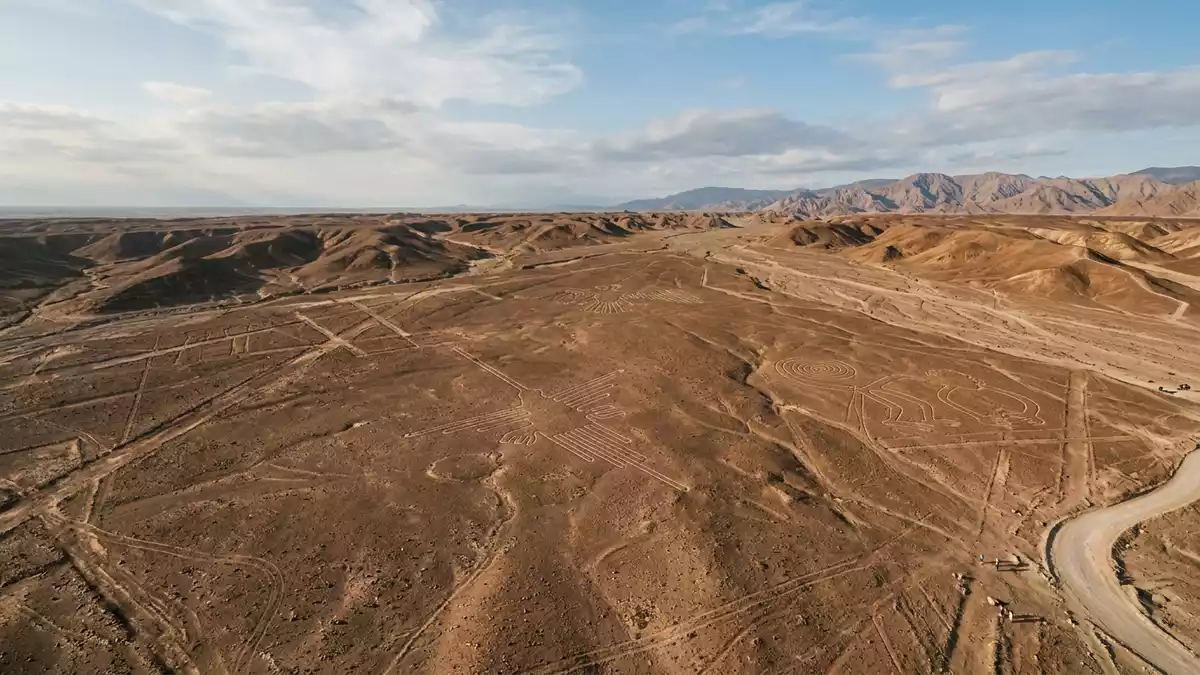
Lineas de Nazca, the Nazca Lines, spreads across the arid coastal plain of southern Peru as a vast field of geoglyphs scratched into pale ground. The site lies near Nazca and carries the UNESCO World Heritage status shared with Palpa.
Desert drawings across the plain
The strongest impression comes from scale. Straight lines run for kilometres, while animal and plant figures lie scattered across the desert surface in a pattern that only resolves from above.
The lines belong to the Nazca culture, which flourished in the first centuries AD. The broader World Heritage designation identifies the place as a landscape of ritual and social meaning, not a single monument.
Figures, lines and geometric forms
The geoglyphs include animal shapes, stylised plants, human figures and geometric forms. Some figures are large enough to be visible from the ground, while the longest lines draw the eye across the plain.
Maria Reiche, the German mathematician who devoted much of her life to the site, helped bring wider attention to the geoglyphs and later inspired a small museum in Nazca. Her name remains closely tied to the modern understanding of the lines.
UNESCO status and ancient setting
UNESCO inscribed the Lines and Geoglyphs of Nasca and Palpa in 1994. The protected landscape covers a broad desert zone in the Ica region, south of Lima, and extends across the pampa and neighbouring foothills.
The site is associated with the Nasca people and with earlier cultures in the same region. Its immense surface traces belong to the late pre-Hispanic world of the Peruvian south coast.
Visiting Lineas de Nazca: what travellers from Western Europe should know
- Lineas de Nazca lies near the town of Nazca in the Ica region of Peru. It is reached from the Pan-American corridor and from Nazca itself by road, with the geoglyphs spread across open desert plains.
- The terrain is a high, arid plateau with little relief. Many of the figures are best understood from elevation rather than from the ground, where the lines sit among gravel, dust and pale soil.
- The UNESCO site also includes Palpa and the Pampas de Jumana. The wider landscape is part of Peru’s south coast desert, with the Rio Grande de Nasca basin nearby.
- English is not an official language in Peru; the official language is Spanish and the currency is the Peruvian sol.
- Entry requirements depend on your nationality; UK travellers can check the FCDO travel advice at gov.uk/foreign-travel-advice, Irish travellers the Department of Foreign Affairs at ireland.ie.
Searching for Lineas de Nazca on social platforms
These links open searches for Lineas de Nazca on each platform.
Frequently asked questions about Lineas de Nazca
Where is Lineas de Nazca?
Lineas de Nazca lies in southern Peru near the town of Nazca, on an arid coastal plain in the Ica region. The protected landscape also extends towards Palpa and the Pampas de Jumana.
What does a visit involve?
The place is an open desert landscape of lines, figures and geometric forms rather than a compact ruin. Its scale is clearer from higher ground than from the flat surface below.
What makes it distinctive?
The combination of enormous scale, geometric precision and animal figures sets Lineas de Nazca apart as a landscape of drawings across desert ground. UNESCO’s 1994 designation underlines its archaeological importance.


