
Lineas de Nazca and the desert drawings of southern Peru
Published on 08/27/2026 at 06:27 | Editorial responsibility: Rafael Müller, Editor-in-Chief AD HOC NEWS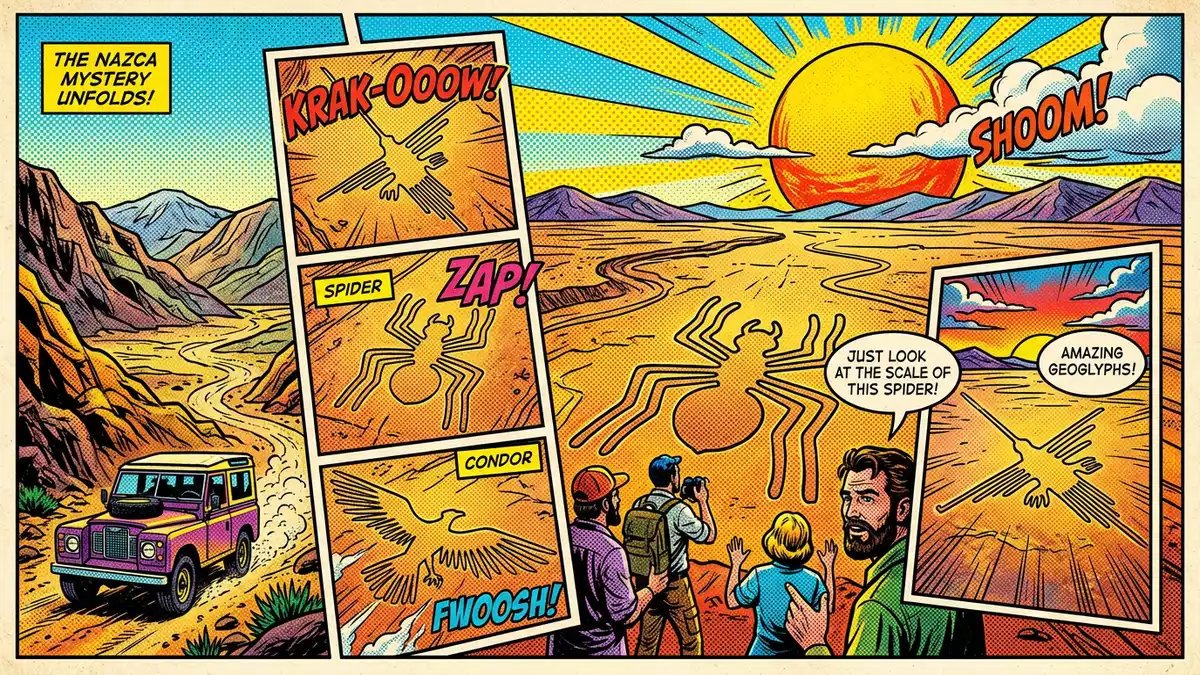
Lineas de Nazca, better known in English as the Nazca Lines, spreads across the high desert plateau between Nazca and Palpa in southern Peru, forming a landscape of colossal drawings cut into the earth. Created by the Nazca culture between about 200 BCE and 500 CE, these geoglyphs turn an otherwise bare plain into a vast graphic canvas that is most clearly read from the air.The Nazca Lines
A desert plain turned into a graphic landscape
The heart of Lineas de Nazca lies on the coastal plain of the Ica Region, roughly 400 km south of Lima, where an arid plateau stretches between the towns of Nazca and Palpa.The desert plains of Nasca and Palpa The plateau forms part of the Pampas de Jumana and neighbouring pampas such as the Pampa Colorada, a broad table of pale soil and scattered stones framed by low Andean foothills.The arid Pampa Colorada
The geoglyphs occupy an area of tens of thousands of hectares, with lines, shapes and figures extending for kilometres across the flat ground.An archaeological area of more than 75,000 ha Many of the lines run dead-straight across gentle undulations, crossing natural gullies and low ridges, while others form trapezoids, spirals and long narrow bands that appear as panels when seen from above.Straight lines and geometric patterns
Ancient geoglyphs and the Nazca culture
The Nazca Lines belong to the cultural tradition of the Nazca civilisation, which flourished on Peru’s south coast between the first millennium BCE and the first millennium CE.Nazca culture in southern Peru Archaeological studies place the main phase of geoglyph creation between about 200 BCE and 600 CE, overlapping with earlier Paracas traditions further north along the same coastal strip.Created between 200 BCE and 500 CE
The designs were made by removing the dark, iron-oxide-coated pebbles that cover the desert surface and exposing the lighter-coloured soil beneath.Clearing away the dark red top soil In this dry, wind-sheltered environment, the contrast between the pale subsurface and the surrounding darker stones has endured for centuries, preserving outlines that are still sharply legible in satellite images.
Figures, animals and geometry on a monumental scale
Across the Nazca desert, thousands of individual geoglyphs combine straight lines, geometric forms and stylised figures of living beings.Nearly 1,200 geoglyphs including animals and plants Surveys count hundreds of long straight lines, several hundred geometric patterns and several dozen depictions of animals, plants and human-like figures spread over the plateau.Large geometric patterns and figures
Some of the best known figures include a spider, a monkey with a coiled tail, a hummingbird, a whale and a figure with an upraised arm standing on a slope overlooking the plain.A spiral, a spider and long lines Many figures stretch across hundreds of metres, while the longest straight lines run for several kilometres between low hills and dry riverbeds.
UNESCO World Heritage and conservation
Lineas de Nazca forms part of the UNESCO World Heritage property “Lines and Geoglyphs of Nasca and Palpa”, inscribed on the World Heritage List in 1994 under cultural criteria (i), (iii) and (iv).UNESCO inscription in 1994 The designated area covers more than 75,000 ha of desert plains and low foothills in the provinces of Nazca and Palpa, recognising both the scale of the geoglyphs and their role in the wider cultural landscape of the Rio Grande de Nasca drainage.Lines and Geoglyphs of Nasca and Palpa
UNESCO highlights Lineas de Nazca as an outstanding example of human creative genius and as an exceptional testimony to the religious and social practices of pre-Hispanic societies on Peru’s south coast.Outstanding universal value The combination of long, straight lines, geometric forms and zoomorphic figures across such a large area, maintained over many centuries, gives the site its particular significance in the archaeological record of the Andean region.
Visiting Lineas de Nazca: what travellers from Western Europe should know
- Lineas de Nazca lies in southern Peru near the town of Nazca in the Ica Region, south of Lima, and is reached overland from coastal and Andean cities.
- The geoglyphs occupy an exposed desert plateau where visitors encounter strong sun, reflective pale ground and minimal natural shade.
- Viewing platforms stand beside the Panamericana Sur highway near Nazca, and light aircraft flights depart from the local airfield to overfly sections of the plateau.
- The desert plain sits at a modest elevation above sea level, with dry air and loose stones underfoot requiring sure footing on paths and viewpoints.
- The official language is Spanish and the currency is the Peruvian sol. Entry requirements depend on your nationality; UK travellers can check the FCDO travel advice at gov.uk/foreign-travel-advice, Irish travellers the Department of Foreign Affairs at ireland.ie.
Searching for Lineas de Nazca on social platforms
These links open searches for Lineas de Nazca on each platform.
Frequently asked questions about Lineas de Nazca
Where are Lineas de Nazca located?
Lineas de Nazca lies in southern Peru on the desert plateau between the towns of Nazca and Palpa in the Ica Region.
What should visitors expect when seeing the Nazca Lines?
Visitors encounter an open desert landscape where the geoglyphs appear as pale designs on the ground, best appreciated from viewing platforms and scenic flights.
What makes Lineas de Nazca distinctive among archaeological sites?
Lineas de Nazca combines hundreds of long straight lines, geometric forms and large animal figures spread across a single desert plateau, created over many centuries by the Nazca culture.


