
Li Jiang and the karst hills of Guilin
Published on 09/23/2026 at 20:20 | Editorial responsibility: Rafael Müller, Editor-in-Chief AD HOC NEWS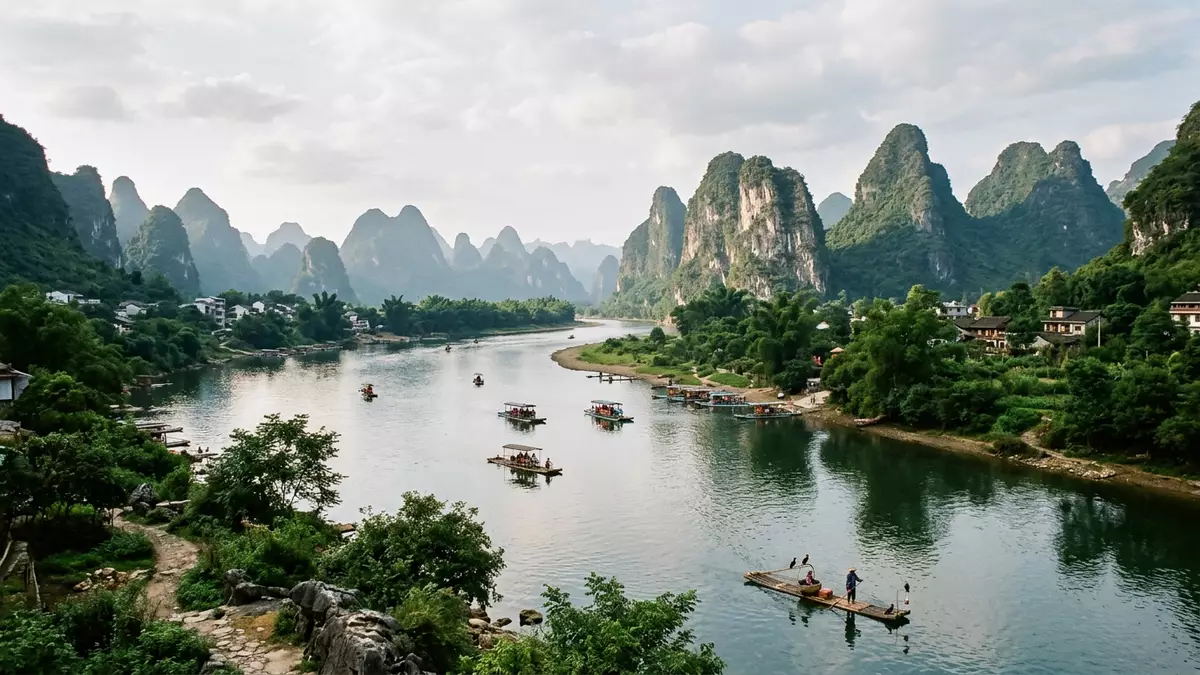
Li Jiang is the Chinese name for the Li River, a waterway flowing through Guilin in Guangxi, China. Its most recognisable setting is a sequence of limestone hills rising directly from the river, creating a landscape of water, rock and distant peaks.
Li Jiang between Guilin and Yangshuo
Li Jiang rises in the Mao’er Mountains of Xing’an County, north of Guilin, and flows south through Guilin and Yangshuo. The river belongs to the upper course of the Gui River, which joins the wider Pearl River system. Its full course is described as 437 km, while the celebrated Guilin–Yangshuo section is a shorter scenic stretch.
The river corridor includes Guilin’s urban waterfront, rural banks, karst hills and the town of Yangshuo. A recognised cruise route runs from the Mopanshan Passenger Terminal near Guilin to Longtoushan Pier in Yangshuo County, covering approximately 61 km. The Li River cruise route occupies only part of the wider river system.
Karst peaks reflected in the water
The defining scenery is tower karst: steep limestone formations separated by low-lying land and waterways. The hills appear as isolated masses, clustered ridges and narrow peaks, with vegetation covering many slopes. Li Jiang passes among these formations instead of running through a broad, uniform valley.
Guilin Karst forms part of the South China Karst World Heritage property, inscribed in 2014. The Guilin section contains both tower-karst and cone-karst landscapes, while the river provides a continuous route through the terrain. UNESCO’s South China Karst property places the scenery within a wider geological region.
Waterway, landscape and cultural memory
Li Jiang is also a historical waterway. The ancient Lingqu Canal connected its upper river system with the Xiang River during the Qin dynasty in 214 BC. This created a navigable link between the river systems flowing towards the Yangtze and the Pearl River.
The river’s cultural image extends beyond transport. Guilin’s landscape appears in Chinese painting, poetry and travel writing, with the water and limestone hills forming a recurring visual language. The scene on the 20-yuan banknote is associated with the Li River landscape near Xingping, downstream from Guilin.
Names along the route reinforce the connection between water and rock. Elephant Trunk Hill stands beside the river in Guilin, while Yangshuo provides a downstream setting of karst peaks and agricultural land. The river’s route through Guangxi connects Guilin, Yangshuo, Pingle and Zhaoping before the water reaches the Xijiang River at Wuzhou.
Visiting Li Jiang: what travellers from Western Europe should know
- Li Jiang lies north-east and south of Guilin, with the best-known river corridor continuing towards Yangshuo. River journeys use terminals near Guilin or piers in Yangshuo County.
- The landscape is viewed from water, riverbanks and karst viewpoints. A cruise combines a low river channel with steep limestone hills rising close to the banks.
- The official language is Mandarin Chinese and the currency is the Chinese yuan.
- Li Jiang connects with named places including Mopanshan, Xingping, Yangshuo and Elephant Trunk Hill.
Searching for Li Jiang on social platforms
These links open searches for Li Jiang on each platform.
Frequently asked questions about Li Jiang
Where is Li Jiang?
Li Jiang is the Li River in north-eastern Guangxi, China. It flows through Guilin and continues south towards Yangshuo.
What does a visit to Li Jiang involve?
A visit centres on the river corridor, with views of limestone hills, wooded banks, rural scenery and named places along the waterway.
What makes Li Jiang distinctive?
Its distinctive character comes from the close relationship between a winding river and tower-karst limestone peaks. The landscape also carries historical links through the Lingqu Canal and the Qin dynasty.


