
Leshan Da Fo and the cliff that holds it
Published on 08/28/2026 at 14:18 | Editorial responsibility: Rafael Müller, Editor-in-Chief AD HOC NEWS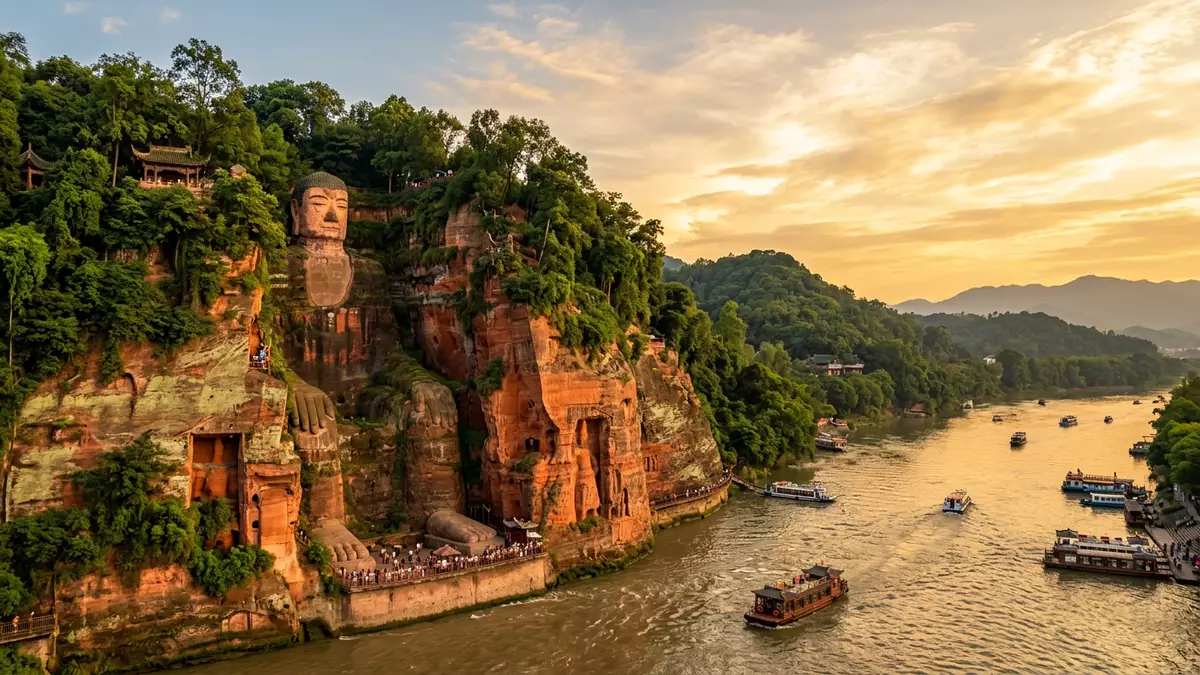
Leshan Da Fo is the seated Buddha cut into red sandstone above the meeting of three rivers near Leshan in Sichuan, China. It rises 71 m (233 ft) and forms part of the Mount Emei Scenic Area, a UNESCO World Heritage site since 199671 m (233 ft)UNESCO World Heritage site.
The cliff face and the seated figure
The statue fills the cliff rather than standing apart from it. Its shoulders stretch 28 m across, and its size is legible in the broad planes of the chest, the long ears and the feet set into the rockshoulders stretch 28 m.
The figure is a Maitreya Buddha, carved in the Tang dynasty. UNESCO places its creation in the eighth century, and Britannica gives the dates 713 to 803 for the work led by the monk Hai Tongeighth centurymonk Hai Tong.
Mount Emei and the river confluence
The setting is part of the site’s identity. The statue faces the confluence of the Min, Qingyi and Dadu rivers, and the wider heritage area also includes Mount Emei, a major Buddhist landscape in Sichuanconfluence of the Min, Qingyi and Dadu rivers.
That broader association matters because the place belongs to a larger religious and historic ensemble, not an isolated monument. The protected area links the cliff carving with temples and mountain terrain, while the Buddha itself remains the clearest visual anchor from the river valley belowlarger religious and historic ensemble.
What the statue shows in detail
The sculpture is read through its proportions as much as through its religious identity. The head, shoulders, hands and feet are scaled far beyond the human body, and the cliff carving keeps those parts tied to the stone face itselfhands and feet.
That material presence is part of its endurance. The Buddha remains a carved cliff figure in red sandstone, with the mountain surface visible around it rather than hidden by a free-standing shellred sandstone.
Visiting Leshan Da Fo: what travellers from Western Europe should know
- The site lies near Leshan in Sichuan, in south-west China. It is reached through the Leshan area and the Mount Emei scenic landscape.
- The approach includes steps and cliff paths around a steep river setting. The statue itself is fixed into the rock face, so the terrain is part of the visit.
- The official language is Chinese and the currency is the Chinese yuan.
- Entry requirements depend on your nationality; UK travellers can check the FCDO travel advice at gov.uk/foreign-travel-advice, Irish travellers the Department of Foreign Affairs at ireland.ie.
Searching for Leshan Da Fo on social platforms
These links open searches for Leshan Da Fo on each platform.
Frequently asked questions about Leshan Da Fo
Where is Leshan Da Fo?
It stands near Leshan in Sichuan, south-west China, where the carved Buddha looks out over the meeting of three rivers.
What does a visit involve?
The setting is built around cliff paths, steps and river views. The statue is encountered as a rock-cut figure rather than a free-standing monument.
What makes it distinctive?
Its scale and material presence define it: a 71 m Buddha cut directly into red sandstone, linked to Tang-dynasty Buddhist history and the Mount Emei heritage landscape.


