
Leptis Magna, a Roman city on Libya’s Mediterranean shore
Published on 09/14/2026 at 14:40 | Editorial responsibility: Rafael Müller, Editor-in-Chief AD HOC NEWS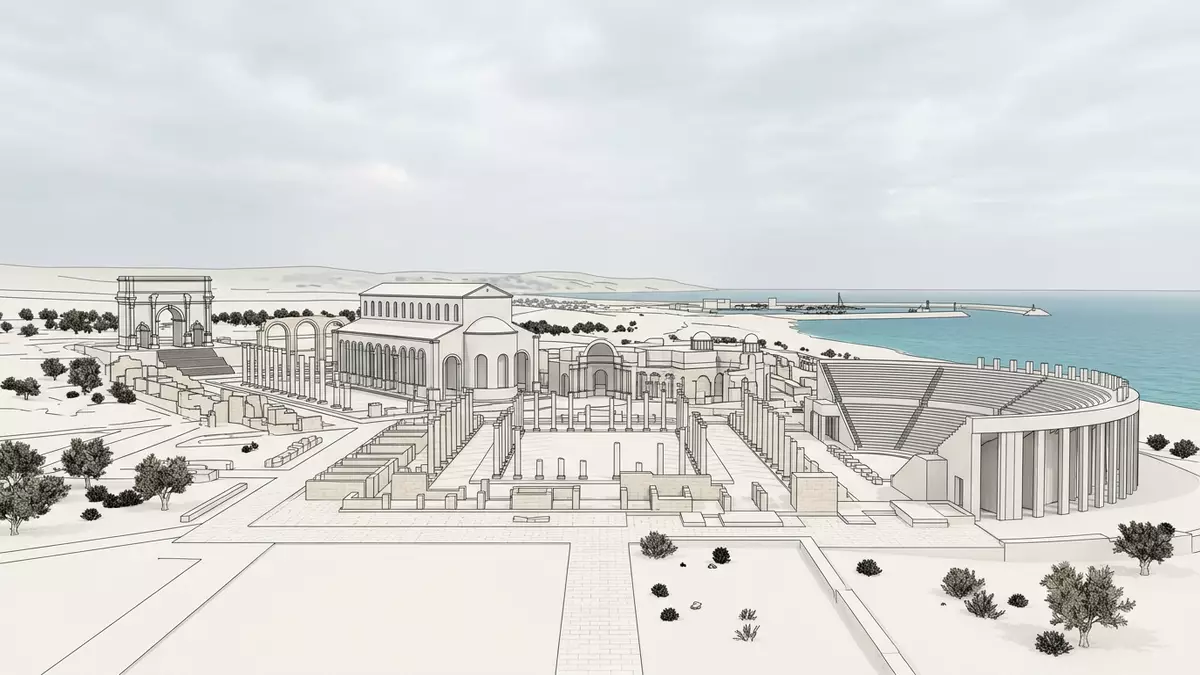
On the Mediterranean coast of Libya near Al Khums lies the ancient city of Leptis Magna, a Roman urban landscape preserved in stone at almost full scale. Founded as a Phoenician trading post and later absorbed into the Roman world, it became one of the major cities of Tripolitania and retains extensive remains from its period of imperial prosperity under Septimius Severus in the early third century AD.major cities of Tripolitania
A Roman city preserved in its urban grid
Leptis Magna stands on the central Mediterranean coast of Libya east of Tripoli, with its ruins lying slightly beyond the modern town of Al Khums. The archaeological area covers several hundred hectares and preserves the main street grid, monumental public spaces and parts of the harbour works in recognisable form.covers an area of nearly 400 hectares Walking into the site, the straight Roman streets and broad squares give a sense of a city rather than a single monument, with colonnaded avenues connecting the forum, basilica, market and theatre in stone.
The ruins include an Augustan theatre close to the shore, an amphitheatre further inland, extensive baths, a serried array of shops and warehouses and the Severan Forum and basilica, set within the regular Roman grid.Augustan theatre, amphitheatre, great baths, forum and Severan basilica The Severan basilica itself is a long hall with a central nave and colonnaded aisles, laid out for judicial and civic functions and measuring roughly 90 m (295 ft) in length by 35 m (115 ft) in width.one of the largest basilicas in the Roman world Columns, carved capitals and wall bases survive in situ, making the volume of the hall easy to read even without its roof.
From Phoenician harbour to Severan showcase
Leptis Magna began as a Phoenician settlement in the seventh century BC, taking advantage of a natural harbour near the mouth of the Wadi Lebda.Phoenician settlement in the seventh century BC Under Roman rule it grew into a significant port city of Roman Africa, handling trade between the African interior, the wider Mediterranean and the Italian peninsula. Olive oil, wine and other commodities passed through its quays, and the townscape expanded with forums, temples and baths as Roman control deepened.
Its most transformative phase came under Septimius Severus, the Roman emperor born in Leptis Magna who ruled from 193 to 211 AD.Septimius Severus (193–211) During his reign the city received major building works including a new forum, the Severan basilica and an expanded harbour, together with an honourary arch that marked his status as a native son.new forum and basilica and a four-way arch Marble cladding and imported stone were used extensively in these Severan projects, adding colour and polish to older masonry and emphasising the city’s role as a showpiece of Roman Africa.
Baths, theatres and the texture of daily life
Among the most instructive structures at Leptis Magna are the Hadrianic baths, a large complex erected in 127 AD and built largely in marble for both structure and ornament.bath building on an imperial scale erected under Hadrian in 127 AD At its northern end an open-air swimming bath forms the centrepiece, surrounded on three sides by porticos and flanked by colonnaded halls. From the pool a sequence of doors leads through a corridor around the large cold room, with plunge baths set at each end and a vaulted ceiling supported by columns.
Beyond the cold hall stand the warm and hot rooms, with a central bath, smaller side basins and a barrel-vaulted hot chamber lit by arched windows. Around these core spaces lie sweating rooms and service areas that once housed furnaces and hypocausts. The scale and completeness of the bath remains, together with nearby palaestra courts and latrines, give a tangible sense of how bathing and exercise were embedded in the city’s daily rhythm.large frigidarium with marble walls and statues
The theatre looks out towards the sea and is carved into a gentle slope, with a semicircular cavea of stone seating facing a stage building. The amphitheatre, set inland, is laid out as an oval arena with encircling tiers, while the market and colonnaded streets nearby frame everyday spaces of trade and movement. Together these structures outline the fabric of civic life, from entertainment and ritual to commerce and administration, in a provincial Roman city that retained an unusually complete set of public buildings.
Visiting Leptis Magna: what travellers from Western Europe should know
- Leptis Magna lies on Libya’s Mediterranean coast slightly east of Al Khums, with the ruins set a short distance inland from the shoreline and the mouth of the Wadi Lebda.
- The archaeological area is extensive and largely open, with long stretches on foot across uneven stone paving, compacted earth and steps between terraces and building platforms.
- The official language is Arabic and the currency is the Libyan dinar. Entry requirements depend on your nationality; UK travellers can check the FCDO travel advice at gov.uk/foreign-travel-advice, Irish travellers the Department of Foreign Affairs at ireland.ie.
Searching for Leptis Magna on social platforms
These links open searches for Leptis Magna on each platform.Frequently asked questions about Leptis Magna
Where is Leptis Magna located?
Leptis Magna is on Libya’s Mediterranean coast near Al Khums, east of Tripoli, with its ruins lying slightly inland from the shoreline and harbour area.located southeast of Tripoli, east of Al Khums
What can visitors expect on a visit?
Visitors encounter an extensive Roman cityscape with forums, a basilica, theatre, amphitheatre, harbour remains and monumental baths, connected by long stretches of stone paving and colonnaded streets.
What makes Leptis Magna distinctive among Roman sites?
Leptis Magna combines a large, well-preserved urban grid with major Severan monuments, including one of the largest Roman basilicas and an extensive marble-clad bath complex, set beside the Libyan sea.exceptional illustration of a Roman city that flourished under imperial patronage


