
Leon Viejo, the buried beginnings of León in Nicaragua
Published on 08/27/2026 at 17:13 | Editorial responsibility: Rafael Müller, Editor-in-Chief AD HOC NEWS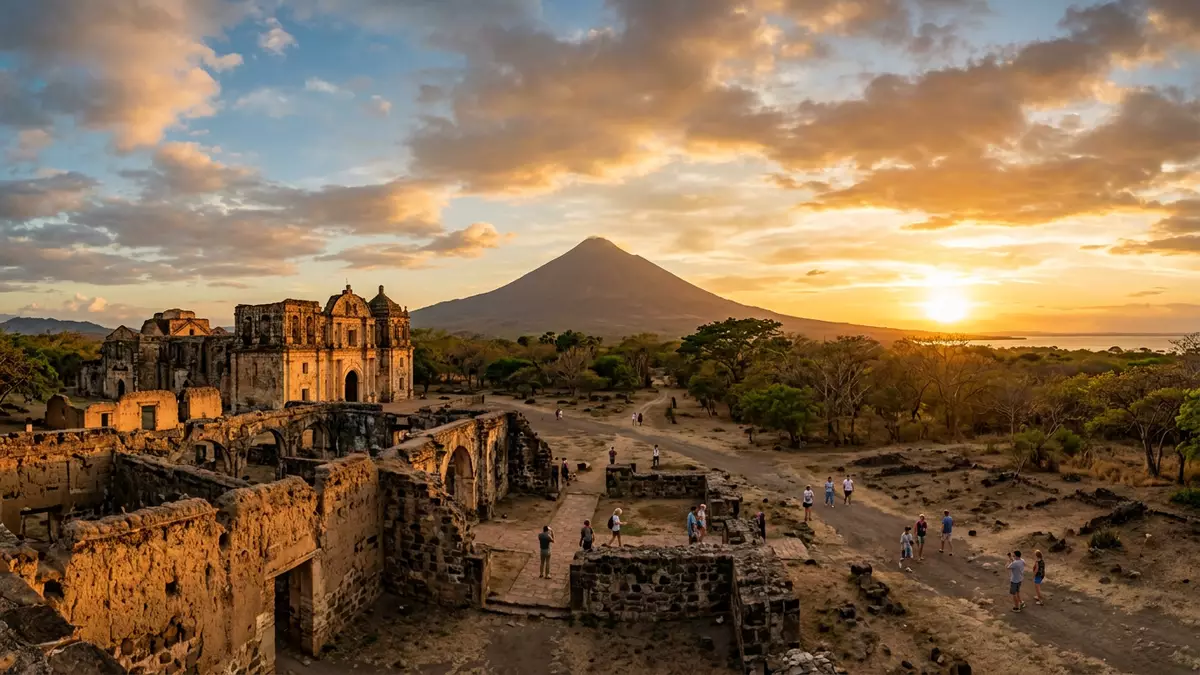
Leon Viejo in western Nicaragua is an archaeological site where the original Spanish colonial city of León once stood, laid out beside Lake Managua under the slopes of Momotombo volcano in the sixteenth century.
A sixteenth-century city left in the ground
The archaeological park of Leon Viejo lies near the lakeside settlement of Puerto Momotombo in the municipality of La Paz Centro, in the Department of León.near the town of Puerto Momotombo From here the ground falls towards the western end of Lake Managua, also known locally as Lake Xolotlán, with the cone of Momotombo rising directly across the water.borders the Managua lake at the foot of the Momotombo volcano The ruins occupy a defined area of low ground incorporating unearthed structures and adjacent zones where further remains still lie beneath the surface.the archaeological area includes unearthed vestiges and surrounding terrain
Leon Viejo represents the first location of the city of León, founded by Spanish colonists in 1524 under the name León de Nagrando and designated capital of the Province of Nicaragua.established in 1524 under the name of Leon de Nagrandofounded in 1524 and designated capital of the Province of Nicaragua The town declined in the later sixteenth century after repeated natural disasters and was abandoned in 1610, when the settlement was transferred to the site of present-day León.abandoned in 1610 and the city transferred to the current location of Leon Because no later urban development took place on the site, its buried fabric gives an unusually direct view of an early Spanish colonial town in Central America.one of the oldest Spanish colonial settlements in the Americas
Streets, plaza and religious buildings in outline
Walking through Leon Viejo today means following cleared traces of streets, building platforms and walls that mark out the plan of the sixteenth-century town. The settlement followed a rectilinear scheme with a central plaza, around which stood the main religious and civic structures of the colony.an exact square layout with a plaza located in its center On one side of the former plaza visitors encounter the remains of the cathedral of Santa María de la Gracia, its foundations and low walls indicating the footprint of the nave and ancillary spaces.the cathedral Santa María de la Gracia among uncovered structures
Nearby stand the archaeological outlines of the church and convent of La Merced, along with secular buildings such as the Casa de la Fundición, where metal was processed, and residential quarters that once housed colonists and officials.La Merced convent, Casa de la Fundición and domestic buildings among excavated structures In several places low masonry, reconstructed up to a modest height, helps visitors visualise doorway positions and the arrangement of rooms within the townhouses and public buildings. Across the site, the cleared areas blend with patches of grass and trees, underlining that Leon Viejo remains largely an archaeological landscape rather than a rebuilt monument.
World Heritage recognition and ongoing archaeology
The rediscovery of Leon Viejo in the twentieth century led to systematic clearance and excavation campaigns from the late 1960s onwards, bringing major structures back to light and stabilising their remains.the rediscovery of the Leon Viejo site in 1967 motivated campaigns of clearance, excavation and restoration In 1994 the Nicaraguan authorities declared the ruins a national historic and cultural monument, and in 2000 UNESCO inscribed the Ruins of León Viejo on the World Heritage List as a cultural property under criteria (iii) and (iv).declared national historic and cultural heritage in 1994 and World Heritage in 2000World Heritage inscription in 2000 under criteria (III) and (IV)
UNESCO’s documentation describes Leon Viejo as one of the oldest Spanish colonial settlements in the Americas, whose undisturbed ruins provide strong evidence of the social and economic structures of the Spanish Empire in the sixteenth century.its ruins are outstanding testimony to the social and economic structures of the Spanish Empire in the 16th centuryRuins of Leon Viejo as a World Heritage property Administration of the site lies with the Nicaraguan Institute of Culture, which oversees conservation and guides, and archaeological work continues to refine understanding of the town’s plan and daily life.administered by the Nicaraguan Institute of Culture
Visiting Leon Viejo: what travellers from Western Europe should know
- Leon Viejo stands near Puerto Momotombo on the western shore of Lake Managua in the municipality of La Paz Centro, reached by road from the cities of León and Managua.
- The archaeological park is largely level terrain with paths across excavated areas; visitors walk on compacted earth and grass among low masonry and open spaces.
- The official language is Spanish and the currency is the Nicaraguan córdoba.
- Entry requirements depend on your nationality; UK travellers can check the FCDO travel advice at gov.uk/foreign-travel-advice, Irish travellers the Department of Foreign Affairs at ireland.ie.
Searching for Leon Viejo on social platforms
These links open searches for Leon Viejo on each platform.
Frequently asked questions about Leon Viejo
Where is Leon Viejo located in Nicaragua?
Leon Viejo is in the Department of León near the settlement of Puerto Momotombo, on the western shore of Lake Managua opposite Momotombo volcano.
What can visitors expect to see at Leon Viejo?
Visitors walk through an archaeological park with exposed foundations, low reconstructed walls, street lines and the outlines of a plaza, cathedral, convent and colonial houses.
What makes Leon Viejo distinctive among colonial sites?
Leon Viejo is an early Spanish colonial town founded in 1524, abandoned in 1610 and later recognised by UNESCO as a World Heritage Site because its undisturbed ruins preserve an entire urban layout.


