
Leon Viejo and the ruins of Spain’s first Nicaraguan capital
Published on 09/14/2026 at 08:39 | Editorial responsibility: Rafael Müller, Editor-in-Chief AD HOC NEWS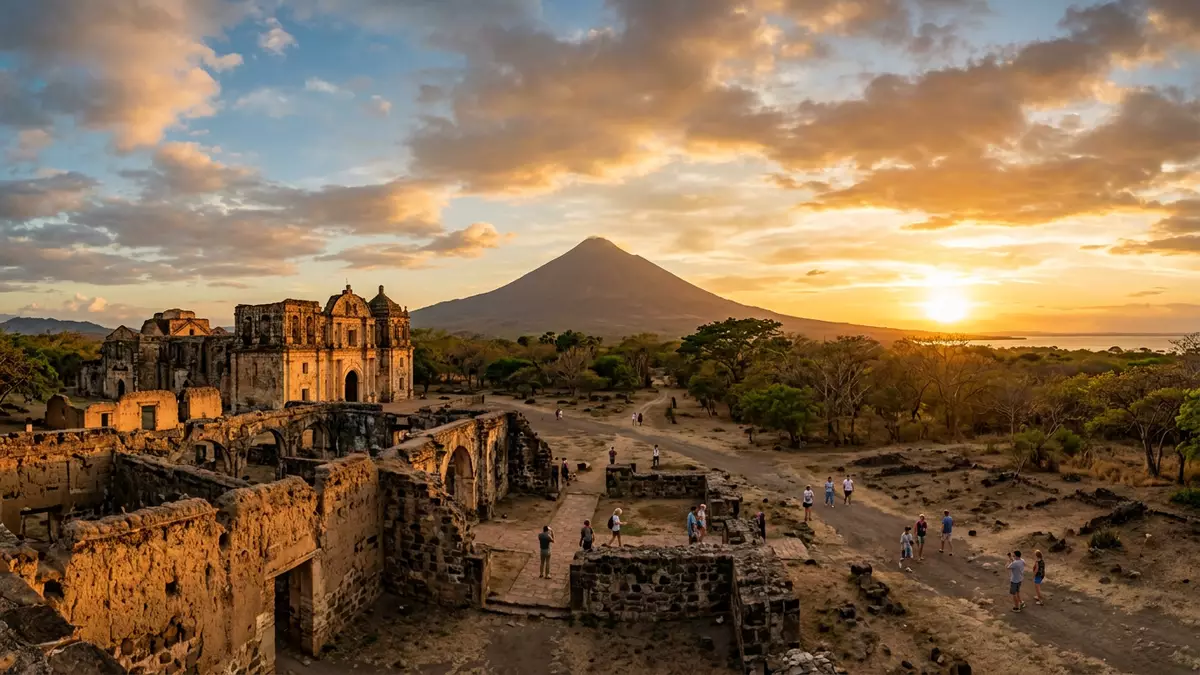
Leon Viejo in Leon, Nicaragua, is an archaeological site of Spanish colonial ruins beside Lake Managua. Founded in 1524 by Francisco Hernández de Córdoba, it preserves the remains of one of the oldest Spanish settlements in the Americasfounded in 1524.
A colonial town reduced to ruins
The site centres on the remains of the original city of León, laid out as a Spanish colonial town in the sixteenth century. Its ruins occupy an archaeological area near Puerto Momotombo, opposite the volcano of the same namenear Puerto Momotombo.
That setting gives the place its strongest visual character: low masonry fragments, open ground and the line of the lake beyond. The site was recognised as a World Heritage place in 2000World Heritage place.
Francisco Hernández de Córdoba and the first settlement
Francisco Hernández de Córdoba founded the town in 1524, and his name remains central to the story of León ViejoFrancisco Hernández de Córdoba. The settlement formed part of Spain’s early colonial expansion in Central America, and the surviving remains reflect that first urban phase.
The Spanish town disappeared in 1610, leaving buried streets, building outlines and archaeological traces. The ruins are a designated cultural heritage site of Nicaragua, a formal status that underlines their national importancecultural heritage site.
Grid planning, masonry and the archaeological landscape
Leon Viejo is known for the physical remains of an early colonial town rather than for surviving monuments alone. The site includes vestiges of the urban layout, and the archaeological area preserves material evidence from the town’s short lifeurban layout.
The landscape around the ruins is broad and open, with the volcano and lake forming the main landmarks. The place reads as archaeology first and scenery second, with scattered foundations and earth-covered fragments carrying most of the visual weight.
Visiting Leon Viejo: what travellers from Western Europe should know
- The ruins lie near Puerto Momotombo in the department of Leon, on the western side of Lake Managua. They can be reached from the lake shore area by local road.
- The ground is archaeological terrain with uneven surfaces and exposed remains. Walking among the ruins means moving across open earth and low masonry.
- Lake Managua and Momotombo define the wider setting. The site sits in an open volcanic landscape rather than in a dense urban quarter.
Searching for Leon Viejo on social platforms
These links open searches for Leon Viejo on each platform.
Frequently asked questions about Leon Viejo
Where is Leon Viejo?
It lies near Puerto Momotombo in the department of Leon, on the edge of Lake Managua. The site stands in western Nicaragua, close to the volcanic landscape around Momotombo.
What does a visit involve?
The place consists of archaeological ruins and open ground, with low remains of the colonial town spread across the site. Expect a landscape of foundations, earth and masonry fragments rather than standing streets of intact buildings.
What makes Leon Viejo distinctive?
Its significance comes from being an early Spanish colonial settlement founded by Francisco Hernández de Córdoba in 1524. The surviving remains give the place a clear sixteenth-century character, with the original town preserved as archaeology.


