
Leon Viejo and the colonial city beneath Lake Managua
Published on 09/24/2026 at 08:39 | Editorial responsibility: Rafael Müller, Editor-in-Chief AD HOC NEWS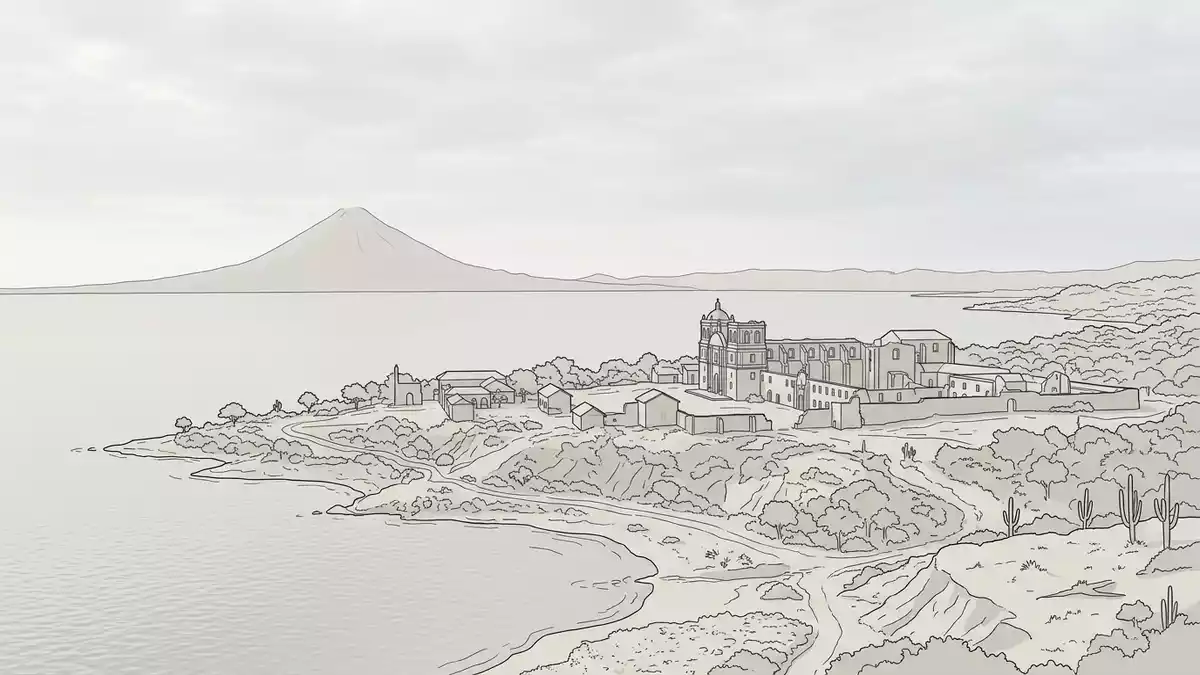
Leon Viejo preserves the first location of León beside Lake Managua in western Nicaragua. Founded by Francisco Hernández de Córdoba in 1524, the Spanish colonial settlement survives as excavated streets, foundations and low walls beneath Momotombo volcano.
Leon Viejo: a city preserved as an archaeological plan
The site lies near Puerto Momotombo, at the western end of Lake Managua, also known as Lake Xolotlán. Momotombo rises across the water, giving the archaeological landscape a clearly defined volcanic setting.
Leon Viejo is not a rebuilt colonial town. Its visible remains trace the arrangement of a sixteenth-century settlement, including the Plaza Mayor, the Calle Real and the foundations of religious, civic, residential and military buildings.
From Francisco Hernández de Córdoba to the first León
Francisco Hernández de Córdoba founded the town in 1524 during the first period of Spanish colonisation in Central America. Leon Viejo became the capital of the Province of Nicaragua, linking the settlement with the political and economic organisation of the Spanish Empire.
The ruins include Santa María de la Gracia Cathedral, the La Merced church and convent, and the Casa de la Fundición. These structures were built with tapial, an earthen construction material, and their surviving walls show the scale and layout of colonial buildings.
Natural disasters marked the settlement’s short history. An eruption of Momotombo damaged the town in 1578, and an earthquake struck in 1610. The city was abandoned in 1610, after which León developed at another location.
What the excavated walls reveal
The archaeological remains preserve a rectilinear urban plan centred on a plaza. Cleared paths cross open ground, while low walls and building platforms identify rooms, doorways and larger public structures.
The site’s importance lies in the relationship between individual buildings and the wider town plan. UNESCO’s León Viejo record identifies the ruins as an exceptional testimony to early European settlements in the Americas and to sixteenth-century Spanish social and economic structures.
Volcanic deposits and the absence of later urban rebuilding left the archaeological layout intact. Excavations began to bring the buried town back into view in 1967, revealing a colonial settlement whose streets and building footprints remain legible.
Nicaragua declared the ruins a national historic and cultural monument in 1994. In 2000, the Ruins of León Viejo entered the UNESCO World Heritage List under criteria connected with material culture and early Spanish colonial town planning.
Visiting Leon Viejo: what travellers from Western Europe should know
- Leon Viejo stands near Puerto Momotombo in the municipality of La Paz Centro, Department of León, on the western end of Lake Managua. Road access connects the site with León and Managua.
- The archaeological area consists of open paths across compacted earth and grass, with exposed foundations and low walls. Walking takes place among uneven archaeological surfaces rather than through intact interiors.
- The official language is Spanish and the currency is the Nicaraguan córdoba.
- Entry requirements depend on your nationality; UK travellers can check the FCDO travel advice at gov.uk/foreign-travel-advice, Irish travellers the Department of Foreign Affairs at ireland.ie.
Searching for Leon Viejo on social platforms
These links open searches for Leon Viejo on each platform.Frequently asked questions about Leon Viejo
Where is Leon Viejo located?
Leon Viejo lies near Puerto Momotombo in Nicaragua’s Department of León, beside the western end of Lake Managua and opposite Momotombo volcano.
What can visitors see at Leon Viejo?
The archaeological site contains exposed foundations, low walls, street lines, the Plaza Mayor, Santa María de la Gracia Cathedral and the La Merced church and convent.
Why is Leon Viejo important?
Founded by Francisco Hernández de Córdoba in 1524 and abandoned in 1610, Leon Viejo preserves the plan of an early Spanish colonial town.


