
Leon Viejo, a buried colonial city by Lake Managua
Published on 09/05/2026 at 22:03 | Editorial responsibility: Rafael Müller, Editor-in-Chief AD HOC NEWS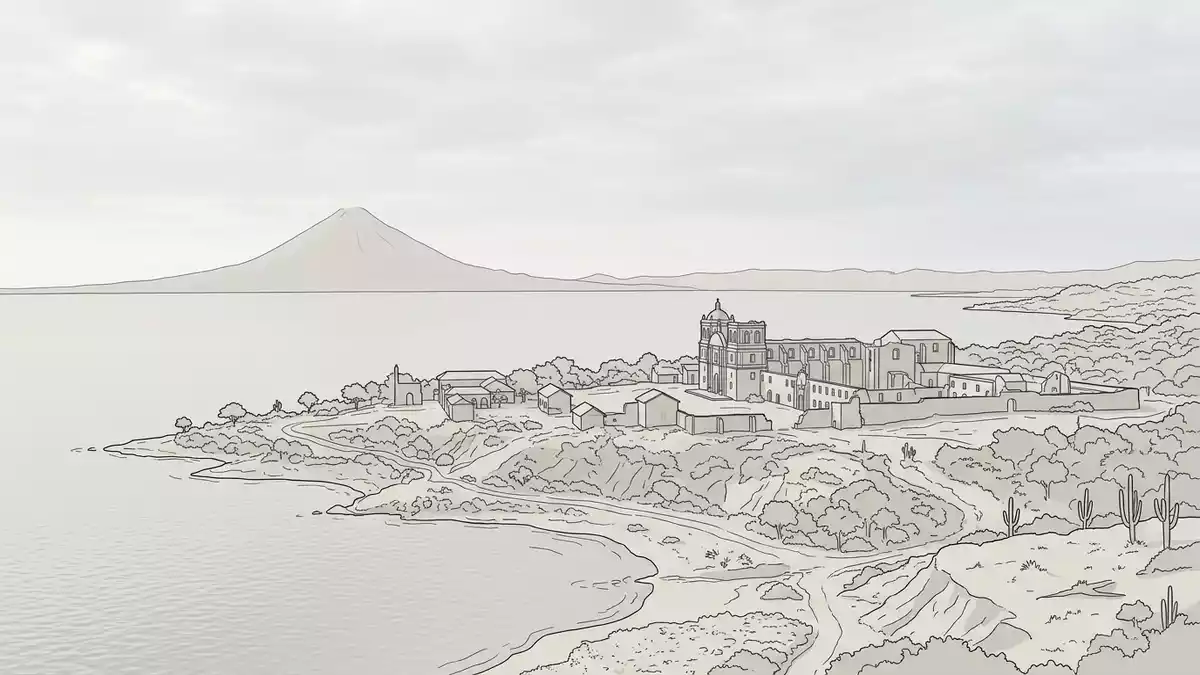
Leon Viejo in western Nicaragua is an archaeological site where a sixteenth-century Spanish colonial town lies partly buried beside Lake Managua with the Momotombo volcano looming across the water. Founded in the early period of Spanish expansion in Central America, the ruined streets and foundations preserve a compact city that was abandoned in 1610 and later covered by volcanic deposits.
A colonial capital frozen in the sixteenth century
Leon Viejo was founded in 1524 as a Spanish colonial town on the shores of Lake Managua, near the indigenous settlement of Imabite in what is now the department of Leon.founded in 1524 The settlement became the capital of the Province of Nicaragua, anchoring Spanish rule in the region and giving its name to the later city of Leon further north.capital of the Province of Nicaragua Its plan followed Spanish models of the time, with a central plaza framed by civic and religious buildings and straight streets radiating from this core.
The town was inhabited for 86 years until its abandonment in 1610, after a period of economic decline and repeated earthquakes associated with the nearby Momotombo volcano.abandonment in 1610 Its fate left the urban fabric largely undisturbed by later rebuilding, a rarity among colonial towns in the Americas, and the ruins now offer a direct view into sixteenth-century town planning and construction in Central America.view into sixteenth-century town planning
Reading a buried city in brick, earth and lake light
Excavations during the twentieth century revealed building foundations, low walls and floor levels, so visitors walk through outlines rather than intact facades, tracing streets between roofless structures set in low relief above the surrounding ground.excavations revealed building foundations Early dwellings followed indigenous models with thatch and reed construction, then gave way to more permanent houses with brick walls and clay tile roofs as Spanish architectural techniques took hold.brick walls and clay tile roofs The mix of simple domestic plots and more formal public buildings is visible in the differing sizes and layouts of the remains.
Leon Viejo lies near Puerto Momotombo at the western end of Lake Managua, also known as Lake Xolotlan, so the site opens onto wide views of water with the conical mass of Momotombo across the lake.western end of Lake Managua The contrast between the low, excavated masonry and the volcanic landscape around it underlines how the town’s history is bound to the geology of this part of Nicaragua, with ash and sediment having helped to cover and preserve much of the former city.covered by volcanic sediment
World Heritage status and the shadow of modern Leon
The ruins of Leon Viejo were declared National Historical and Cultural Heritage of Nicaragua in 1994, and in 2000 they became the country’s first site inscribed on the UNESCO World Heritage List as a cultural property under criteria (iii) and (iv).first Nicaraguan World Heritage site The UNESCO designation recognises the archaeological ensemble as one of the earliest Spanish colonial settlements in the Americas whose urban form was not altered by later development.earliest Spanish colonial settlements
The abandonment of Leon Viejo led to the founding of the present-day city of Leon further to the north, near the indigenous town of Sutiava, so visitors can experience both the buried first capital and the later city in one region.founding of modern Leon At the site itself, interpretation panels and the exposed ground plans help visitors reconstruct the appearance of the streets and plazas, while the open surroundings keep the focus on the relationship between the ruins, the lake and the volcano.
Visiting Leon Viejo: what travellers from Western Europe should know
- Leon Viejo lies near the lakeside community of Puerto Momotombo in the municipality of La Paz Centro, north-east of the modern city of Leon in western Nicaragua.
- The archaeological area consists of uneven ground with excavated building outlines, low walls and earth paths, so visitors walk over packed soil with occasional steps and mild gradients.
- The site sits near the shore of Lake Managua with open exposure, and shade is limited to scattered trees and simple shelters around the ruins.
- The official language is Spanish and the currency is the Nicaraguan córdoba.
- Entry requirements depend on your nationality; UK travellers can check the FCDO travel advice at gov.uk/foreign-travel-advice, Irish travellers the Department of Foreign Affairs at ireland.ie.
Searching for Leon Viejo on social platforms
These links open searches for Leon Viejo on each platform.
Frequently asked questions about Leon Viejo
Where is Leon Viejo in relation to the modern city of Leon?
Leon Viejo lies near Puerto Momotombo in the municipality of La Paz Centro, north-east of the present-day city of Leon in western Nicaragua.
What can visitors expect to see when exploring Leon Viejo?
Visitors follow earth paths through excavated streets, low masonry walls and building outlines, with interpretation panels and wide views over Lake Managua and the Momotombo volcano.
What makes Leon Viejo distinctive among colonial sites in the Americas?
Leon Viejo preserves a sixteenth-century Spanish colonial town that was abandoned rather than rebuilt, giving an unusually direct view of early urban planning beside a volcanic lake landscape.


