
Lekki Conservation Centre and its treetop walkway in Lagos
Published on 08/27/2026 at 16:41 | Editorial responsibility: Rafael Müller, Editor-in-Chief AD HOC NEWS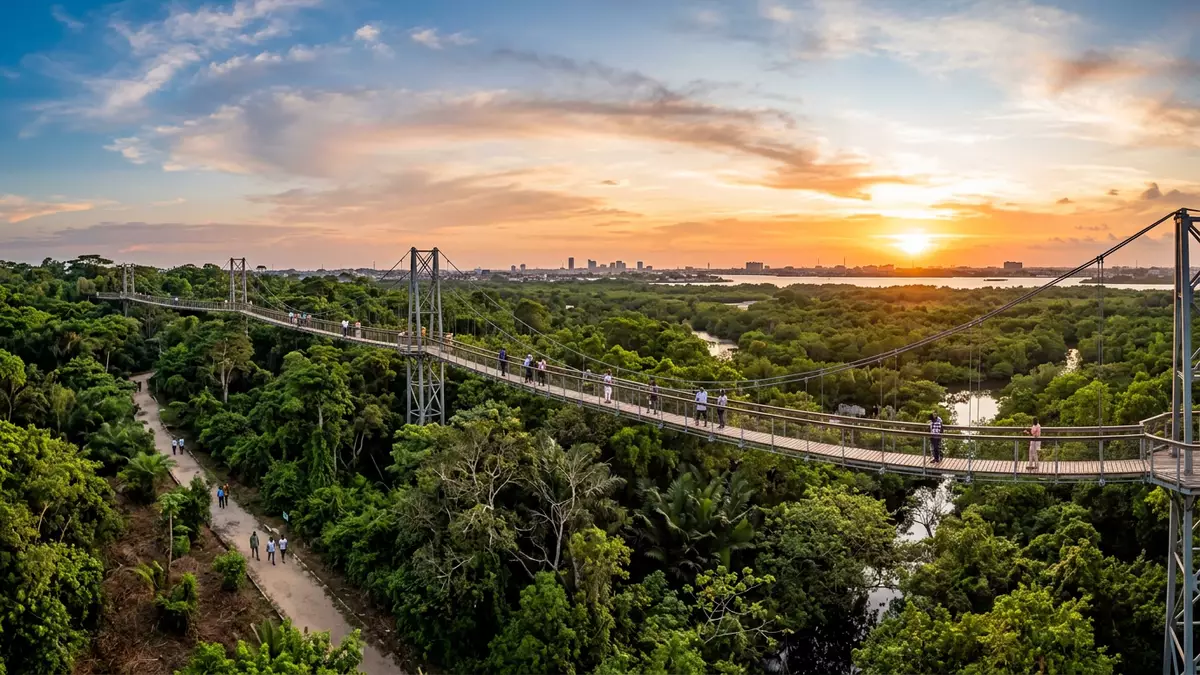
On the Lekki Peninsula in Lagos, Lekki Conservation Centre preserves a stretch of coastal wetland and mangrove forest within one of West Africa’s busiest urban regions. Established in 1990 by the Nigerian Conservation Foundation, it protects a compact reserve where raised walkways and a treetop route bring visitors into direct contact with the landscape.
A wetland reserve beside the lagoons
Lekki Conservation Centre occupies a protected area of roughly 78 hectares of low-lying terrain between the Lekki Lagoon and the wider Lagos Lagoon, on the eastern side of the city. A network of boardwalks crosses swampy ground and patches of forest, keeping feet above the damp soil while making the vegetation and wildlife accessible.78-hectare nature reserve The reserve lies along the Lekki–Epe Expressway, a major road corridor that links the peninsula with other parts of Lagos.
The site functions as an urban wildlife sanctuary where monkeys, birds and swamp reptiles live among raffia palms, mangroves and seasonal pools. It also serves as an environmental education centre, with structures such as a raised lookout tower and a simple tree house highlighting views over the wetland and forest canopy.managed by the Nigerian Conservation Foundation The Nigerian Conservation Foundation, headquartered in Lagos, oversees the reserve’s conservation work.
Africa’s longest canopy walkway above the trees
The defining feature of Lekki Conservation Centre is its elevated canopy walkway, a suspended route that lifts visitors above the treetops. The structure extends for about 401 m (1,316 ft) through the forest canopy, a length that gives it recognised status as the longest canopy walkway in Africa. At its highest points it rises more than 20 m (65 ft) above the ground, supported by steel towers linked by narrow hanging spans and platforms.longest canopy walkway in Africa The walkway forms a continuous sequence of segments, each suspended between sturdy support frames.
Access to the canopy route begins from within the reserve, where a short approach path leads to the first platform set among tall trees. From there the suspended sections progress across the wetland, with intermediate platforms providing pauses and views over the mangroves and lagoons. The experience contrasts with the lower boardwalks and open grassed areas of the family park, giving a sense of the vertical structure of the forest and the way wildlife uses different levels of the habitat.401-metre canopy walkway Seen from the ground, the towers and cables form a visible line above the trees.
Wildlife, family park and conservation focus
Within the reserve, wildlife is a central part of any visit. Groups of monkeys move between the trees and clearings, while birds use both the canopy and the open spaces. In the wetter zones, swamp reptiles and fish inhabit ponds and channels linked to the surrounding lagoons. Simple interpretation boards and guided routes introduce the habitats and the species that rely on them, connecting the treetop walkway and ground-level paths with the wider ecological story.
Alongside the wilder sections of forest and swamp, Lekki Conservation Centre includes a family park area with lawns, picnic spaces and small structures where visitors can spend time before or after exploring the boardwalks. Features such as a tree house, a tilapia pond and play installations sit within this more open part of the site, contrasting with the dense vegetation beyond.environment education centre The combination of recreational facilities and conservation zones reflects the centre’s role as both a protected area and a place for learning about Nigeria’s coastal ecosystems.
Visiting Lekki Conservation Centre: what travellers from Western Europe should know
- Lekki Conservation Centre stands along the Lekki–Epe Expressway on the Lekki Peninsula in Lagos, with road access from the city’s mainland districts and coastal neighbourhoods.
- Much of the reserve is reached by raised boardwalks and the canopy walkway, so visitors spend extended periods on narrow walkways, stairways and platforms above wet ground and forest.
- The wider site includes open lawns and a family park area beside the forest, providing places to rest between walking sections of the reserve.
- The official language is English and the currency is the Nigerian naira.
- Entry requirements depend on your nationality; UK travellers can check the FCDO travel advice at gov.uk/foreign-travel-advice, Irish travellers the Department of Foreign Affairs at ireland.ie.
Searching for Lekki Conservation Centre on social platforms
These links open searches for Lekki Conservation Centre on each platform.
Frequently asked questions about Lekki Conservation Centre
Where is Lekki Conservation Centre located?
It lies on the Lekki Peninsula in Lagos, Nigeria, along the Lekki–Epe Expressway between the Lekki Lagoon and the wider Lagos Lagoon.
What can visitors expect during a visit?
Visitors follow raised boardwalks through wetland and forest, see wildlife in a compact reserve and, for those who choose to, walk the extended canopy route above the trees.
What makes Lekki Conservation Centre distinctive?
The combination of a mangrove-lined wetland reserve in a major city and a treetop walkway of about 401 m (1,316 ft) that is recognised as Africa’s longest gives the centre its particular character.


