
Largo do Senado and Macau’s patterned civic square
Published on 09/18/2026 at 13:58 | Editorial responsibility: Rafael Müller, Editor-in-Chief AD HOC NEWS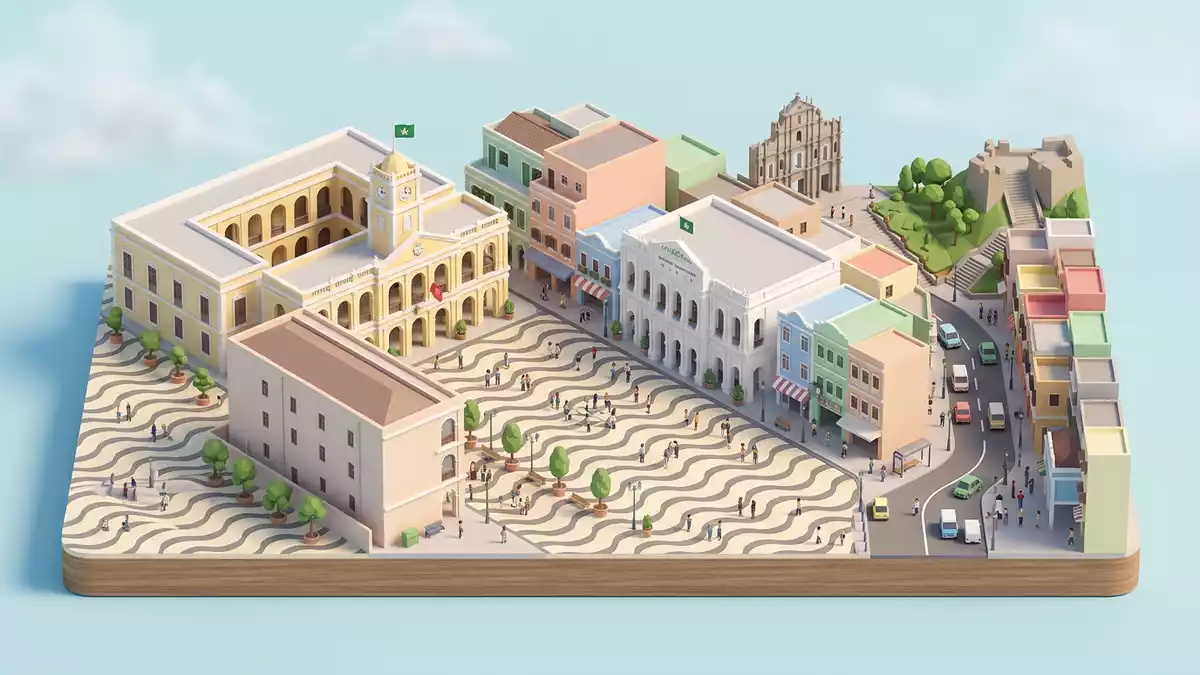
Largo do Senado in Macau is a paved civic square where a black-and-white wave mosaic spreads between pastel-fronted buildings in the historic centre of the peninsula. Set in the Sé parish and forming part of the Historic Centre of Macao, the square records several centuries of contact between Portugal and southern China within a compact urban space.
A civic square shaped by Sino?Portuguese history
Largo do Senado is a public square on the Macau Peninsula, identified in English as Senado Square, and serves as one of the principal civic spaces in this small coastal city in southern China.paved town square in Sé The square forms part of the Historic Centre of Macao, which UNESCO inscribed as a World Heritage Site in 2005 as a group of streets, plazas and buildings that document the fusion of European and Chinese townscape in this former Portuguese-administered port.Historic Centre of Macao inscription in 2005
The Portuguese name “Largo do Senado” refers directly to the Leal Senado, the “Loyal Senate” building fronting one side of the square, which housed the municipal council during the long period of Portuguese administration.Leal Senado facing the square The area around Largo do Senado developed as a civic core from the sixteenth century, when a permanent Portuguese settlement took shape in Macau and an open space emerged in front of the senate hall for meetings, ceremonies and public life.governmental centre of the colony
Wave-pattern pavement and pastel façades
The most immediately recognisable feature of Largo do Senado is its patterned ground, laid out in an undulating black-and-white stone mosaic that evokes the movement of the sea. The pavement uses calcada portuguesa, the traditional Portuguese technique of setting contrasting limestone cubes into flowing motifs, and spreads across the civic space in a continuous surface.wave-pattern Portuguese stone mosaic The pattern links Largo do Senado visually to other Lusophone plazas that share similar paving traditions, while remaining firmly rooted in Macau’s own street grid.
Around the edges of the square, façades present a largely neoclassical civic vocabulary, with restrained ornament, arcades and regular window rhythms derived from Mediterranean town architecture.neoclassical appearance in the late nineteenth to early twentieth century Many of these buildings carry pale colours such as yellow, white and terracotta, creating a pastel backdrop to the darker pavement and framing the space as a defined urban room.buildings painted in yellow, white and terracotta Within this ensemble sit notable structures including the Leal Senado, the Holy House of Mercy and St Dominic’s Church, all listed within the wider Historic Centre of Macao.
Largo do Senado within Macau’s historic centre
Largo do Senado occupies a central position on the Macau Peninsula, where several early streets converge in the Sé parish and where civic, religious and commercial buildings gather around one shared paved surface.central part of the Macau Peninsula The square’s role as an urban focus is reinforced by its inclusion in the Historic Centre of Macao, a contiguous zone of monuments, churches, fortifications and streets that together trace the evolution of Macau as an intermediary between China and the Portuguese-speaking world.pedestrianised heart of the Historic Centre
The square itself has an elongated plan that narrows towards one end, giving visitors shifting perspectives on the façades as they move through the space.elongated triangular civic square At one side, the Leal Senado presents a civic frontage with its council chambers behind; at another, arcaded buildings open into shops and passageways that lead deeper into the historic centre. The ensemble of structures around the square largely dates from the late nineteenth and early twentieth centuries, when earlier constructions were rebuilt or refurbished in a cohesive style that emphasised neoclassical proportions and continuous façades.cohesive architectural appearance
Visiting Largo do Senado: what travellers from Western Europe should know
- Largo do Senado lies on the Macau Peninsula in the Sé parish, reached on foot from other parts of the Historic Centre and connected to wider Macau by urban streets and public transport.
- The square itself is level and paved with small stone mosaics, with surrounding streets offering short gradients and occasional steps where they rise towards neighbouring churches and lanes.
- The Historic Centre around Largo do Senado includes named sites such as the Ruins of St Paul’s and St Dominic’s Church, both within walking distance along narrow streets lined with mixed Sino?Portuguese architecture.
- Macau is a Special Administrative Region of China, where the official languages are Chinese and Portuguese and the currency is the Macanese pataca.
- Entry requirements depend on your nationality; UK travellers can check the FCDO travel advice at gov.uk/foreign-travel-advice, Irish travellers the Department of Foreign Affairs at ireland.ie.
Searching for Largo do Senado on social platforms
These links open searches for Largo do Senado on each platform.
Frequently asked questions about Largo do Senado
Where is Largo do Senado located in Macau?
Largo do Senado stands in the Sé parish on the Macau Peninsula, forming a central square within the Historic Centre of Macao and surrounded by civic and commercial streets.
What should visitors expect when entering the square?
Visitors step onto a patterned stone pavement laid out in black-and-white waves, enclosed by pastel-coloured neoclassical façades that house municipal offices, charitable institutions and shops.
What makes Largo do Senado distinctive among Macau’s historic sites?
The combination of calcada portuguesa paving, neoclassical civic buildings and its role within the UNESCO-listed Historic Centre gives Largo do Senado a patterned civic character that reflects Macau’s Sino?Portuguese heritage.


