
Largo do Senado and Macau’s patterned civic heart
Published on 09/23/2026 at 19:34 | Editorial responsibility: Rafael Müller, Editor-in-Chief AD HOC NEWS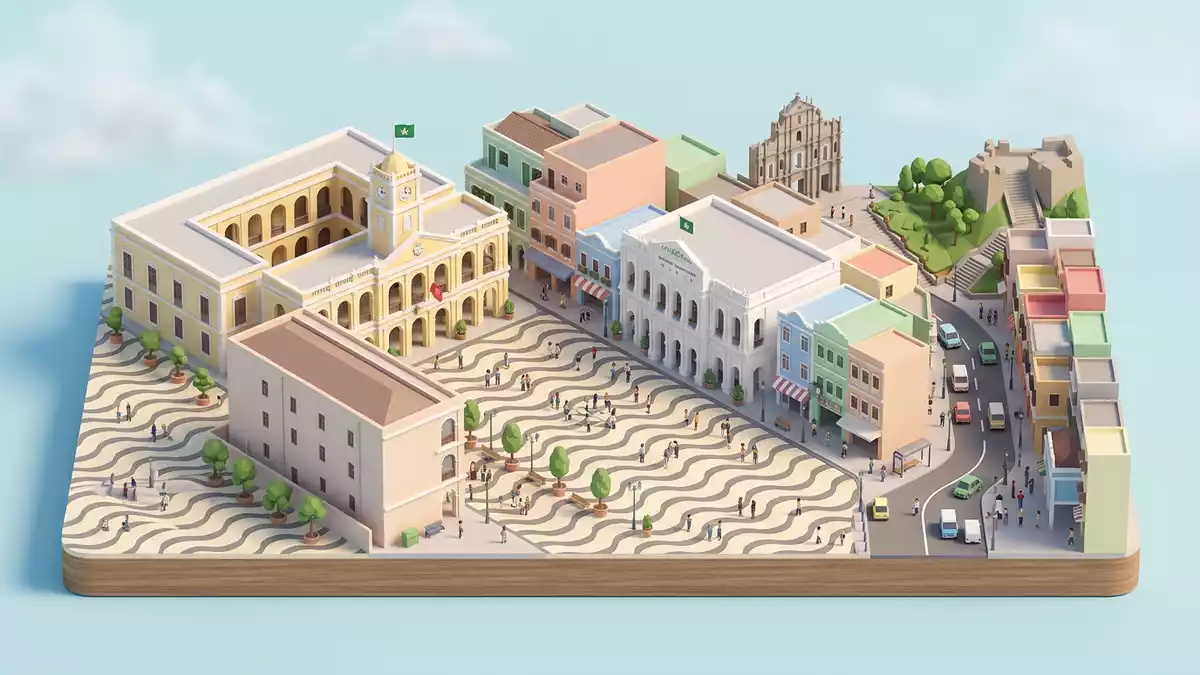
Largo do Senado is a paved public square on Macau’s central peninsula, where flowing stone patterns meet pastel façades and arcaded buildings. The square forms part of the Historic Centre of Macao, inscribed on the World Heritage List in 2005.
Wave-patterned pavement across Macau’s civic square
The ground is laid with traditional Portuguese pavement, known as calçada portuguesa. Small black and white stones form undulating bands across the open surface, creating a strong visual field beneath the surrounding buildings.
The pavement gives Largo do Senado a clear identity as an urban room. Streets converge around its edges, while arcades and upper-storey windows create a continuous architectural frame. The square links civic buildings, religious landmarks and commercial streets within the Sé parish.
Pastel façades around Largo do Senado
The buildings around the square show neoclassical influences, with symmetrical fronts, regular windows, arcades and restrained cornices. Their colours include yellow, white and soft terracotta, producing a coherent streetscape across different buildings.
The Leal Senado Building faces the square and gives Largo do Senado its name. Constructed in 1784, it served as the headquarters of Macau’s municipal government during Portuguese administration. Its formal frontage includes arched openings and a central pediment.
From Leal Senado to the Historic Centre of Macao
Largo do Senado’s name refers to the Leal Senado, or Loyal Senate, which connected Portuguese and Chinese officials in Macau. The square developed as a civic space during the Portuguese period, with municipal activity and public ceremonies associated with the surrounding buildings.
The Holy House of Mercy stands among the arcaded façades and reflects the charitable institutions established in Portuguese Macau. St Dominic’s Church lies nearby along connected streets. Together with the Leal Senado and other monuments, these buildings form part of the Historic Centre of Macao, inscribed in 2005.
The heritage ensemble records Chinese and Portuguese urban traditions within a compact area of the Macau Peninsula. Its character comes from the relationship between patterned paving, European-influenced façades, religious architecture and the dense streets leading away from the square. The paved town square remains closely associated with Macau’s historic civic landscape.
Visiting Largo do Senado: what travellers from Western Europe should know
- Largo do Senado lies in the Sé parish on the central Macau Peninsula. Avenida de Almeida Ribeiro and nearby urban streets lead towards the square.
- The square is entirely paved, with hard walking surfaces and changes in level near church steps and arcaded frontages.
- The Leal Senado, the Holy House of Mercy and St Dominic’s Church stand within the surrounding historic district. Short walks connect the civic and religious landmarks.
- The official languages are Chinese and Portuguese, and the currency is the Macanese pataca.
- Entry requirements depend on your nationality; UK travellers can check the FCDO travel advice at gov.uk/foreign-travel-advice, Irish travellers the Department of Foreign Affairs at ireland.ie.
Searching for Largo do Senado on social platforms
These links open searches for Largo do Senado on each platform.
Frequently asked questions about Largo do Senado
Where is Largo do Senado?
Largo do Senado is in the Sé parish on the central Macau Peninsula. It forms part of the Historic Centre of Macao.
What can visitors see around the square?
The square has Portuguese pavement, pastel façades, arcaded walkways and nearby civic and religious buildings. The Leal Senado and Holy House of Mercy stand close to the open space.
What makes Largo do Senado distinctive?
Its patterned black and white pavement combines with neoclassical façades and Portuguese-era civic buildings. The ensemble reflects Chinese and Portuguese urban traditions within Macau’s historic centre.


