
Largo do Senado and Macau’s patterned civic heart
Published on 08/27/2026 at 20:53 | Editorial responsibility: Rafael Müller, Editor-in-Chief AD HOC NEWS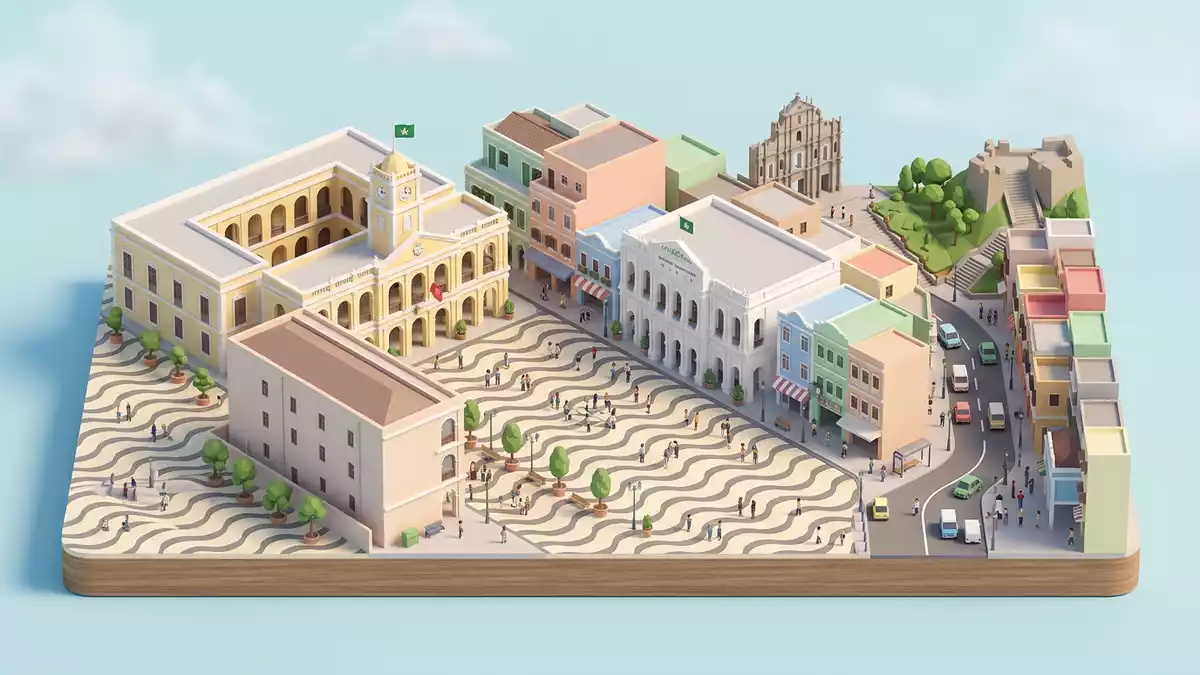
Largo do Senado, known in English as Senado Square, is a paved public square on the Macau Peninsula where Portuguese civic architecture meets dense Chinese streets in a compact urban room. Set in the Sé parish and forming part of the Historic Centre of Macao, the square anchors a district that records several centuries of contact between Portugal and southern China.
A Portuguese Senate square in a Chinese city
Largo do Senado lies in the central area of the Macau Peninsula, in a position where older streets converge and civic buildings gather around an elongated open space. It forms part of the Historic Centre of Macao, which UNESCO added to its World Heritage List in 2005 as a group of streets and plazas that document the fusion of European and Chinese townscape in this port city.Historic Centre of Macao The Portuguese name “Largo do Senado” refers directly to the Leal Senado, the “Loyal Senate” building that fronts one side of the square and housed the municipal council during the long period of Portuguese administration.Leal Senado building
The area around Largo do Senado has been a civic core since the sixteenth century, not long after Portuguese traders established a permanent presence in Macau in the 1500s.civic core since the 16th century Over time, the open ground in front of the senate evolved into a recognisable square associated with administration, religious life and commerce, with ceremonies and reviews held in the space and council business conducted in the hall overlooking it. The present ensemble of façades around the square largely dates from the late nineteenth and early twentieth centuries, when a neoclassical civic idiom influenced by Mediterranean towns was adopted or reinforced on the surrounding buildings.late nineteenth to early twentieth century appearance
Wave-patterned pavement and pastel façades
What immediately marks Largo do Senado is its patterned stone surface, laid out in a flowing wave motif. The square is paved in traditional Portuguese calçada, a mosaic of black and white stone cubes that was installed when the square was remodelled as a pedestrian space.Portuguese pavement The alternating bands of dark and light stone run across the square, picking up the curves of the space and giving the ground a continuous texture that ties together the façades, fountain and surrounding arcades.
The buildings around Largo do Senado are predominantly European in style, with neoclassical proportions, arched openings and stucco surfaces painted in pale colours such as yellow, white and terracotta.coloured civic architecture Many of these structures are protected as monuments within the Historic Centre of Macao, their details including cornices, pilasters and tiled interiors reflecting Portuguese and Mediterranean influences adapted to a subtropical Chinese climate.European styled buildings Together with the pavement, the façades form a cohesive scene that is recognisably Lusophone in character yet set amid Chinese-language shopfronts and signage.
Civic buildings and churches around the square
Several individual buildings around Largo do Senado carry the history of contact between Europe and East Asia. The Leal Senado building, constructed in 1784, stands on one long side of the square and served as the municipal council headquarters for Portuguese Macau.Leal Senado constructed in 1784 Behind its façade, the building contains a courtyard and interior spaces with Portuguese decorative elements such as azulejo tiles, giving a sense of how civic architecture from Lisbon was adapted in the colony.municipal council building
On another side of the square stands the Holy House of Mercy, or Santa Casa da Misericórdia, a charitable institution dating from 1569 that is regarded as the oldest Western-style charity in this part of Asia.Holy House of Mercy dating from 1569 Its façade continues the neoclassical rhythm and contributes to the sense of a continuous civic ensemble. A short walk away, along connected streets rather than directly on the square itself, St Dominic’s Church forms part of the same Historic Centre grouping, linking religious architecture with the administrative and commercial functions clustered at Largo do Senado.St Dominic’s Church nearby
Visiting Largo do Senado: what travellers from Western Europe should know
- Largo do Senado stands in the Sé parish of Macau, in the central part of the Macau Peninsula, reached along Avenida de Almeida Ribeiro and other urban streets.
- The square itself is paved and level, with the patterned stone surface bordered by steps into surrounding arcades and entrances to civic buildings.
- Nearby landmarks include the Leal Senado building and the Holy House of Mercy around the square, with St Dominic’s Church located within walking distance in the same historic district.
- The official languages of Macau are Chinese and Portuguese, and the currency is the Macanese pataca.
- Entry requirements depend on your nationality; UK travellers can check the FCDO travel advice at gov.uk/foreign-travel-advice, Irish travellers the Department of Foreign Affairs at ireland.ie.
Searching for Largo do Senado on social platforms
These links open searches for Largo do Senado on each platform.
Frequently asked questions about Largo do Senado
Where is Largo do Senado located in Macau?
Largo do Senado is a public square in the Sé parish on the Macau Peninsula, in the central urban area where several important streets meet.
What can visitors expect when they walk into the square?
Visitors encounter a patterned stone pavement, pastel-coloured neoclassical façades, arcades with shops and civic buildings such as the Leal Senado and Holy House of Mercy.
What makes Largo do Senado distinctive among Macau’s historic sites?
The square combines Portuguese calçada pavement, European civic architecture and Chinese commercial streets in one compact space within the UNESCO-listed Historic Centre of Macao.


