
Lamu Old Town and the living fabric of Swahili streets
Published on 09/14/2026 at 22:59 | Editorial responsibility: Rafael Müller, Editor-in-Chief AD HOC NEWS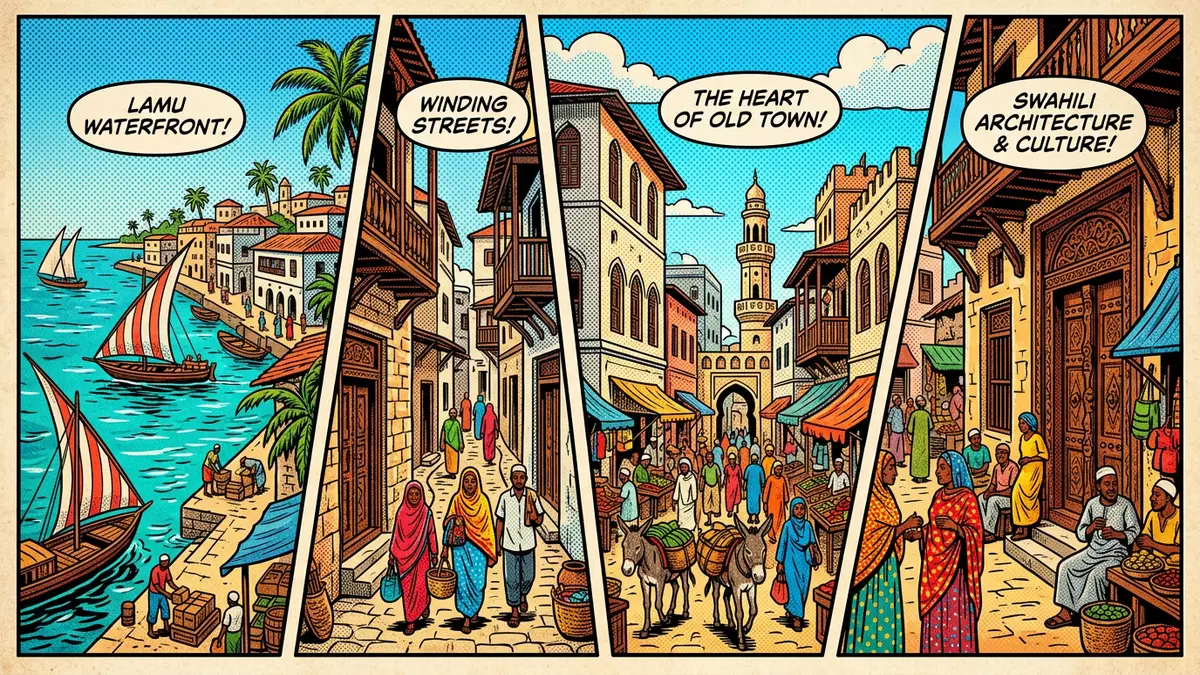
Lamu Old Town on Lamu Island, off Kenya’s northern coast, is a historic Swahili town where coral-stone houses, carved timber doors and narrow streets have evolved over more than seven centuries of settlement. In 2001 it was inscribed as a UNESCO World Heritage Site, recognised as the oldest and best-preserved Swahili settlement on the East African coast and built largely in coral stone and mangrove timber.Lamu Old Town was inscribed on the World Heritage List in 2001
Coral stone, mangrove timber and the Swahili house
Lamu Old Town lies on the shore of Lamu Island in the Lamu Archipelago on Kenya’s Indian Ocean coast, facing a sheltered channel towards Manda Island and backed by low ground where the streets rise away from the waterfront.Lamu Old Town lies on Lamu Island, part of the Lamu Archipelago The historic fabric covers around 16 ha within a wider buffer zone that extends across the water towards Manda Island, preserving the skyline and the relationship between town and sea.the Old Town occupies approximately 16 hectares with a buffer zone of approximately 1,200 hectares
Buildings in Lamu Old Town are characteristically constructed in coral stone and lime mortar, with mangrove timber beams and roofing, giving the streets pale, textured walls and dark timber lines at floor levels.Built in coral stone and mangrove timber, the town is characterized by the simplicity of structural forms Many houses rise through several storeys, with ground floors that are largely blank except for heavy wooden entrance doors, and upper levels where small windows and shaded verandas look down onto the lanes. Inside, traditional Swahili houses are organised around inner courtyards, with painted ceilings, niches and decorative plasterwork that combine local craft traditions with imported materials such as Chinese porcelain set into the walls.
Streets, waterfront and religious life
The layout of Lamu Old Town is defined by narrow, winding streets that climb and bend between the houses, forming a network of passages where pedestrians and donkeys move between waterfront, bazaar and residential quarters.The town is characterized by narrow streets and magnificent stone buildings with impressive curved doors This pattern is structured into small wards known locally as mitaa, where closely related households cluster in adjoining dwellings, and it reflects long-established traditions of land division and urban development in Swahili coastal towns.
Along the seafront a continuous line of stone buildings with arcades and open verandas gives Lamu Old Town a distinctive silhouette when approached from the water, with façades opening towards the channel where wooden dhows and small boats tie up.The buildings on the seafront with their arcades and open verandas provide a unified visual impression of the town when approaching it from the sea Among the waterfront and inner streets stand religious and civic landmarks including mosques, madrassas, the Lamu Fort and the former German Post Office, together with the Lamu Museum housed in an old Swahili warehouse, all woven into the daily life of the town.
Trade routes, World Heritage status and Swahili culture
Lamu Old Town has roots in the medieval period, with Lamu Town dated to around the fourteenth century and much of the standing fabric corresponding to building phases from the eighteenth century onwards.Lamu Town dates from about the 14th century, although very little of what exists today is much older than the 18th century Its position along Indian Ocean trade routes brought merchants, scholars and sailors from Arabia, Persia, India and Europe, whose trading activities and religious learning shaped an urban culture that blends African and wider oceanic influences in architecture, craft and language.the architecture and urban structure of Lamu graphically demonstrate cultural influences from Europe, Arabia and India
In 2001 Lamu Old Town was inscribed on the UNESCO World Heritage List under cultural criteria (ii), (iv) and (vi), recognised as the oldest and best-preserved Swahili settlement on the East African coast and a centre for Islamic and Swahili learning where religious festivals have taken place since the nineteenth century.Lamu Old Town is the oldest and best-preserved Swahili settlement in East Africa The listing highlights both the material fabric of coral-stone houses, carved doors and labyrinthine streets, and the continuity of social and cultural practices in a town that has remained inhabited for over 700 years.
Visiting Lamu Old Town: what travellers from Western Europe should know
- Lamu Old Town stands on the eastern side of Lamu Island in the Lamu Archipelago on Kenya’s northern coast, reached by local boats that cross the channel from the mainland or nearby islands.
- Within the Old Town, movement takes place along narrow stone-paved streets and lanes where pedestrians and donkeys share the way, with steps and gentle gradients between waterfront and higher quarters.
- Lamu Old Town lies close to the Indian Ocean, and the seafront looks across sheltered waters towards Manda Island, where low hills form the backdrop to the town’s skyline.
- The official language is Swahili and English is also widely used; the currency is the Kenyan shilling.
- Entry requirements depend on your nationality; UK travellers can check the FCDO travel advice at gov.uk/foreign-travel-advice, Irish travellers the Department of Foreign Affairs at ireland.ie.
Searching for Lamu Old Town on social platforms
These links open searches for Lamu Old Town on each platform.
Frequently asked questions about Lamu Old Town
Where is Lamu Old Town located?
Lamu Old Town is on Lamu Island in the Lamu Archipelago on Kenya’s northern Indian Ocean coast, facing a sheltered channel towards Manda Island.
What can visitors expect when walking through Lamu Old Town?
Visitors encounter narrow stone-paved streets, multi-storey coral-stone houses with carved wooden doors and shaded verandas, mosques and small squares opening towards the seafront.
What makes Lamu Old Town distinctive among Swahili towns?
Lamu Old Town combines a long continuity of habitation, coral-stone and mangrove-timber architecture, labyrinthine streets and its recognised status as a UNESCO World Heritage Swahili settlement.


