Lamu Old Town and the living fabric of Swahili streets
Published on 09/03/2026 at 20:44 | Editorial responsibility: Rafael Müller, Editor-in-Chief AD HOC NEWS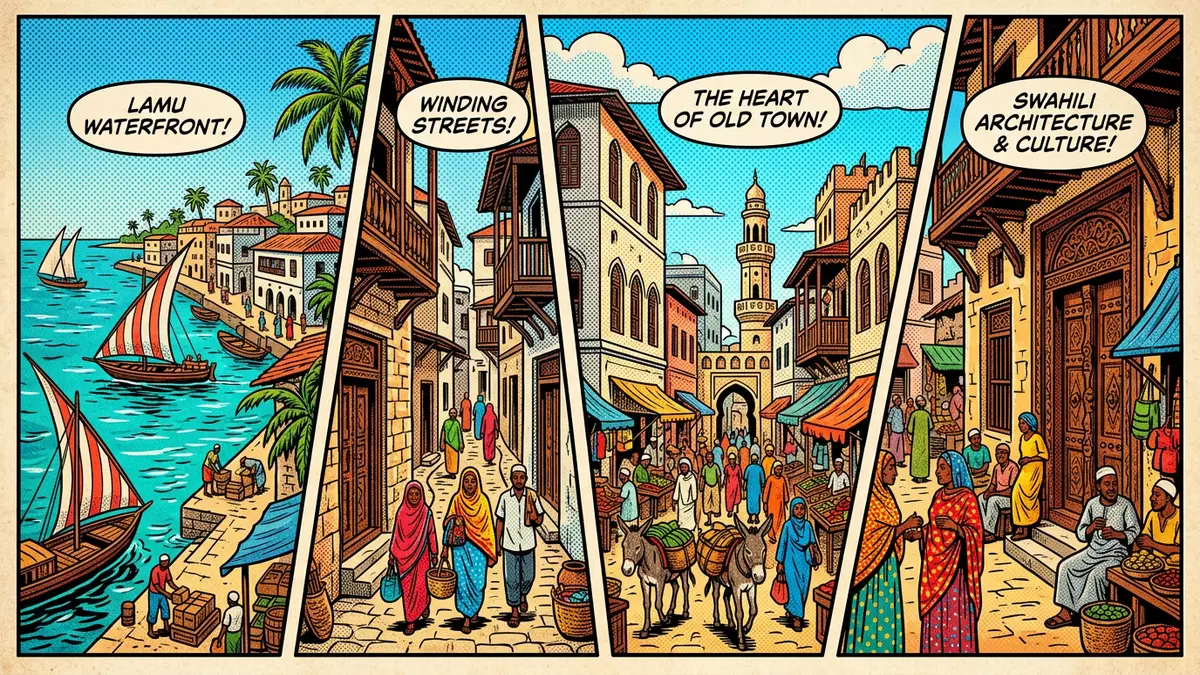
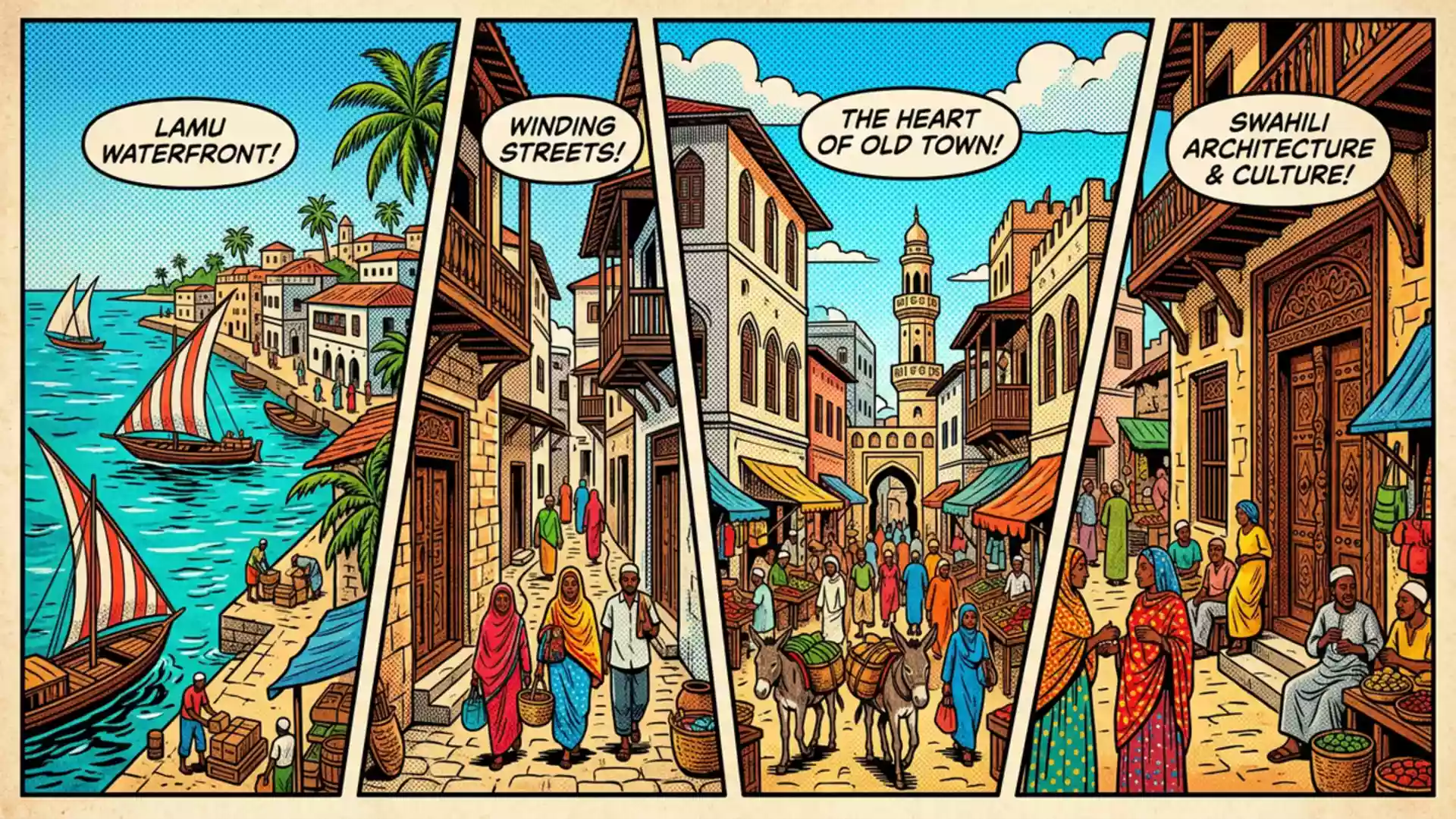
Lamu Old Town on Lamu Island, off Kenya’s northern coast, is a compact Swahili town where coral-stone houses, carved timber doors and Islamic learning form a dense urban fabric that has evolved over more than seven centuries. Recognised as a UNESCO World Heritage Site since 2001, it stands as the oldest and best-preserved example of Swahili settlement on the East African coast, with streets and courtyards that still serve everyday life.
Swahili townscape between ocean and alleyways
Lamu Old Town occupies part of Lamu Island on the northern Kenyan coast, facing the Indian Ocean and the skyline of Manda Island across a narrow channel. The historic core covers roughly 15 to 16 hectares, framed by a wider buffer zone of water and adjacent land that helps preserve views towards the sea and surrounding islands.The Old Town occupies approximately 16 hectares Within this compact footprint, the streets form a fine-grained network that responds to the town’s long history as a Muslim coastal settlement.
The buildings are constructed largely in coral stone bonded with lime, with mangrove timber used for beams, verandas and upper floors.Built in coral stone and mangrove timber Facades tend towards simple structural forms, while details concentrate around inner courtyards, shaded verandas and elaborately carved wooden doors that mark the transition from alleyway to private space.Elaborately carved wooden doors Many streets are narrow and irregular, with occasional wider spaces near the waterfront and mosques where small squares open between buildings.
A coastal settlement shaped by centuries of trade
Lamu’s origins lie in the fourteenth century, when a Swahili trading town emerged on Lamu Island as part of a chain of coastal settlements linked by Indian Ocean shipping routes.Founded in 1370 as one of the original Swahili settlements Over more than 700 years of continuous settlement, merchants, sailors and scholars from Bantu communities, Arabia, Persia, India and Europe interacted with local residents, leaving traces in building techniques, everyday objects and language.Cultural influences from Europe, Arabia and India
Political control has shifted repeatedly. Portuguese forces dominated parts of the East African coast in the sixteenth century, followed by a period of Omani influence from 1698 into the nineteenth century when Lamu flourished as a centre of literature, scholarship and trade.Omani protectorate in the late seventeenth to early nineteenth century Later administrations by the sultan of Zanzibar, German authorities and the British each left administrative and cultural traces before Lamu became part of independent Kenya in 1963.Transition to independent Kenya in 1963
Religious life, carved doors and living heritage
Lamu Old Town retains a conservative Muslim character, with mosques embedded directly into the street pattern and houses organised around private courtyards and reception spaces that accommodate religious and social practices.Conservative character of its Muslim population Since the nineteenth century Lamu has hosted major Muslim religious festivals, and the town has developed into a centre for Islamic and Swahili scholarship along the coast.Centre for the study of Islamic and Swahili cultures
The domestic architecture reflects these roles. Large courtyard houses with carved doors facing the alleys date mainly from the period of Omani Arab control between the late seventeenth and mid nineteenth centuries, when Lamu experienced a cultural and economic high point.Courtyard homes from Omani Arab control Despite changes in trade and administration, the town has largely maintained its original street network, building fabric and social functions, which formed part of the basis for inscription on the UNESCO World Heritage List in 2001 under cultural criteria (ii), (iv) and (vi).Inscribed on the World Heritage List in 2001 under criteria (ii), (iv) and (vi)
Visiting Lamu Old Town: what travellers from Western Europe should know
- Lamu Old Town lies on Lamu Island off Kenya’s northern coast; access involves travelling to the mainland town of Mokowe and crossing the channel to reach the island.
- The historic streets are narrow and often stepped, with uneven coral surfaces and occasional steep alleys, so walking through the town involves frequent changes in level underfoot.
- The waterfront forms a long edge between buildings and sea, with boats moored along the shore and views towards Manda Island and the wider Lamu Archipelago.
- The official language is Swahili and English is widely used; the currency is the Kenyan shilling.
- Entry requirements depend on your nationality; UK travellers can check the FCDO travel advice at gov.uk/foreign-travel-advice, Irish travellers the Department of Foreign Affairs at ireland.ie.
Searching for Lamu Old Town on social platforms
These links open searches for Lamu Old Town on each platform.
Frequently asked questions about Lamu Old Town
Where is Lamu Old Town located?
Lamu Old Town is on Lamu Island off the northern coast of Kenya, opposite Manda Island and north-east of Mombasa along the Indian Ocean.
What can visitors expect when walking through the town?
Visitors encounter narrow coral-stone streets lined with courtyard houses, mosques and carved doors, with frequent changes in level and occasional open spaces towards the seafront.
What makes Lamu Old Town distinctive among coastal settlements?
Lamu Old Town combines coral and mangrove architecture, over 700 years of continuous Swahili settlement and a documented role in Islamic and Swahili scholarship, recognised through its UNESCO World Heritage status.