
Lamu Old Town and its coral-stone streets
Published on 09/22/2026 at 13:30 | Editorial responsibility: Rafael Müller, Editor-in-Chief AD HOC NEWS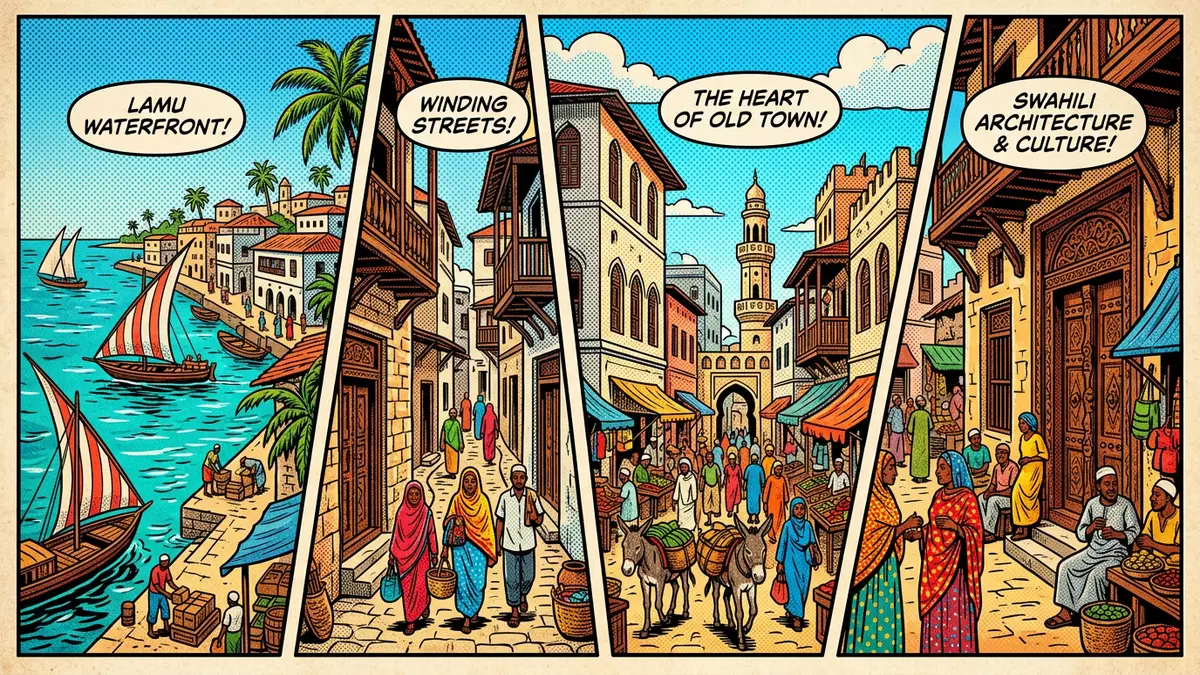
Lamu Old Town occupies the southern coast of Lamu Island in Kenya, where narrow streets run between coral-stone buildings and timber doors. The settlement is a living Swahili town, with mosques, courtyards, shops and houses forming a dense urban landscape beside the Indian Ocean.
Coral stone and Swahili streets
Lamu Old Town is built largely from coral stone, lime plaster, mangrove poles and timber. The materials belong to the coastal architecture of the Swahili world, a culture shaped by African, Arabian, Persian and Indian Ocean connections.
The streets are narrow and irregular, with buildings standing close together. Deep doorways, shaded arcades, carved wooden doors and internal courtyards appear throughout the settlement. The architecture is practical in form, yet its details carry the identity of individual homes, religious buildings and commercial premises.
Many houses have plain exterior walls facing the street, while the interior contains more elaborate decoration. Timber beams support upper floors and roofs, and carved doors mark entrances to homes and businesses. The contrast between restrained street fronts and detailed doorways is a recurring feature of Lamu Old Town.
Lamu’s long Indian Ocean history
Lamu Old Town developed as part of the Swahili coast’s network of maritime settlements. The town’s history reaches back for centuries, with trade connecting the coast to ports around the western Indian Ocean.
Islam has shaped the town’s buildings, calendar and public life. Mosques stand among houses, workshops and market streets, while Arabic and Swahili influences appear in architectural forms and decorative patterns. The settlement’s history is therefore visible in both its buildings and its cultural practices.
The town became an important centre in the nineteenth century under the rule of the Sultanate of Zanzibar. Its architecture records this period through substantial houses, religious buildings and commercial spaces associated with Indian Ocean trade.
Lamu Old Town was inscribed as a UNESCO World Heritage Site in 2001. The designation recognises the settlement’s historic architecture and its place within Swahili culture. Its heritage value rests on the relationship between individual buildings, streets and the wider townscape.
Buildings, doors and everyday life
Lamu Old Town is not a collection of isolated monuments. Its character comes from the continuous fabric of houses, mosques, shops, courtyards and lanes. Everyday activity takes place within this historic setting.
Wooden doors are among the most recognisable details. Some carry carved geometric patterns, while others include plant forms or inscriptions. The doors vary from one building to another, giving the streets a sequence of distinct entrances rather than a single repeated design.
Donkeys are part of the town’s traditional transport culture, particularly in the narrow lanes where motor vehicles have little place. Small shops and workshops occupy ground-floor spaces, and residential buildings rise above them.
The waterfront forms another part of the town’s identity. Dhows and smaller boats connect Lamu with settlements on the island and along the coast. The sea is not a distant backdrop, but part of the town’s geography, economy and cultural history.
Visiting Lamu Old Town: what travellers from Western Europe should know
- Lamu Old Town lies on Lamu Island off Kenya’s northern coast. Air connections serve Manda Island, followed by a boat crossing to Lamu Island.
- The historic core is explored on foot through narrow lanes, uneven surfaces, steps and shaded passages. Comfortable walking footwear suits the stone and sandy ground.
- The town’s architecture is dispersed through ordinary streets. Carved doors, mosques, courtyards, waterfront buildings and market spaces appear among homes and businesses.
- The official language is Swahili and the national currency is the Kenyan shilling.
- Entry requirements depend on your nationality; UK travellers can check the FCDO travel advice at gov.uk/foreign-travel-advice, Irish travellers the Department of Foreign Affairs at ireland.ie.
Searching for Lamu Old Town on social platforms
These links open searches for Lamu Old Town on each platform.Frequently asked questions about Lamu Old Town
Where is Lamu Old Town?
Lamu Old Town is on Lamu Island, off Kenya’s northern coast in the Indian Ocean. It forms the historic core of Lamu, beside the waterfront and traditional boat routes.
What can visitors expect to see?
Visitors encounter narrow lanes, coral-stone houses, carved wooden doors, mosques, courtyards, shops and waterfront buildings. The historic fabric remains part of an inhabited town.
What makes Lamu Old Town distinctive?
Its distinctive character comes from the continuous combination of Swahili architecture, Islamic cultural influence, Indian Ocean history and coral-stone construction. The town’s streets and buildings form a connected historic landscape rather than a single monument.


