
Lamu Old Town and its coral-stone streets
Published on 09/07/2026 at 22:43 | Editorial responsibility: Rafael Müller, Editor-in-Chief AD HOC NEWS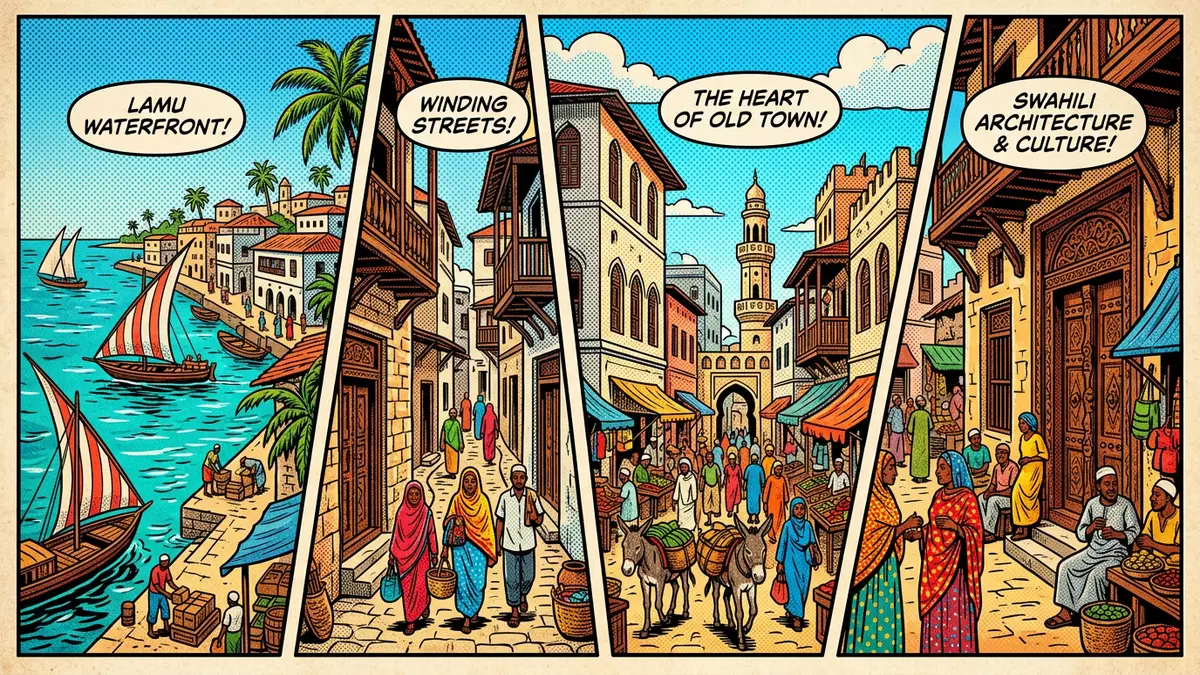
Lamu Old Town on Kenya’s Lamu Island is a compact Swahili town of coral stone and mangrove timber, where narrow streets remain pedestrian and lined with carved wooden doors.Lamu Old Town, located on an island by the same name has been continuously inhabited for more than 700 years and is inscribed on the UNESCO World Heritage List as the oldest and best-preserved Swahili settlement in East Africa.a unique historical living heritage with more than 700 years of continuous settlement
Coral stone, mangrove timber and Swahili house fronts
The fabric of Lamu Old Town is defined by houses built in coral stone and mangrove timber, a coastal construction tradition that gives walls and facades a pale, textured surface.built in coral stone and mangrove timber Many houses turn inward around shaded inner courtyards, while their street fronts are marked by deep verandahs and heavy wooden doors carved with geometric panels, inscriptions and floral motifs.simplicity of structural forms enriched by inner courtyards, verandas, and elaborately carved wooden doors
Along the waterfront and in the older residential quarters, these Swahili houses stand in continuous terraces, creating long, almost unbroken street walls punctuated by doors and small openings. Upper floors often project slightly over the ground level, supported by timber beams, so that parts of the lanes run beneath wooden overhangs. Within the courtyards, stone staircases, arcaded galleries and plaster niches form private spaces oriented away from the busy lanes outside, while flat roofs and rooftop terraces give views over the townscape and across the channel to Manda Island.ornate courtyard homes with elaborately carved Arabic doors
A pedestrian town shaped by narrow lanes
Lamu Old Town occupies roughly 16 hectares on the eastern side of Lamu Island, facing the Indian Ocean channel and the skyline of Manda Island.the Old Town occupies approximately 16 hectares Its plan is a dense mesh of lanes and alleys, most too narrow for vehicles, which has helped preserve a way of moving through the town that relies on walking and the use of donkeys for transport and carrying goods.the town has retained its authentic building fabric
The main seafront street runs along the harbour edge, lined with arcaded buildings, small mosques, civic structures and the Lamu Fort, a massive square towered building that dominates the centre of the town.the Lamu Museum and Lamu Fort Behind this waterfront strip, lanes slope slightly inland and weave past residential quarters, small squares and religious buildings, forming a compact urban landscape where stairways, stepped alleys and sudden openings create frequent changes of level and perspective. Because the town sits just above the shoreline, many routes offer glimpses of moored dhows and tidal water at the ends of streets, reinforcing the sense that Lamu Old Town is oriented towards the sea.
Seven centuries of Swahili, Islamic and trading history
Lamu Old Town dates back to the twelfth century and is one of the oldest continuously inhabited Swahili towns on the East African coast.dating back to the 12th century Over these centuries, it became an important centre of trade, scholarship and religion, with cultural influences from Arabia, India and Europe layered onto a Swahili base.cultural influences from Europe, Arabia, and India The town’s built fabric reflects this history, with mosques, madrassas, merchant houses and public buildings illustrating different phases of prosperity under Portuguese, Omani and later colonial control.period of Omani Arab control from 1698 to the mid 1800s
In the nineteenth century Lamu hosted major Muslim religious festivals and became a recognised centre for the study of Islamic and Swahili cultures, a role that continues with religious schools and scholarly traditions in the town.Lamu has hosted major Muslim religious festivals since the 19th century The enduring use of Arabic script on door lintels and plaques, the presence of mosques throughout the town and the continued importance of religious scholarship give Lamu Old Town a cultural depth that mirrors its physical age. Its World Heritage inscription in 2001 recognised both this long continuity of settlement and the distinct Swahili urban culture expressed in its architecture and street plan.inscribed on the World Heritage List in 2001
Visiting Lamu Old Town: what travellers from Western Europe should know
- Lamu Old Town lies on Lamu Island off Kenya’s northern coast, reached by local boat services from mainland jetties to the harbour along the town’s seafront.
- The old streets are narrow, stepped in places and largely pedestrian, so visiting involves walking on uneven stone surfaces and sharing lanes with donkeys used for transport.
- The town faces an Indian Ocean channel, and parts of the waterfront are exposed to strong sun and onshore breezes, while interior lanes and courtyards feel more enclosed.
- The official language is Swahili and the currency is the Kenyan shilling.
- Entry requirements depend on your nationality; UK travellers can check the FCDO travel advice at gov.uk/foreign-travel-advice, Irish travellers the Department of Foreign Affairs at ireland.ie.
Searching for Lamu Old Town on social platforms
These links open searches for Lamu Old Town on each platform.
Frequently asked questions about Lamu Old Town
Where is Lamu Old Town and what kind of place is it?
Lamu Old Town is a historic Swahili settlement on Lamu Island off Kenya’s northern Indian Ocean coast, recognised as a UNESCO World Heritage cultural site.
What should visitors expect when walking through the town?
Visitors encounter narrow pedestrian lanes, stepped alleys and continuous terraces of coral-stone houses with carved wooden doors, along a harbourfront lined with dhows and arcaded buildings.
What makes Lamu Old Town distinctive among East African coastal towns?
Lamu Old Town combines more than seven centuries of continuous settlement with a well-preserved Swahili urban fabric of coral-stone houses, courtyards and mosques, set in a compact, pedestrian-scale street network.


