
Lamu Old Town, a Swahili streetscape shaped by centuries of trade
Published on 09/16/2026 at 16:58 | Editorial responsibility: Rafael Müller, Editor-in-Chief AD HOC NEWS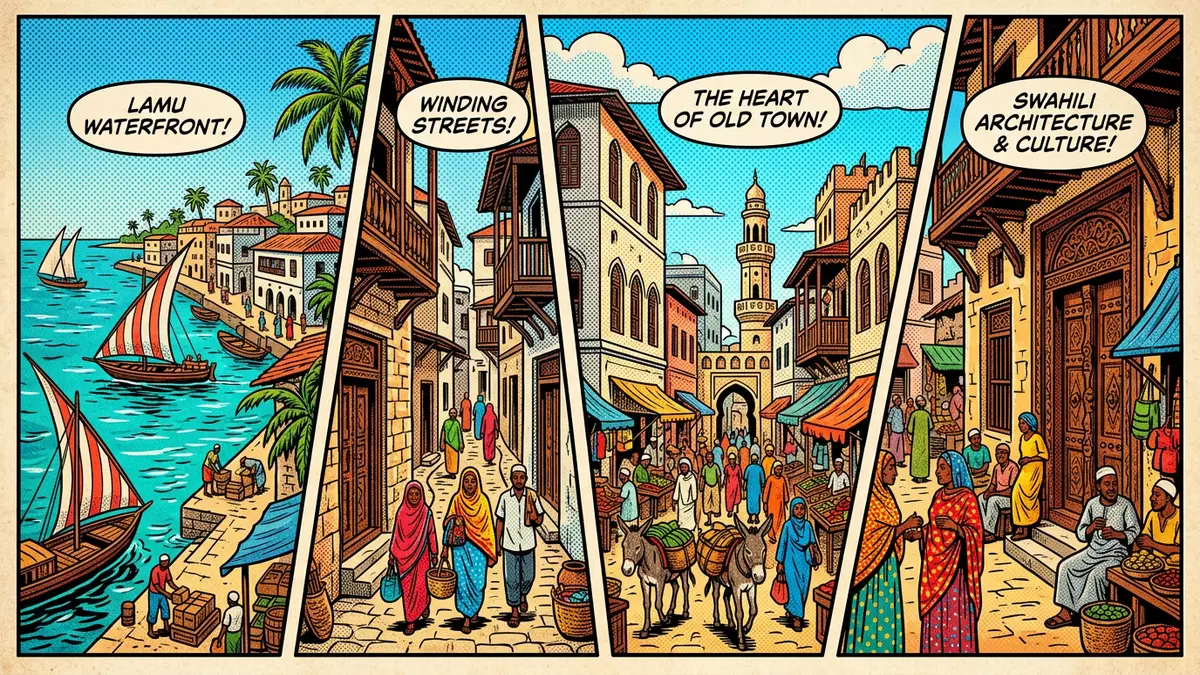
Lamu Old Town on Kenya’s northern coast is a compact Swahili settlement on Lamu Island, defined by narrow lanes, coral-stone houses and a sheltered harbour looking towards the Indian Ocean. The town has grown over more than seven centuries as an island port, and in 2001 it was inscribed as a cultural UNESCO World Heritage Site, recognised for both its architecture and its continuing urban life.Lamu Old Town World Heritage Site
A living Swahili town on Kenya’s northern coast
Lamu Old Town occupies the eastern shore of Lamu Island, part of the Lamu Archipelago off the north coast of Kenya, a stretch of shoreline lined with mangroves and sandbanks where the island forms a natural harbour.Lamu Old Town location and values The old town itself covers a small area, with its streets running parallel to the waterfront and climbing slightly inland, while views across the channel take in the skyline of Manda Island and the open waters of the Indian Ocean.Lamu Old Town archipelago setting
Lamu is recognised as one of the oldest continuously inhabited Swahili settlements on the East African coast, with occupation reaching back at least to the twelfth century and more than 700 years of urban life documented in its streets and houses.Lamu continuous settlement over centuries The town’s history reflects its role as a maritime centre, linked into trade routes that connected the East African coast to Arabia, Persia and the wider Indian Ocean world; Swahili, Arab, Indian and European influences are visible in both its built form and its cultural life.Lamu Old Town trading port history
Coral-stone houses, carved doors and dense lanes
The built fabric of Lamu Old Town is dominated by houses constructed in coral stone with mangrove timber, materials drawn from the surrounding coast and islands.Coral stone and mangrove timber buildings Many dwellings follow a courtyard layout, with rooms organised around interior spaces that bring light into the dense urban blocks, while verandahs and upper-level galleries overlook the narrow streets.
Street-level facades are marked by heavy wooden doors, elaborately carved with geometric and floral patterns and sometimes inscribed panels, which have become one of the most recognisable features of Lamu’s architecture.Elaborately carved wooden doors Within the town, small mosques, a historic fort, former merchants’ houses and public buildings such as the Lamu Museum form a streetscape where domestic architecture, religious structures and civic spaces are closely woven together.Lamu Fort and museum in the old town
Faith, scholarship and the UNESCO inscription
Lamu Old Town has long been an important centre of Swahili and Islamic culture on the East African coast, with mosques, religious schools and town squares supporting a calendar of Muslim religious gatherings that have taken place since the nineteenth century.Centre for Islamic and Swahili culture The town became part of independent Kenya in 1963, and its cultural role sits alongside the everyday life of an island community whose economy remains closely connected to the sea and regional trade.Lamu in post-independence Kenya
In 2001 Lamu Old Town was inscribed on the UNESCO World Heritage List as a cultural site under criteria (ii), (iv) and (vi, recognising its interchange of human values, its representation of an era and its association with belief systems.UNESCO inscription and criteria The designation highlights both the town’s intact architecture and its status as a living Swahili settlement whose urban pattern, building materials and cultural practices together express a long history of coastal East Africa.
Visiting Lamu Old Town: what travellers from Western Europe should know
- Lamu Old Town lies on the eastern side of Lamu Island on Kenya’s northern coast, reached by local boats that cross the channel from mainland jetties serving the archipelago.
- The old town’s lanes are narrow and mostly laid out for walking or handcarts, with stepped alleys and waterfront quays that require steady footing and attention to uneven surfaces.
- The waterfront faces an enclosed harbour, and inland streets rise slightly away from the sea, so short climbs link the shorefront with residential quarters and small mosques set back within the town.
- English and Swahili are widely used in Lamu, and the national currency is the Kenyan shilling.
- Entry requirements depend on your nationality; UK travellers can check the FCDO travel advice at gov.uk/foreign-travel-advice, Irish travellers the Department of Foreign Affairs at ireland.ie.
Searching for Lamu Old Town on social platforms
These links open searches for Lamu Old Town on each platform.Frequently asked questions about Lamu Old Town
Where is Lamu Old Town and what kind of place is it?
Lamu Old Town is a historic Swahili settlement on Lamu Island off Kenya’s northern coast, forming the main urban centre of the Lamu Archipelago.
What should visitors expect on a first visit to Lamu Old Town?
Visitors encounter a dense network of lanes, coral-stone houses, mosques and harbourfront quays, with everyday island life continuing within streets shaped by centuries of coastal trade.
What makes Lamu Old Town distinctive among East African coastal towns?
Lamu Old Town combines more than 700 years of continuous settlement with intact Swahili architecture in coral stone and timber, recognised through its inscription as a UNESCO World Heritage Site.


