
Lamu Old Town, a coral-stone Swahili labyrinth by the sea
Published on 08/26/2026 at 08:49 | Editorial responsibility: Rafael Müller, Editor-in-Chief AD HOC NEWS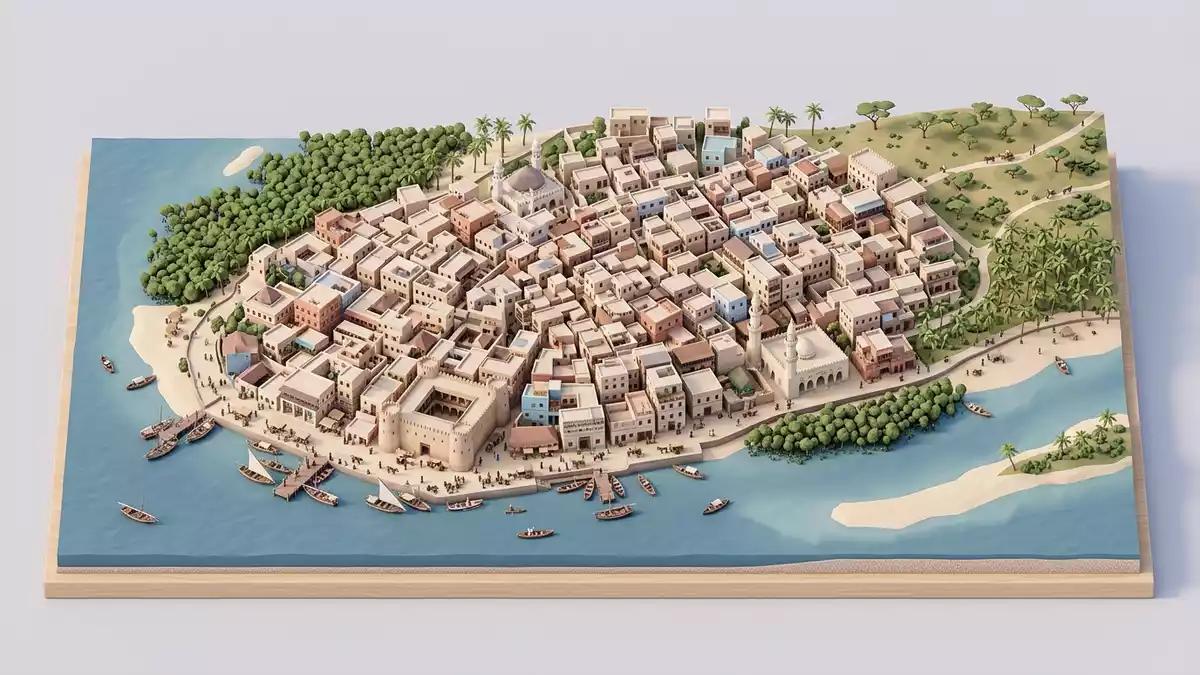
Lamu Old Town on Kenya’s Lamu Island is a compact Swahili town where coral-stone walls, mangrove beams and narrow lanes form a dense streetscape along a sheltered Indian Ocean channel. Inscribed as a UNESCO World Heritage Site in 2001, it represents more than seven centuries of continuous urban life in a small island settlement on the East African coast.
Coral-stone streets shaped by the sea
Lamu Old Town occupies part of Lamu Island off Kenya’s northern coast, in the Lamu Archipelago near the border with Somalia, with the town’s buildings stepping back from a tidal channel that faces Manda Island.Lamu Old Town occupies part of Lamu Island The settlement stands on coral rock at low elevation above sea level, with the urban fabric compressed between the waterfront and the gently rising ground inland.
The seafront forms a continuous edge where a linear public space separates the dense coral and timber houses from the water, and where boat landings line the shore.waterfront of boat landings From this strip, views extend across the channel towards Manda Island, making the sea and the skyline part of the town’s everyday backdrop.
A Swahili town of coral stone and carved doors
Lamu Old Town is built largely in coral stone bonded with lime, strengthened by mangrove timber beams in floors and roofs, materials typical of Swahili settlements along the East African coast.Built in coral stone and mangrove timber Many houses rise over several storeys, with plain lower levels punctuated mainly by heavy wooden entrance doors and with upper levels that project slightly over the lanes.
The town’s architecture reflects centuries of contact across the Indian Ocean, combining Swahili building traditions with elements linked to Arabian, Persian, Indian and European merchants and settlers.architecture and urban structure of Lamu Within this fabric, inner courtyards, shaded verandas and elaborately carved doors form recurring motifs, giving the streets a distinctive sequence of surfaces, projections and recesses.
UNESCO recognition and a living Swahili centre
Lamu Old Town was inscribed on the UNESCO World Heritage List in 2001 as a cultural site under criteria (ii), (iv) and (vi), recognising its architecture, town plan and associations with Swahili and Islamic culture.inscribed on the World Heritage List in 2001 The UNESCO listing highlights Lamu as the oldest and best-preserved Swahili settlement in East Africa, with an urban structure that has remained in continuous use.
The town’s role as a centre of Islamic learning on the East African coast is documented, with religious festivals and scholarship recorded since the nineteenth century.Lamu has hosted major Muslim religious festivals Mosques, madrasa buildings and houses with prayer spaces are integrated into the urban fabric, and the continuity of religious practice forms part of the site’s cultural significance.
Visiting Lamu Old Town: what travellers from Western Europe should know
- Lamu Old Town stands on Lamu Island off Kenya’s northern coast, facing the Indian Ocean, with access to the island commonly made by boat from the mainland town of Mokowe.Lamu Island off Kenya’s north coast
- Within the old town, movement largely relies on walking, donkeys and handcarts along narrow, sometimes uneven lanes, and many routes involve stepped passages and changes in level.movement within the old town largely relies on walking
- Lamu Old Town lies close to the equator on Kenya’s coast, with a tropical climate, and the surrounding archipelago includes further islands and beaches that are reached by boat.
- The official language is English alongside Swahili, and the currency is the Kenyan shilling.
- Entry requirements depend on your nationality; UK travellers can check the FCDO travel advice at gov.uk/foreign-travel-advice, Irish travellers the Department of Foreign Affairs at ireland.ie.
Searching for Lamu Old Town on social platforms
These links open searches for Lamu Old Town on each platform.Frequently asked questions about Lamu Old Town
Where is Lamu Old Town located?
Lamu Old Town is on Lamu Island off Kenya’s northern coast in the Indian Ocean, forming part of the Lamu Archipelago near the border with Somalia.
What can visitors expect when walking through Lamu Old Town?
Visitors encounter narrow lanes lined with coral-stone houses, carved wooden doors, inner courtyards, mosques and a waterfront edged by landing places for dhows and smaller boats.
What makes Lamu Old Town distinctive among Swahili settlements?
Lamu Old Town is recognised as the oldest and best-preserved Swahili settlement in East Africa, with coral-stone architecture, a fine-grained street network and continuous cultural life.


